Peabody Energy Corporation Class Action Lawsuit – BTU
Key Facts About Peabody Energy Corporation (NYSE: BTU)
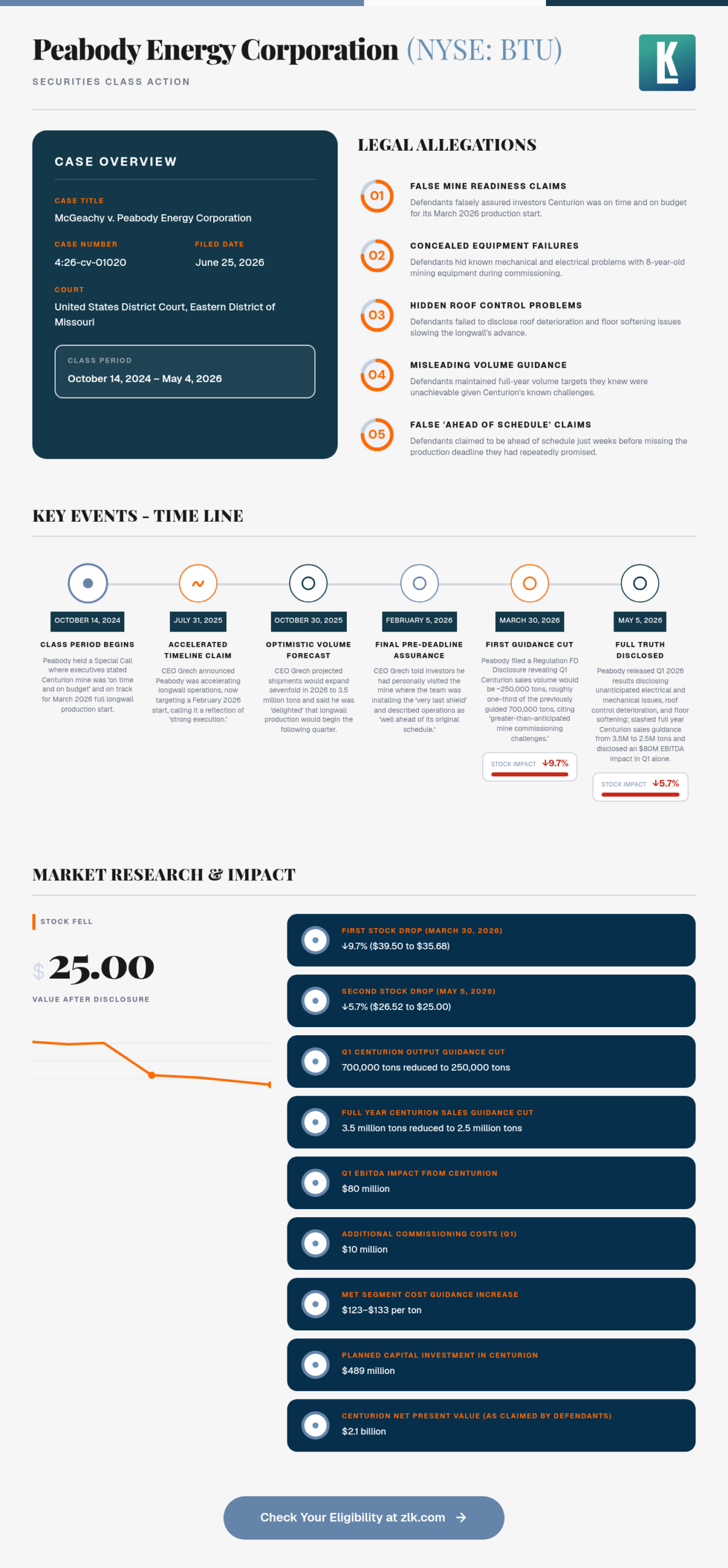
● The Allegation: Peabody Energy and three senior executives allegedly made materially false and misleading statements about the Company's ability to ramp up its flagship Centurion coal mine to full longwall production by March 2026. The complaint alleges defendants concealed mechanical, electrical, and roof control challenges that caused significant delays and volume shortfalls.
● The Stock Drop: BTU fell $3.82 per share, approximately 9.7%, to $35.68 per share on March 30, 2026, after the Company slashed first quarter Centurion output guidance from 700,000 tons to 250,000 tons; BTU fell an additional $1.52 per share, approximately 5.7%, to $25.00 per share on May 5, 2026, after the Company cut full year Centurion sales guidance from 3.5 million tons to 2.5 million tons.
● Class Period & Defendants: The class period runs from October 14, 2024 through May 4, 2026, inclusive. Named defendants include Peabody Energy Corporation, James C. Grech (President, Chief Executive Officer, and Director), Mark A. Spurbeck (Executive Vice President and Chief Financial Officer), and Marc E. Hathhorn (President of Global Operations through October 31, 2024).
● Lead Plaintiff Deadline: August 24, 2026. No action is required before the deadline to remain a potential class member. Action is only needed if you wish to seek appointment as lead plaintiff.
Peabody Energy Class Action Summary
|
|
|
|
Company |
Peabody Energy Corporation (NYSE: BTU) |
|
Lead Plaintiff Deadline |
August 24, 2026 |
|
Class Period |
October 14, 2024 – May 4, 2026 |
|
Stock Drop |
March 30, 2026 – BTU fell $3.82 (9.7%) to $35.68; May 5, 2026 – BTU fell $1.52 (5.7%) to $25.00 |
Introduction
A securities class action has been filed against Peabody Energy Corporation (NYSE: BTU) and three of its senior executives. The lawsuit was filed by Levi & Korsinsky, LLP on behalf of investors who purchased or otherwise acquired BTU common stock between October 14, 2024 and May 4, 2026.
The complaint alleges defendants made materially false and misleading statements about the Centurion mine. They allegedly assured investors the mine would reach full longwall production by March 2026. According to the complaint, the Company was facing serious mechanical, electrical, and roof-control problems that defendants allegedly failed to disclose.
The lawsuit alleges that the truth emerged in two stages, and BTU stock dropped sharply after each disclosure. On March 30, 2026, shares fell about 9.7% after a surprise guidance cut. On May 5, 2026, shares fell another 5.7% after the Company slashed its full year outlook.
Company Profile
Peabody Energy Corporation is a leading producer of metallurgical and thermal coal, with interests in 16 active coal mining operations in the United States and Australia. The Centurion mine, located in Australia, is the Company's flagship premium hard coking coal asset with approximately 140 million tonnes of reserves and an expected mine life exceeding 25 years.
Class Period
October 14, 2024 – May 4, 2026
Investors who purchased or acquired Peabody Energy (BTU) common stock during the Class Period may be eligible to seek recovery under the federal securities laws.
Allegations
The complaint alleges that beginning on October 14, 2024, Peabody Energy's executives made repeated statements that the Company's Centurion mine was on track to achieve full longwall production by March 2026. During a Special Call that day, Defendant Marc Hathhorn, then President of Global Operations, told investors the mine was advancing "on time and on budget" and expressed confidence that the March 2026 deadline would be met. He pointed to new equipment, a "world-class team," and development work that was "ahead of schedule" as reasons for his confidence. Defendant Spurbeck reinforced this message, highlighting $489 million in planned capital investment and the March 2026 longwall production start.
These assurances continued throughout 2025. On July 31, 2025, Defendant Grech announced that Peabody was accelerating longwall operations, now targeting a February 2026 start, calling it a reflection of "strong execution." On October 30, 2025, Grech stated he was "delighted" that longwall production would begin the following quarter, projecting shipments to expand sevenfold in 2026 to 3.5 million tons. By February 5, 2026, Grech told investors he had personally visited the mine, where the team was "installing the very last shield" and "putting the finishing touches" on the operation "well ahead of its original schedule." He described Centurion's net present value at $2.1 billion and called it "the cornerstone asset" in the Company's strategy.
According to the complaint, these statements were materially false and misleading. The complaint alleges that defendants knew or recklessly disregarded that the mine faced a multitude of issues that would prevent it from meeting the March 2026 deadline. These included unanticipated electrical and mechanical problems with 8-year-old mining equipment that had been fitted with updated technology, as well as roof control conditions and floor softening caused by the longwall's slow advance during commissioning. The complaint alleges defendants possessed actual knowledge of these challenges through their positions of control and access to non-public operational data, yet they continued to portray confidence in the ramp-up timeline, even claiming to be ahead of schedule mere weeks before the deadline they would fail to meet.
The Truth Emerges
On March 30, 2026, Peabody Energy filed a Regulation FD Disclosure with the SEC, revealing that Centurion mine sales volume for the first quarter would be approximately 250,000 tons, roughly one-third of the previously estimated 700,000 tons. The Company attributed the shortfall to "greater-than-anticipated mine commissioning challenges" but provided no further detail about the nature or scope of those challenges. Notably, the Company maintained its full year 2026 metallurgical coal volume targets of 10.3 to 11.3 million tons, a reassurance the complaint alleges was itself misleading given what defendants already knew about the breadth of Centurion's problems.
The complaint alleges the full truth emerged on May 5, 2026, when Peabody released its first quarter 2026 results. Defendant Grech disclosed for the first time that the mine had encountered unanticipated electrical and mechanical issues during commissioning of equipment that had been sitting unused for eight years. These problems slowed the longwall's advance, which in turn caused localized roof control deterioration, moisture accumulation in roof cavities, and floor softening beneath the shields, leading to shield misalignment. The Company slashed its full year Centurion sales outlook from 3.5 million tons to 2.5 million tons, increased met segment cost guidance to $123 to $133 per ton, and disclosed that the Centurion ramp-up had caused an $80 million EBITDA impact in the first quarter alone, including $10 million in additional commissioning costs. The complaint alleges these disclosures contradicted months of assurances that the mine was on time, on budget, and ahead of schedule.
Market Reaction
The market responded sharply to each disclosure. On March 30, 2026, following the initial guidance cut, Peabody Energy's stock fell from $39.50 to $35.68 per share, a decline of approximately 9.7% in a single trading day. Analysts noted the magnitude of the miss but observed that the Company had provided minimal detail about the underlying challenges. Jefferies maintained a Buy rating but flagged that production was "less than half" of initial guidance. UBS titled its report "Centurion ramp-up challenges now resolved," reflecting the Company's assurance that the issues were temporary.
The complaint alleges that assurance proved premature. On May 5, 2026, after Peabody disclosed what the complaint describes as the full scope of Centurion’s problems, BTU fell from $26.52 to $25.00 per share, a decline of 5.7%. UBS cut its price target from $32.00 to $30.50, while Jefferies described the results as "significantly weaker-than-expected" and noted an $80 million EBITDA impact from Centurion alone. Across the period from March 27, 2026 to May 5, 2026, BTU moved from $39.50 to $25.00. The complaint separately alleges stock drops of about 9.7% and 5.7% following the two alleged disclosures.
Next Steps
● Lead Plaintiff Deadline: August 24, 2026
● After the lead plaintiff deadline, the Court will consider any lead plaintiff motions.
● Defendants may file a motion to dismiss.
● If the case proceeds, the Court may later consider class certification.
Disclaimer: This shareholder alert is for informational purposes only and does not constitute legal advice. Consult a qualified attorney for personalized guidance. No specific outcomes are guaranteed.
Check Eligibility
✓ No cost or obligation
✓ See if you qualify