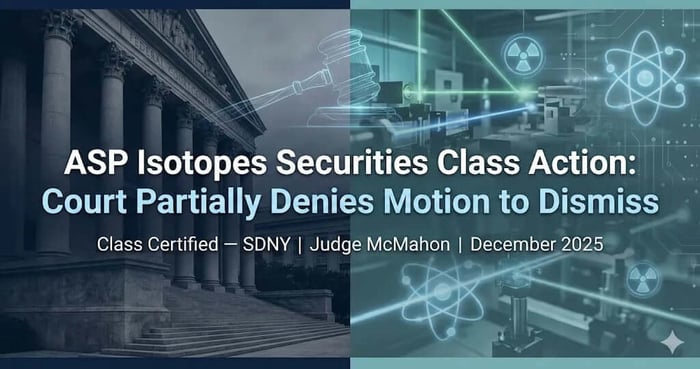

Caption: Leone v. ASP Isotopes Inc., et al.
Case No.: 24-cv-9253 (CM)
Jurisdiction: U.S. District Court, Southern District of New York
Judge: Hon. McMahon
Summary
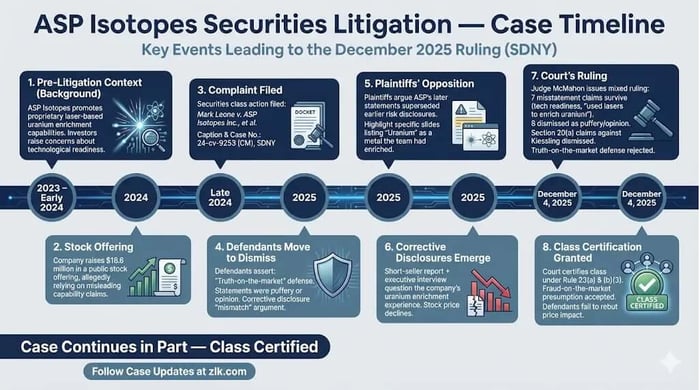
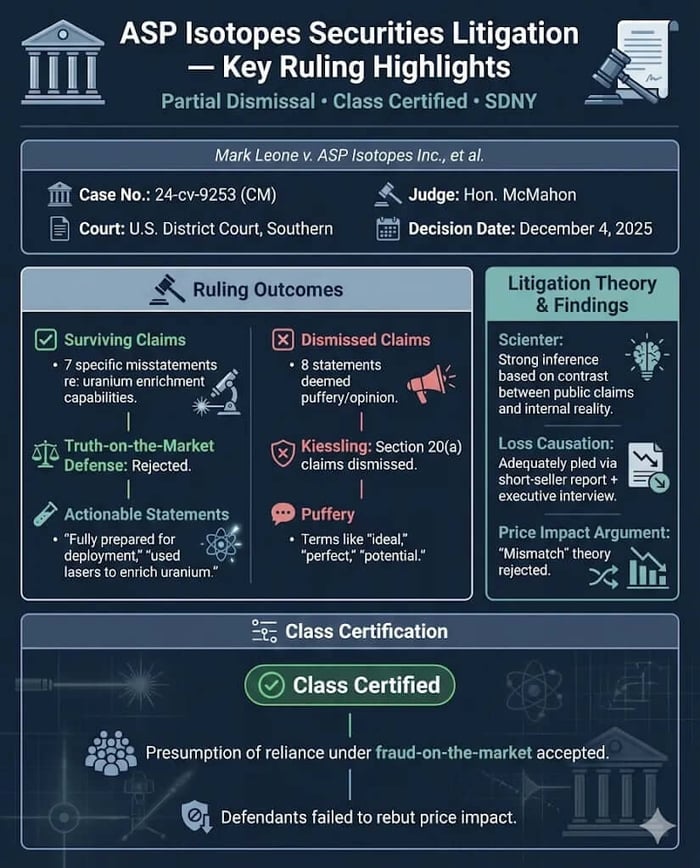
On December 4, 2025, Judge McMahon granted in part and denied in part the defendants' motion to dismiss in the securities class action against ASP Isotopes Inc.. The Court dismissed claims regarding vague statements of optimism but allowed claims concerning the company's uranium enrichment capabilities to proceed. Additionally, the Court granted the plaintiffs' motion for class certification.
Allegations Against ASP Isotopes Inc.
Plaintiffs alleged that ASP Isotopes and its executives made materially false and misleading statements concerning the company's ability to enrich uranium using proprietary technology. The complaint asserted that the defendants suggested the company had experience enriching uranium comparable to existing methods, despite never testing or operating the technology on uranium at any scale. Plaintiffs further alleged that the company capitalized on these misleading statements to raise $18.6 million in a stock offering.
Defendants’ Motion to Dismiss
The defendants moved to dismiss primarily on a "truth-on-the-market" defense, arguing that the company's fiscal year 2023 Form 10-K had already disclosed that they had never tested the technology on uranium and lacked necessary regulatory approvals . They also argued that the challenged statements were inactionable expressions of opinion, corporate optimism, or puffery. Defendants further contended that the corrective disclosure cited by plaintiffs created a "mismatch" that failed to establish price impact.
Plaintiffs’ Opposition
Plaintiffs countered that the defendants' subsequent affirmative representations superseded the earlier risk disclosures found in the Form 10-K. They argued that specific statements, such as a presentation slide listing "Uranium" among metals the team had enriched, were factual assertions of present capabilities rather than forward-looking aspirations. Plaintiffs maintained that these statements materially altered the total mix of information available to investors.
Court’s Ruling
The Court dismissed claims based on statements deemed to be pure opinion or puffery but denied the motion regarding specific assertions of technological readiness and safety.
ASP Isotopes Inc. & Paul E. Mann: Claims regarding seven specific misstatements survived dismissal, while eight others were dismissed.
Heather Kiessling: Section 20(a) control-person claims against defendant Kiessling were dismissed as she was not mentioned in the complaint's allegations regarding control or culpable state of mind .
Class Certification: The Court granted the motion to certify the class.
Court’s Rationale
Truth-on-the-Market: The Court rejected this defense, holding that a company cannot rely on prior disclosures to cure later misleading statements that suggest contingencies have been resolved. The Court found that a reasonable investor could interpret the later materials as an indication that the company had successfully enriched uranium since the previous filing.
Falsity: The Court determined that statements describing the technology as "fully prepared for deployment" or claiming the team had "used lasers to enrich" uranium were actionable factual assertions. However, vague terms like "ideal," "perfect," or "potential" were deemed inactionable opinions or puffery.
Scienter: The Court found a strong inference of scienter based on the stark contrast between the company's public statements and its internal reality, specifically that it had never enriched uranium. The Court noted that the temporal proximity between the alleged misrepresentations and a significant stock offering supported a motive to defraud.
Loss Causation: Plaintiffs adequately pleaded that corrective disclosures, including a short-seller report and an executive interview, revealed the truth and caused the stock price decline. The Court rejected the defendants' argument that there was a "mismatch" between the fraud and the disclosure.
Class Certification: The Court found that the proposed class satisfied all requirements of Rule 23(a) and (b)(3). The Court accepted the fraud-on-the-market presumption of reliance, noting that the defendants failed to rebut it with evidence of a lack of price impact.
Case Status
The case continues in part, with the class certified and Mark Leone appointed as Class Representative. Claims against Defendant Kiessling have been dismissed.