
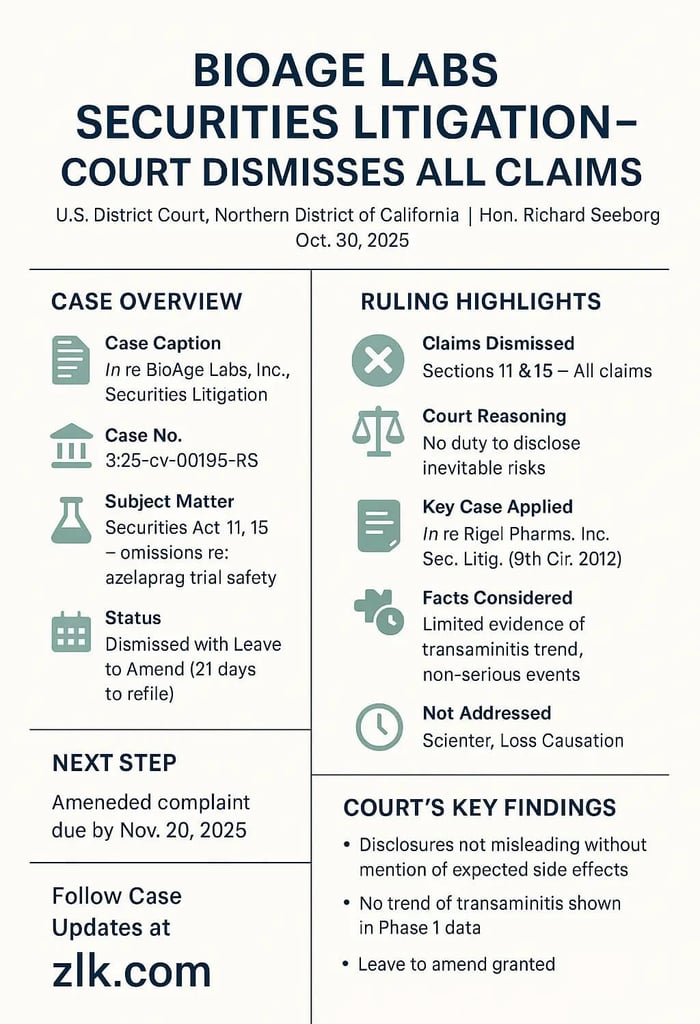
Caption: In re BioAge Labs, Inc., Securities Litigation
Case No.: 3:25-cv-00196-RS
Jurisdiction: U.S. District Court, Northern District of California
Judge: Hon. Richard Seeborg
Summary
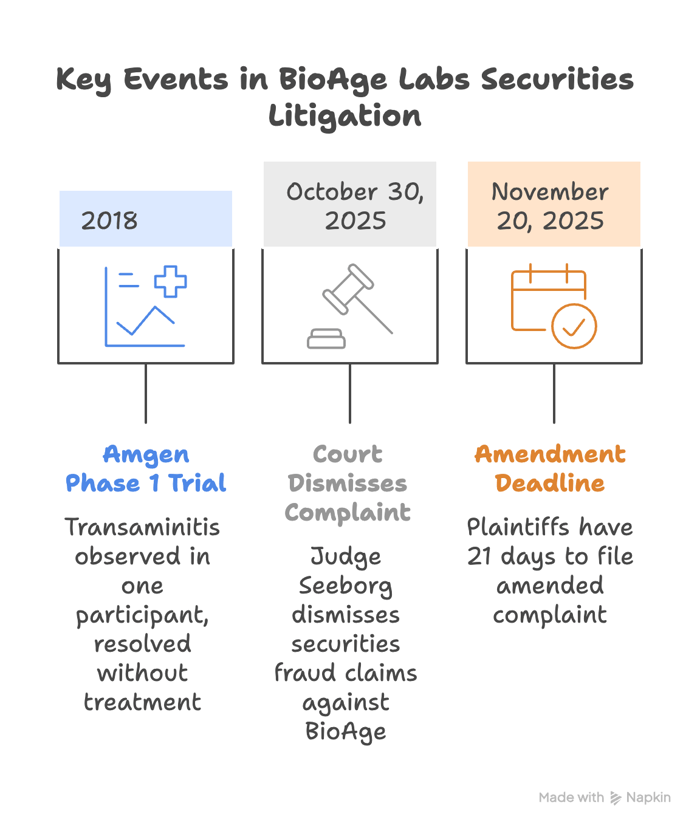
On October 30, 2025, Judge Richard Seeborg granted defendants’ motion to dismiss the consolidated amended complaint. The Court dismissed all claims under Sections 11 and 15 of the Securities Act of 1933. Leave to amend was granted.
Allegations Against BioAge Labs, Inc.
The complaint alleged that BioAge and ten corporate officers omitted from the registration statement and prospectus critical information about the safety of azelaprag and risks to the Phase 2 STRIDES trial. Plaintiffs said the offering documents failed to disclose that transaminitis presented a serious risk that had already materialized in a 2018 Amgen Phase 1 trial. They contended transaminitis was typical, expected, and virtually certain to occur in the STRIDES trial.
Defendants’ Motion to Dismiss
BioAge moved to dismiss for failure to state a claim under Rule 12(b)(6).
Plaintiffs’ Opposition
Plaintiffs argued that transaminitis was not just a possible hazard but the hazard that was virtually certain to derail the STRIDES trial. They said accurate discussion of risks to the trial required express disclosure of transaminitis.
Court’s Ruling
The Court dismissed the Section 11 claims. The Section 15 control-person claims were also dismissed.
Court’s Rationale
The Court found SEPTA’s theory suffered from two defects, one legal and one factual.
Falsity: The Court held that the offering documents’ risk disclosures were not misleading absent discussion of transaminitis. The Court applied In re Rigel Pharms., Inc. Sec. Litig., 697 F.3d 869 (9th Cir. 2012), and rejected the proposition that disclosing some safety information requires disclosing all material safety information. The Court found that risk disclosures using “unexpected” or “atypical” side effects did not imply no risk from expected side effects. The Court distinguished Set Capital LLC v. Credit Suisse Grp. AG, 996 F.3d 64 (2d Cir. 2021), and held that Section 11 imposes no duty to disclose a risk merely because it will inevitably occur. The Court stated that once an issuer speaks on a topic, it must not mislead, but silence imposes no obligation.
Scienter: The Court did not address scienter.
Loss Causation: The Court did not address loss causation.
Other Issues: The Court found the complaint failed to plead transaminitis was inevitable. The Court examined three sources: a single Phase 1 participant with grade 1 and 2 liver enzyme increases that resolved without treatment; mouse studies showing azelaprag reduced liver enzymes in high-fat diet cohorts; and STRIDES trial design features that increased but did not make transaminitis inevitable. The Court found one transaminitis observation in 265 Phase 1 participants created no trend and was not serious. The Court rejected conclusory averments that transaminitis materialized before the IPO. The Court noted that even if omitting a grade 4 muscle enzyme increase rendered Phase 1 results misleading, no damage resulted because it did not cause the stock drop.
Case Status
The case has been dismissed with leave to amend. Plaintiffs have 21 days from October 30, 2025, to file an amended complaint.