
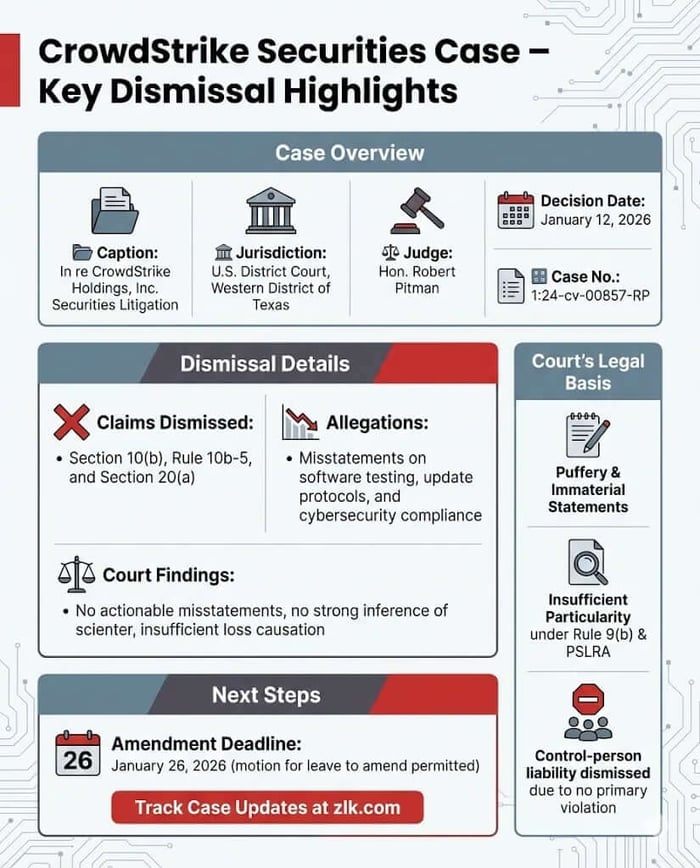
Caption: In re CrowdStrike Holdings, Inc. Securities Litigation.
Case No.: 1:24-cv-00857-RP
Jurisdiction: U.S. District Court, Western District of Texas, Austin Division
Judge: Hon. Robert Pitman
Summary
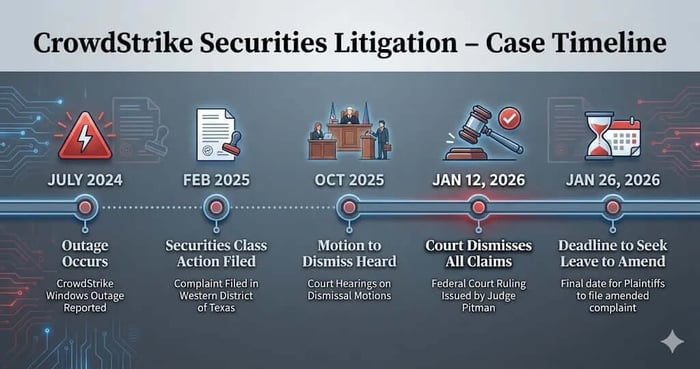
On January 12, 2026, Judge Robert Pitman granted defendants’ motion to dismiss the consolidated securities class action against CrowdStrike Holdings, Inc. The Court dismissed all Exchange Act claims asserted under Section 10(b) and Rule 10b-5, as well as the derivative control-person claims under Section 20(a). The order resolved the motion in full.
Allegations Against CrowdStrike
Plaintiffs alleged that CrowdStrike and two senior executives made materially false or misleading statements during the class period concerning the company’s software testing, quality assurance, and update deployment practices. The complaint focused on statements about product reliability, testing protocols, and compliance with federal cybersecurity standards, which plaintiffs said were contradicted by a July 2024 outage affecting Windows systems.
Defendants’ Motion to Dismiss
CrowdStrike and the individual defendants argued that the complaint failed to plead actionable misstatements or omissions, scienter, or loss causation with the particularity required by Rule 9(b) and the PSLRA. They contended that many challenged statements were taken out of context, constituted nonactionable puffery, or concerned customer usage rather than CrowdStrike’s own development processes.
Plaintiffs’ Opposition
Plaintiffs countered that the challenged statements would have been understood by reasonable investors as assurances about CrowdStrike’s internal testing and deployment practices. They argued that later disclosures following the outage demonstrated falsity and supported a strong inference of scienter.
Court’s Ruling
The Court dismissed all Section 10(b) and Rule 10b-5 claims against CrowdStrike and the individual defendants. Because no primary violation was adequately pleaded, the Court also dismissed the Section 20(a) control-person claims.
Court’s Rationale
Falsity: The Court found that most challenged statements, when read in context, were not misleading and did not concern CrowdStrike’s internal testing of software updates. Several statements were deemed puffery or immaterial as a matter of law.
Scienter: Even where plaintiffs plausibly alleged falsity as to limited statements, the Court held that the complaint did not support a strong inference of scienter that was at least as compelling as nonfraudulent explanations.
Loss Causation: Given the failure to plead actionable misstatements and scienter, the Court did not find loss causation adequately alleged.
Section 20(a): The control-person claims failed because the underlying Exchange Act claims were dismissed.
Case Status
All claims have been dismissed pursuant to the Court’s January 12, 2026 order. The dismissal is without prejudice. Plaintiffs have been permitted to file a motion for leave to amend their complaint on or before January 26, 2026.