
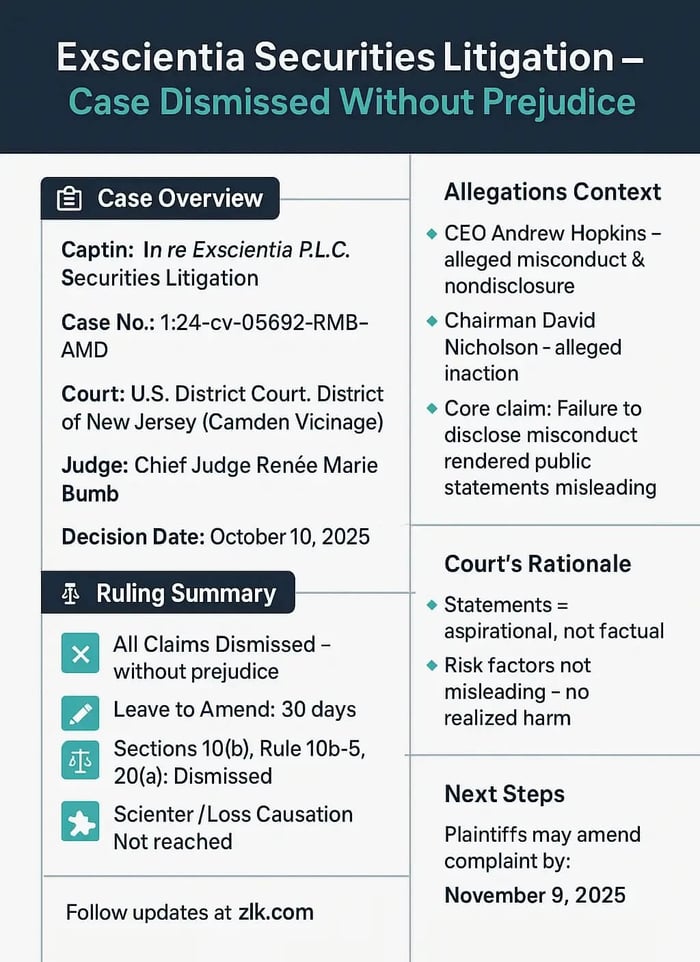
Caption: In re Exscientia p.l.c. Securities Litigation
Case No.: 1:24-cv-05692-RMB-AMD
Jurisdiction: U.S. District Court for the District of New Jersey, Camden Vicinage
Judge: Chief Judge Renée Marie Bumb
Summary
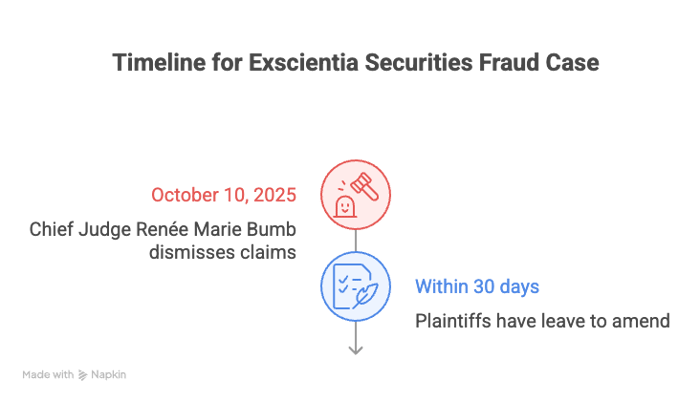
On October 10, 2025, Chief Judge Renée Marie Bumb granted the motion to dismiss the amended complaint. The Court dismissed all claims without prejudice. Plaintiffs received leave to amend within 30 days.
Allegations Against Exscientia
Plaintiffs alleged that Exscientia, former CEO Andrew Hopkins, and former Chairman David Nicholson violated Section 10(b), Rule 10b-5, and Section 20(a). They said Hopkins engaged in inappropriate relationships with two female subordinates and sexually harassed them. The complaint alleged that an employee reported the conduct to Nicholson, who took no action despite obligations under the Code of Conduct and committee charters. Plaintiffs claimed that the failure to disclose the misconduct rendered statements about the Code, corporate culture, diversity, risk disclosures, committee charters, and SOX certifications false and misleading.
Defendants’ Motion to Dismiss
Exscientia, Hopkins, and Nicholson moved to dismiss. They argued that the challenged statements were inactionable puffery or not false when made. Defendants contended that plaintiffs failed to plead falsity, materiality, scienter, and loss causation with particularity.
Plaintiffs’ Opposition
Plaintiffs opposed the motion. They argued that the Code and related statements were actionable because Hopkins and Nicholson violated them. Plaintiffs said the statements were not aspirational but mandatory, and the #MeToo context made them material. They contended that risk disclosures were misleading because the risk of Hopkins’ termination had materialized.
Court’s Ruling
The Court dismissed the Section 10(b) and Rule 10b-5 claims. The Court also dismissed the Section 20(a) claims as derivative.
Court’s Rationale
Falsity: The Court held that statements in the Code were inactionable puffery because the Code is inherently aspirational and required by SEC and NASDAQ rules. The Court found that corporate culture and diversity statements contained aspirational language and were not verifiable. The Court ruled that risk disclosures were not misleading because the identified risks had not materialized. The Court determined that committee charter statements described responsibilities but did not guarantee compliance. The Court held that SOX certifications were inactionable because the underlying filings contained no false statements.
Scienter: The Court did not reach scienter. The Opinion focuses its analysis on falsity/materiality and dismisses for failure to plead actionable statements
Loss Causation: The Court did not reach loss causation. The Opinion dismisses the complaint for failure to plead actionable misstatements (material falsity).
Section 20(a): The Court dismissed the claims because no primary violation existed.
Case Status
The case has been dismissed without prejudice. Plaintiffs have 30 days to amend.