
Caption: In re Stem, Inc. Securities Litigation.
Case No.: 3:23-cv-02329-MMC
Jurisdiction: U.S. District Court, Northern District of California
Judge: Hon. Maxine M. Chesney
Summary
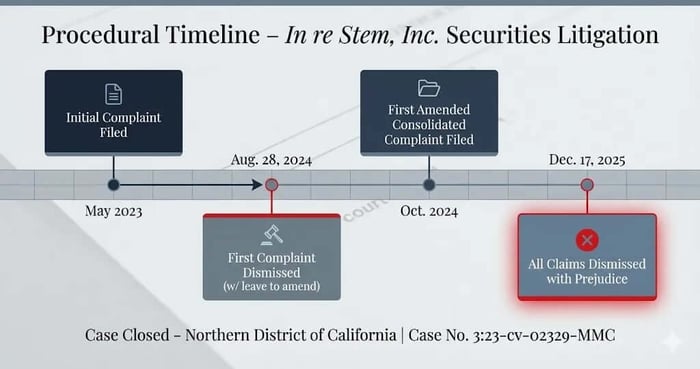
On December 17, 2025, Judge Maxine M. Chesney granted defendants’ motion to dismiss the First Amended Consolidated Complaint in its entirety. The Court dismissed all Exchange Act claims with prejudice and denied plaintiffs further leave to amend. The ruling follows an earlier dismissal in August 2024, after plaintiffs failed to cure identified pleading deficiencies.
Allegations Against Stem, Inc.
Plaintiffs alleged that Stem, Inc. and related defendants made false and misleading statements in connection with a SPAC merger, including representations about the automation and commercial success of Stem’s Athena software platform in front-of-the-meter projects. The complaint also challenged risk disclosures, proxy statements, and alleged insider trading, asserting violations of Sections 10(b), 14(a), 20(a), and 20A of the Exchange Act.
Defendants’ Motion to Dismiss
Stem, its executives, and SPAC-related defendants moved to dismiss under Rules 12(b)(6), 8(a), and 9(b). They argued that plaintiffs failed to plead any actionable misstatement or omission, failed to satisfy PSLRA and Rule 9(b) standards, and could not establish falsity, scienter, or loss causation. Defendants also sought dismissal of derivative control-person and insider trading claims.
Plaintiffs’ Opposition
Plaintiffs contended that amended allegations cured prior defects by adding detail from confidential witnesses, post-class-period statements by the former CEO, and subsequent financial results. They argued these facts showed Athena was not automated as represented and that risks had already materialized when defendants spoke.
Court’s Ruling
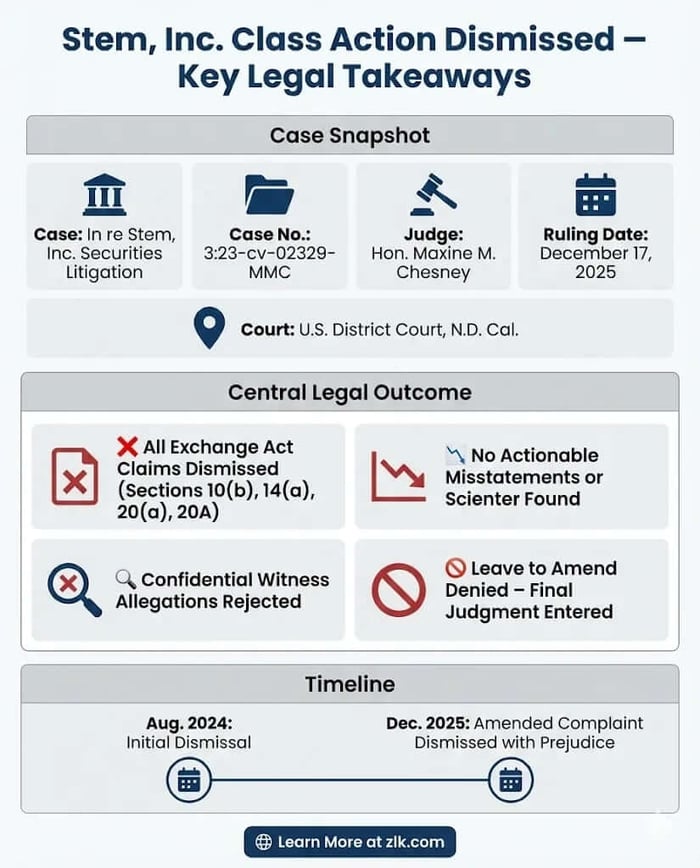
The Court dismissed all claims under Sections 10(b) and Rule 10b-5, including scheme liability theories. The Court also dismissed Section 14(a) proxy claims, as well as derivative claims under Sections 20(a) and 20A. All claims were dismissed with prejudice, and leave to amend was denied.
Court’s Rationale
Falsity: The Court held that none of the challenged statements were false or misleading when read in context. Statements describing Athena as automated identified specific functions and did not represent full automation. Statements regarding market success and risk were not contradicted by the pleaded facts.
Confidential Witnesses: The Court found that confidential witness allegations lacked reliability, personal knowledge, or temporal linkage to the challenged statements. The amended complaint did not cure defects previously identified.
Scienter and Loss Causation: Because plaintiffs failed to plead any actionable misstatement or omission, the Court did not reach other elements of Section 10(b).
Section 14(a): The proxy claims sounded in fraud and failed Rule 9(b) for the same reasons as the Section 10(b) claims. Plaintiffs did not allege distinct negligent misrepresentations.
Sections 20(a) and 20A: With no primary Exchange Act violation pleaded, the derivative control-person and insider trading claims failed as a matter of law.
Case Status
The case has been dismissed with prejudice. Judgment has been entered, and no further amendment was permitted.