
Caption: Monsky v. Direct Digital Holdings, Inc., et al.
Case No.: 4:24-cv-01940
Jurisdiction: U.S. District Court, Southern District of Texas
Judge: Hon. Kenneth M. Hoyt
Summary
On August 7, 2025 Judge Kenneth M. Hoyt tossed out a securities fraud case against Direct Digital Holdings. Judge Hoyt granted defendants’ motion to dismiss and didn’t plaintiffs permission to edit the faulty complaint. The Court dismissed all claims under Section 10(b) of the Exchange Act and Rule 10b-5, as well as derivative claims under Section 20(a).
Allegations Against Direct Digital Holdings
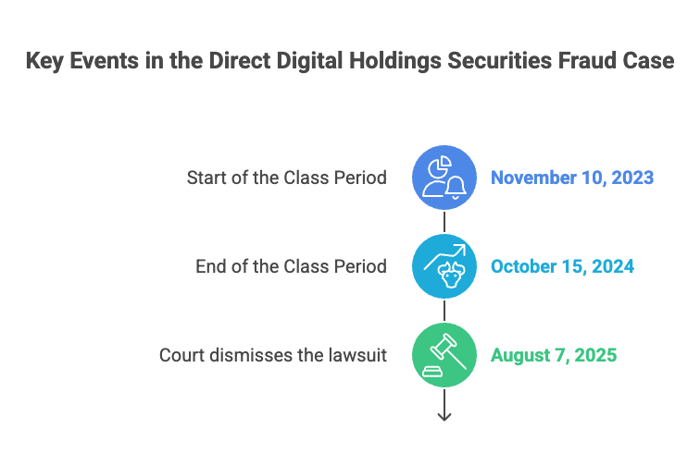
This case, Monsky v. Direct Digital Holdings, Inc. et al., was brought on behalf of investors who purchased Direct Digital stock between November 10, 2023 and October 15, 2024 (“the Class Period”). Plaintiffs said Direct Digital and some of its execs misled investors by making overly optimistic statements while concealing disruptions at its key subsidiary, Colossus Media, particularly with major partners Trade Desk and Google. Plaintiffs claimed these misrepresentations propped up Direct Digital’s stock price. But when the truth came out, the stock collapsed and investors lost a substantial amount of money.
Defendants’ Motion to Dismiss
The defendants (Direct Digital, CEO Mark Walker, President Keith W. Smith, CFO Diana Diaz, director Susan Echard, and Direct Digital Management, LLC) asked the Court to dismiss the case, per Rule 12(b)(6). Defendants said the alleged misstatements were non-actionable corporate bluster, that plaintiffs didn’t plead any “materially false or misleading statements,” and that plaintiffs didn’t argue sufficient facts to create a strong inference of scienter. Defendants also said the Section 20(a) has got to fail since there wasn’t a primary claim left in tact.
Plaintiffs’ Opposition
Plaintiffs countered that the complaint identified specific false statements and omissions made across earnings calls, press releases, and SEC filings. They argued the proximity between these statements and later disclosures supported falsity, that Colossus was central to Direct Digital’s business, and that the overall record gave rise to a strong inference of scienter. Plaintiffs also requested leave to amend should the Court find deficiencies.
Court’s Ruling
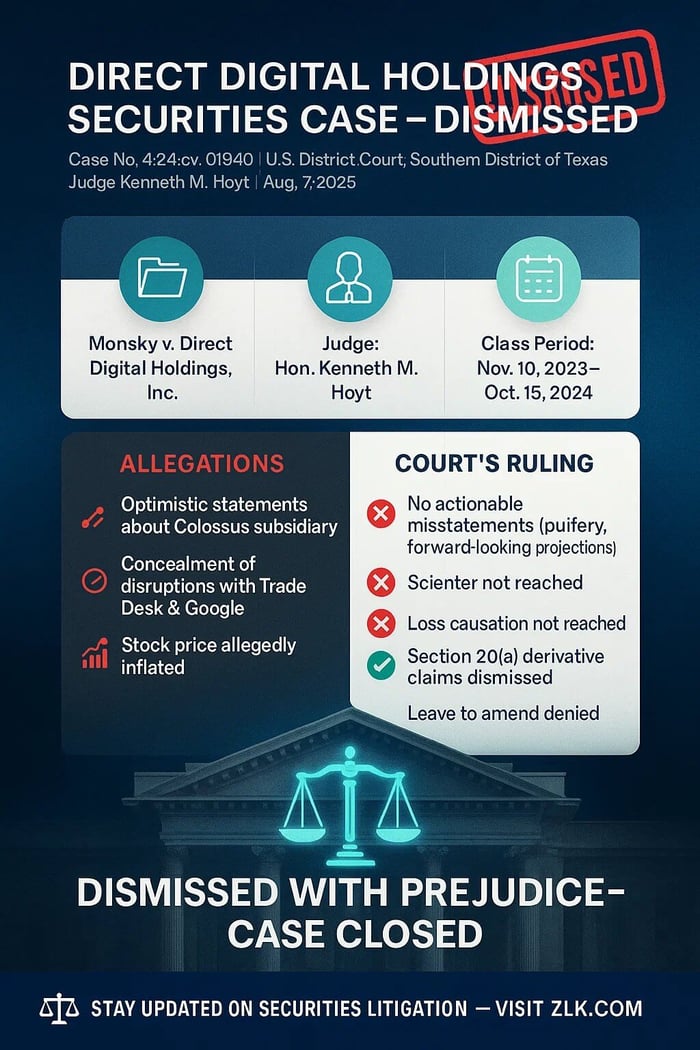
The Court granted defendants’ motion in full. It held that the alleged misstatements were either forward-looking projections, vague expressions of optimism, or otherwise not materially misleading under the securities laws. The Court emphasized that corporate officials are not obligated to present their business “in a pejorative light” and are not liable for failing to foresee future events. Because the complaint failed to allege any actionable misrepresentation or omission, the Court did not reach scienter.
Court’s Rationale
Falsity: The Court found none of the seventeen statements cited by plaintiffs amounted to material misrepresentations. Many were forward-looking, qualified projections or general statements of optimism—legally considered puffery. Others acknowledged changing strategy or softer demand, aligning with the very market conditions plaintiffs alleged.
Scienter: Having found no actionable misstatements, the Court declined to conduct a full scienter analysis.
Loss Causation: The Court likewise did not reach loss causation, as dismissal rested on the threshold failure to plead falsity.
Section 20(a): Because the Section 10(b)/Rule 10b-5 claim failed, the derivative control-person claims under Section 20(a) also failed.
Leave to Amend: Plaintiffs’ request to amend, made only in a conclusory fashion at the close of briefing, was denied for lack of any showing of how amendment would cure the deficiencies.
Case Status
The Court dismissed the entire case, with prejudice. Defendants’ motion to dismiss was granted and plaintiffs aren’t allow to amend the complaint.