![Dow Inc. (DOW) Securities Class Action Lawsuit Update [October 13, 2025]](https://dropinblog.net/cdn-cgi/image/fit=scale-down,format=auto,width=700/34260815/files/featured/dow-inc-securities-lawsuit-blog-banner.webp)

Introduction to Dow Inc. (DOW) Securities Class Action Lawsuit
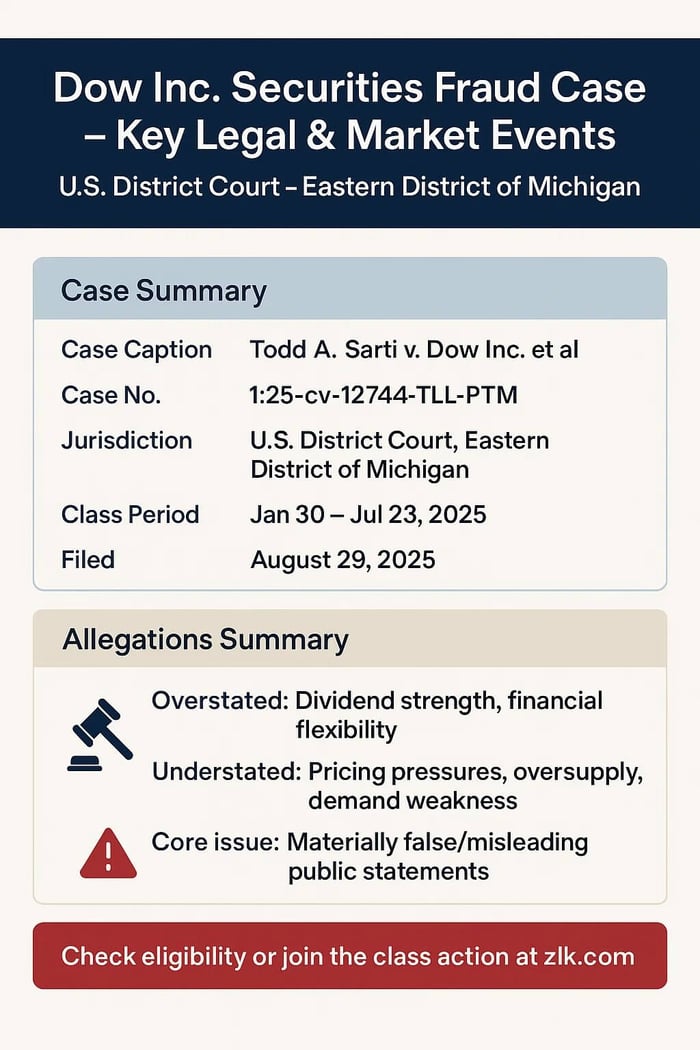
A federal securities fraud class action has been filed against Dow Inc. (NYSE: DOW) and related defendants. The proposed class covers investors who bought Dow securities from January 30, 2025 through July 23, 2025, both dates inclusive. Investors allege the Company overstated its ability to navigate macroeconomic and tariff headwinds, maintain financial flexibility, and protect an industry-leading dividend, while understating competitive and pricing pressures, softening demand, and oversupply. The narrative broke when, after a June analyst downgrade citing dividend pressure, Dow's July results showed a larger-than-expected loss, a year-over-year sales decline, and a 50% dividend cut. On these disclosures, Dow's stock fell 3.21% on June 23 and then 17.45% on July 24, allegedly harming investors who purchased at inflated prices.
Dow Inc. (DOW) Securities Lawsuit Case Details
Case Name: Sarti v. Dow Inc., et al.
Case No.: 1:25-cv-12744-TLL-PTM
Jurisdiction: U.S. District Court, Eastern District of Michigan, Northern Division
Filed on: August 29, 2025
Dow Inc. (DOW) Company Profile
Dow is an American materials science company serving customers in packaging, infrastructure, mobility, and consumer applications. It operates worldwide through three segments: Packaging & Specialty Plastics; Industrial Intermediates & Infrastructure; and Performance Materials & Coatings.
Dow Inc. (DOW) Securities Lawsuit Class Period
January 30, 2025–July 23, 2025, inclusive
Investor eligibility: all persons and entities other than Defendants that purchased or otherwise acquired Dow securities during the Class Period may be eligible to join the Dow Inc. (DOW) class action lawsuit.
Allegations in the Dow Inc. (DOW) Securities Class Action Lawsuit
According to the complaint, the lawsuit targets Dow Inc., its subsidiary The Dow Chemical Company, and executives Jim Fitterling (CEO and Chair), Jeffrey L. Tate (CFO), and Karen S. Carter (COO). The case centers on what they allegedly said about growth, competitive positioning, financial flexibility, and the Company's "industry‑leading" dividend.
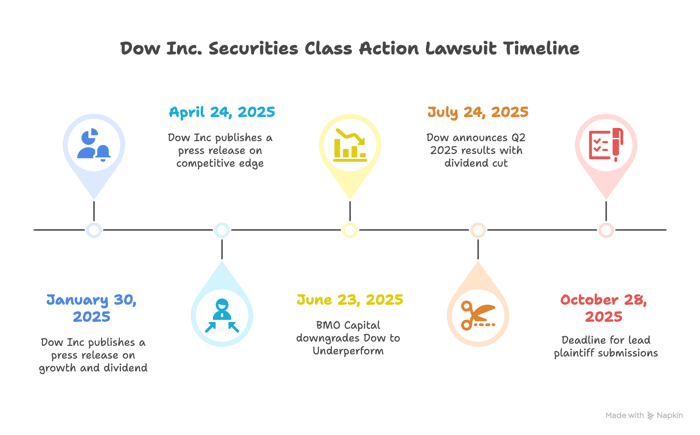
The story begins on January 30, 2025, when CEO Jim Fitterling stated in a press release that, despite persistently weak macroeconomic conditions, "Team Dow delivered our fifth consecutive quarter of [Y/Y] volume growth," and he emphasized cost advantages and confidence in near‑term projects and operational discipline. That same release asserted the Company's "differentiated portfolio and strong balance sheet" enabled delivery on all capital allocation priorities, "including an industry‑leading dividend." On a conference call the same day, Fitterling reinforced that Dow would "keep taking advantage of our low‑cost position" and that "keeping our dividend strong is one of the number one priorities."
As the year progressed, in an April 24, 2025 press release, management repeated the theme. Fitterling said Dow delivered a sixth consecutive quarter of year‑over‑year volume growth while reducing costs and right‑sizing capacity. On the accompanying call, COO Karen S. Carter described more than 95% of North American volume as USMCA‑compliant and touted an "unmatched cost position," feedstock flexibility, superior product mix, and geographic diversity that "give Dow a competitive edge." CFO Jeffrey L. Tate told investors, "[w]e still expect demand to be positive for the year," and said actions taken would "deliver $6 billion in cash support over the next two years," enabling Dow to maintain its financial flexibility.
Meanwhile, investors allege a different picture was unfolding. The complaint asserts Defendants overstated Dow's ability to offset macroeconomic and tariff headwinds and to maintain the financial flexibility necessary to support its dividend, while understating the severity of competitive and pricing pressures, softening global sales and demand, and an oversupply of products across Dow's markets. As a result, the public statements during the Class Period were allegedly false and misleading.
The Truth Emerges
The sequence began to shift on June 23, 2025, when BMO Capital downgraded Dow to Underperform from Market Perform and cut its price target to $22 from $29, citing sustained weakness across key end markets and "mounting pressure" on the dividend. This external reassessment directly challenged the Company's assurances about resilience and dividend strength.
Then, on July 24, 2025, Dow issued a press release announcing Q2 2025 results showing a non‑GAAP loss per share of $0.42, substantially larger than the approximately $0.17–$0.18 loss expected by analysts, alongside net sales of $10.1 billion, a 7.3% year‑over‑year decline that missed consensus by $130 million. The Company cut its dividend in half, from $0.70 to $0.35 per share, and management acknowledged a "lower‑for‑longer earnings environment" amplified by trade and tariff uncertainties and "signs of oversupply" from new entrants exporting at "anti‑competitive economics." According to the complaint, these developments undermined prior assurances about maintaining financial flexibility and an industry‑leading dividend and allegedly revealed that such statements were materially false or misleading.
Market Reaction
The market reacted in two stages, following the June 23 downgrade and the July 24 earnings announcement. On June 23, 2025, following the BMO downgrade, Dow's stock fell $0.89, or 3.21%, to close at $26.87.
The market reaction was larger after the earnings disclosure. On July 24, 2025, after the Company reported the larger-than-expected loss and halved its dividend, the stock fell $5.30, or 17.45%, to close at $25.07.
Next Steps
- Submissions for lead plaintiff are due October 28, 2025.
- The Court will issue its order for lead plaintiff and counsel in the weeks after submissions are due.
- The Court will then consider motion for class certification.
- The Court will later consider a Motion to Dismiss.
To learn if you are eligible for recovery under the DOW securities class action lawsuit, visit the case submission page here.
Disclaimer: This shareholder alert is for informational purposes only and does not constitute legal advice. Consult a qualified attorney for personalized guidance. No specific outcomes are guaranteed.
![Semler Scientific, Inc. (SMLR) Securities Class Action Lawsuit [October 9, 2025]](https://dropinblog.net/cdn-cgi/image/fit=scale-down,format=auto,width=700/34260815/files/featured/semler-scientific-securities-lawsuit-blog-banner.webp)
![Charter Communications, Inc. (CHTR) Securities Class Action Lawsuit Update [October 13, 2025]](https://dropinblog.net/cdn-cgi/image/fit=scale-down,format=auto,width=700/34260815/files/featured/charter-communications-chtr-securities-class-action-update.webp)
![Fly-E Group, Inc. (FLYE) Securities Class Action Lawsuit Update [October 9, 2025]](https://dropinblog.net/cdn-cgi/image/fit=scale-down,format=auto,width=700/34260815/files/featured/flye-securities-fraud-lawsuit-blog-banner.webp)