
Table of Contents
Caption: Meade v. Lincoln National Corporation
Case No: 24-1704
Jurisdiction: U.S. District Court, Eastern District of Pennsylvania
Judge: Judge Murphy
Summary
On July 24, 2025, the U.S. District Court for the Eastern District of Pennsylvania granted Defendants’ motion to dismiss in Meade v. Lincoln National Corporation, dismissing the Amended Complaint without prejudice and granting leave to file a Second Amended Complaint within 14 days. The Court found the allegations insufficient to plead falsity or scienter regarding Lincoln’s statements on lapse rates and reserves.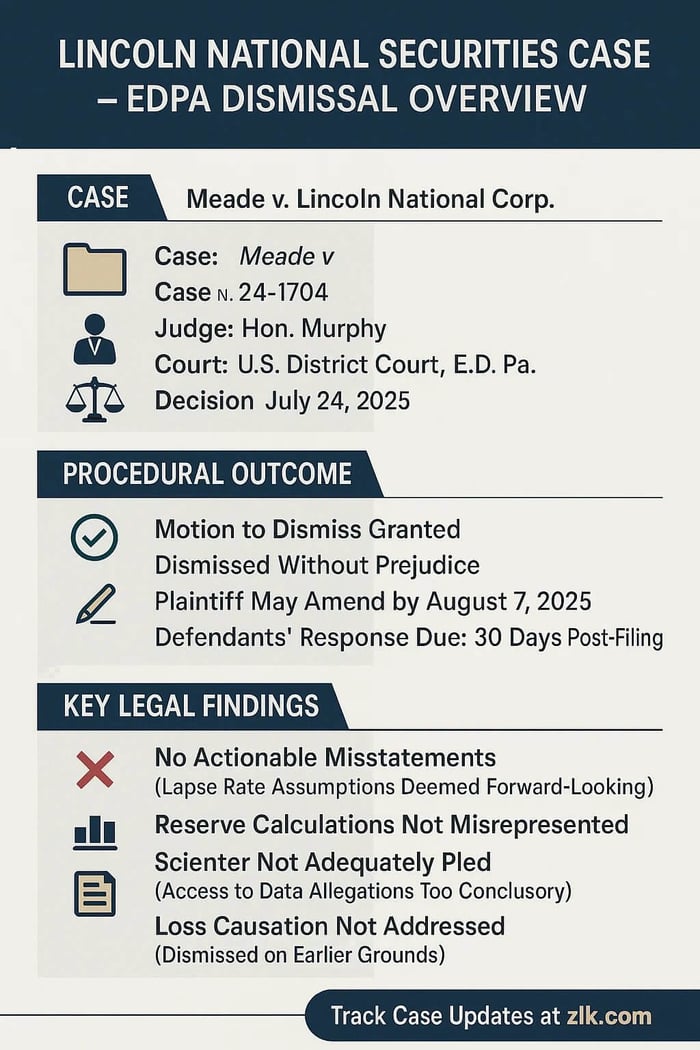
Underlying Lawsuit
Plaintiff Donald C. Meade, on behalf of purchasers of Lincoln National Corporation securities from December 8, 2021, to November 2, 2022, alleged violations of Section 10(b) and Rule 10b-5 against Lincoln National Corporation and executives Ellen Cooper, Dennis Glass, and Randal Freitag, and Section 20(a) against the executives. The Amended Complaint claimed Defendants misrepresented lapse rates for guaranteed universal life insurance policies, ignoring internal data showing lower lapses that increased reserve obligations, leading to a $2.197 billion Q3 2022 change and a stock price drop.
Defendants’ Motion to Dismiss Arguments
Defendants moved to dismiss under Rule 12(b)(6), arguing:
- Falsity: Statements were non-actionable opinions, forward-looking, or not misleading, as no specific data showed knowledge of adverse trends at the time.
- Scienter: No strong inference of intent or recklessness, lacking particularized facts on what Defendants knew and when.
- Loss Causation: The Q3 2022 loss was due to revised assumptions, not fraud; stock drop was unrelated to alleged misstatements.
Plaintiffs’ Opposition
Plaintiff argued statements on lapse rates and reserves were misleading, as internal data and an industry study showed lower lapses requiring reserve increases. Scienter was supported by executives’ access to data and participation in assumption reviews. Loss causation stemmed from the $2.6 billion loss and stock drop after disclosures.
Court’s Ruling
The Court granted the motion, dismissing the Amended Complaint without prejudice, finding no actionable misstatements or scienter. Leave to amend was granted.
Court’s Rationale
Falsity
The Court held statements on lapse rates were opinions or forward-looking, not misleading without specific internal data showing adverse trends at the time. No duty to disclose interim assumption review details arose, and cautionary language protected forward-looking claims.
Scienter
Plaintiffs failed to plead a strong inference of scienter, as allegations of executives’ access to data were conclusory, lacking particularized facts on knowledge of policyholder behavior or study results contradicting public statements.
Loss Causation
The Court did not reach loss causation, having dismissed the complaint on falsity and scienter grounds.
Final Disposition and Next Steps
The Amended Complaint is dismissed without prejudice. Plaintiff may file a Second Amended Complaint by August 7, 2025. Defendants must respond within 30 days of any filing. If no amendment is filed, the Clerk will enter judgment for Defendants.