
Caption: In re UiPath, Inc. Securities Litigation.
Case No.: 24 Civ. 3800 (ER)
Jurisdiction: U.S. District Court, Southern District of New York
Judge: Hon. Edgardo Ramos
Summary
On July 23, 2025, the U.S. District Court for the Southern District of New York dismissed all claims in In re UiPath, Inc. Securities Litigation. Judge Edgardo Ramos granted the motion to dismiss the Amended Complaint with prejudice and denied leave to amend. The Court found that the challenged statements were not actionable, the allegations did not support a strong inference of scienter, and the complaint failed to link the claimed losses to any misrepresentation. 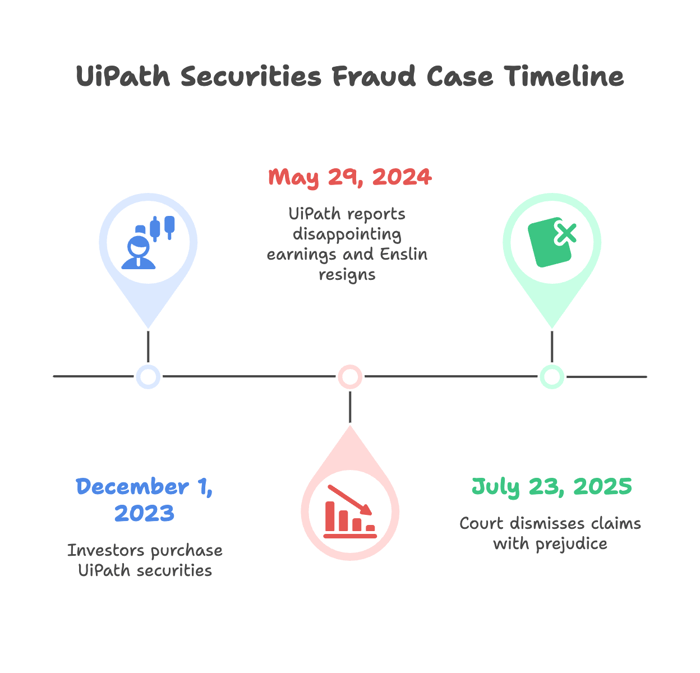
Underlying Lawsuit
The case was brought by investors who purchased UiPath securities between December 1, 2023, and May 29, 2024. Plaintiffs alleged violations of Section 10(b) and Rule 10b-5 against UiPath, Inc., as well as its CEO Daniel Dines, co-CEO Robert Enslin, and CFO Ashim Gupta. They also brought control person claims under Section 20(a) against the same executives.
According to the Amended Complaint, Defendants misrepresented the company’s sales execution and investment strategy, particularly around its sales teams and product development. Plaintiffs claimed that internal sales practices—such as bundling and multi-year ramped contracts—artificially boosted ARR metrics while reducing short-term revenue, and that these practices were not adequately disclosed. The stock price fell by about 30% after May 29, 2024, when UiPath reported disappointing earnings and Enslin announced his resignation. 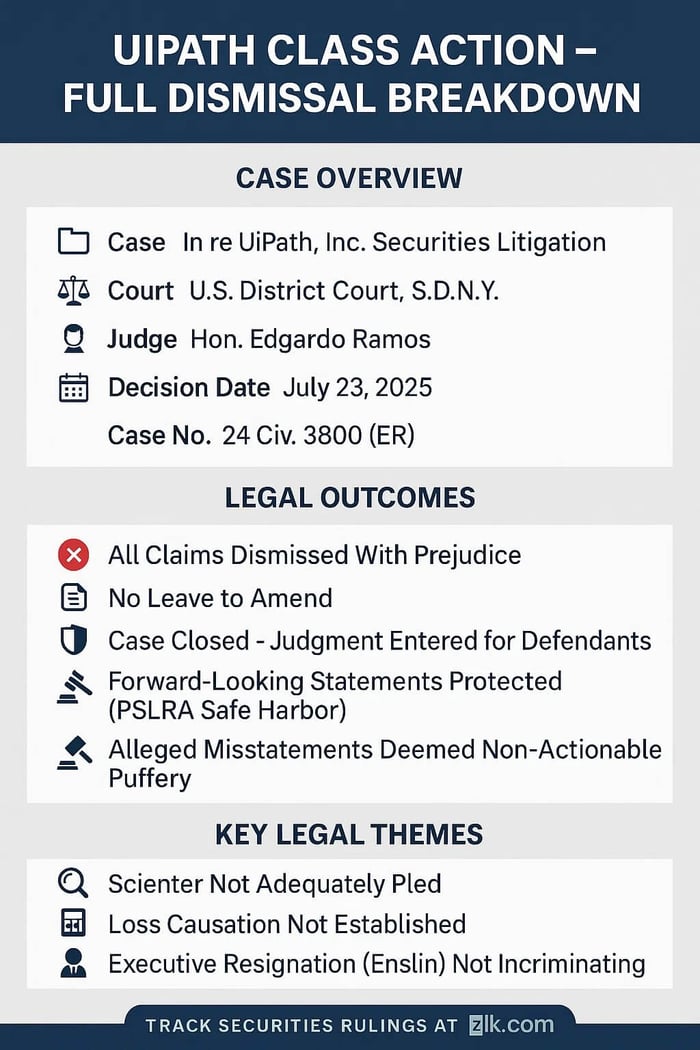
Defendants’ Motion to Dismiss
Defendants moved to dismiss under Rule 12(b)(6), raising several arguments:
- Falsity: They argued that statements about sales execution and strategic investments were non-actionable—framed as general optimism, opinion, or forward-looking commentary. Nothing was said that could be proven false.
- Scienter: The motion asserted that Plaintiffs failed to show intent or recklessness. There were no particularized allegations about internal reports, and no motive was alleged. Enslin’s departure, they said, did not imply wrongdoing.
- Loss Causation: Defendants argued that the May 2024 disclosures were not tied to any alleged fraud. They described a disappointing quarter, not a corrective revelation, and analyst reports supported that interpretation.
Plaintiffs’ Opposition
Plaintiffs maintained that statements about sales investments were misleading, given internal issues around ramped deals and bundling. They pointed to executives’ access to data, participation in meetings, and the timing of Enslin’s resignation as indicators of scienter. They argued that the stock drop following the May 29 disclosures was tied to the exposure of earlier misstatements.
Court’s Ruling
The Court granted the motion in full. All claims were dismissed with prejudice, and no further amendments will be permitted. The Clerk was directed to enter judgment for Defendants and close the case.
Court’s Rationale
Falsity
Judge Ramos concluded that the challenged statements were too general to be actionable. Descriptions of sales execution and strategy were viewed as puffery or opinion. The Court also found no duty to disclose details about contract structure or bundling. Because these were business decisions and not misrepresented risks, the statements were not materially false. Forward-looking claims were protected under the PSLRA’s safe harbor provisions.
Scienter
The Court held that the complaint did not support a strong inference of scienter. It lacked specific allegations showing that executives had access to contradictory data or knowingly made misleading statements. No motive was alleged. The Court did not view Enslin’s resignation as meaningful in this context and rejected attempts to apply the core operations or conscious misbehavior doctrines.
Loss Causation
The Court found that Plaintiffs did not adequately plead loss causation. The disclosures on May 29 reflected underperformance, not a revelation of fraud. Analyst coverage at the time treated the results as a business disappointment. There was no clear connection between the alleged misstatements and the stock decline.
Final Disposition and Next Steps
All claims have been dismissed with prejudice. No amendment is permitted. The case is closed, and judgment will be entered in favor of the Defendants.