
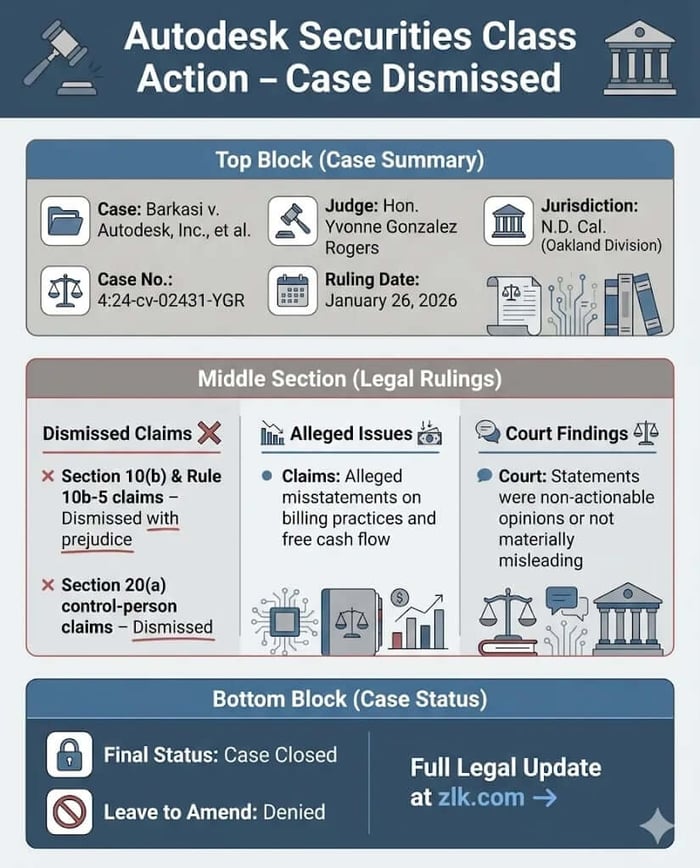
Caption: Barkasi v. Autodesk, Inc., et al.
Case No.: 4:24-cv-02431-YGR
Jurisdiction: U.S. District Court, Northern District of California
Judge: Hon. Yvonne Gonzalez Rogers
Summary
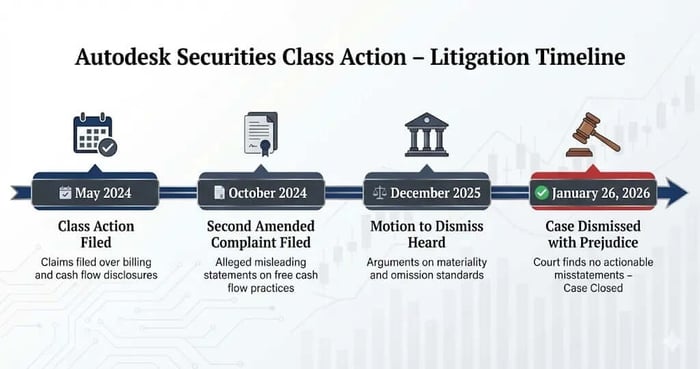
On January 26, 2026, Judge Yvonne Gonzalez Rogers granted defendants’ motions to dismiss the Second Amended Class Action Complaint in the securities fraud action against Autodesk, Inc. and two senior executives. The Court dismissed all Exchange Act claims with prejudice. Plaintiffs were denied further leave to amend, and the Court ordered the case closed.
Allegations Against Autodesk, Inc.
Plaintiffs alleged that Autodesk, its CEO, and its CFO misled investors about the company’s free cash flow practices. According to the complaint, Autodesk had announced a plan to transition certain enterprise customers from multiyear upfront billing to annual billing, but later reversed course. Plaintiffs claimed Autodesk relied on elevated levels of upfront enterprise agreements to meet free cash flow targets without adequately disclosing that practice.
Defendants’ Motion to Dismiss
Autodesk and the individual defendants moved to dismiss the Second Amended Complaint, arguing that plaintiffs failed to identify any actionable misstatement or omission. They contended that the challenged statements were vague, non-actionable opinions or explanatory remarks that did not require additional disclosure. Defendants also argued that plaintiffs failed to plead scienter and had already been given an opportunity to amend.
Plaintiffs’ Opposition
Plaintiffs argued that Autodesk’s statements about billing transitions and free cash flow created a misleading impression that the company was moving away from upfront billing. They contended that the omission of information regarding the scale and impact of upfront enterprise agreements rendered those statements misleading. Plaintiffs also relied on an expert analysis to argue that the alleged practices materially affected reported free cash flow.
Court’s Ruling
The Court dismissed all Section 10(b) and Rule 10b-5 claims against Autodesk and the individual defendants. Because the primary Exchange Act claims were dismissed, the Court also dismissed the Section 20(a) control-person claims. The dismissal was with prejudice.
Court’s Rationale
Falsity: The Court held that none of the challenged statements were materially false or misleading. It found that Autodesk’s statements about transitioning “more” enterprise agreements to annual billing were not sufficiently concrete to require disclosure of volumes, timing, or the full extent of billing practices. The Court concluded that plaintiffs attempted to convert general statements into specific assurances that Autodesk did not make.
Opinion Statements: The Court held that statements describing non-GAAP measures as “useful” or providing “greater transparency” were expressions of opinion. Plaintiffs did not plausibly allege that defendants disbelieved those opinions at the time they were made or embedded false factual assertions within them.
Omissions and Explanatory Statements: The Court found that Autodesk was not required to provide a complete accounting of all factors contributing to free cash flow in its explanatory remarks. The absence of additional detail did not render the statements misleading under the securities laws.
Section 20(a): Because plaintiffs failed to plead a primary Exchange Act violation, the control-person claims failed as a matter of law.
Case Status
The action has been dismissed with prejudice. The case is closed.