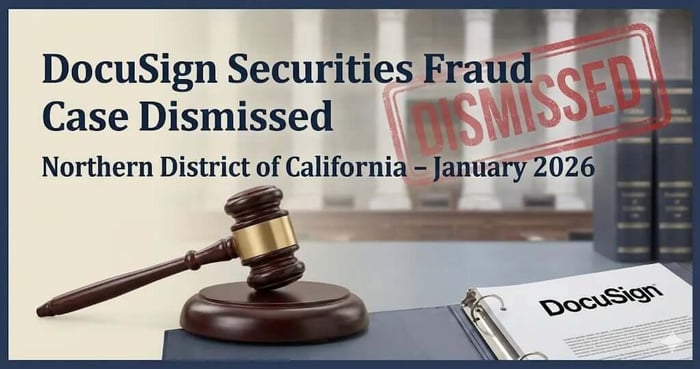

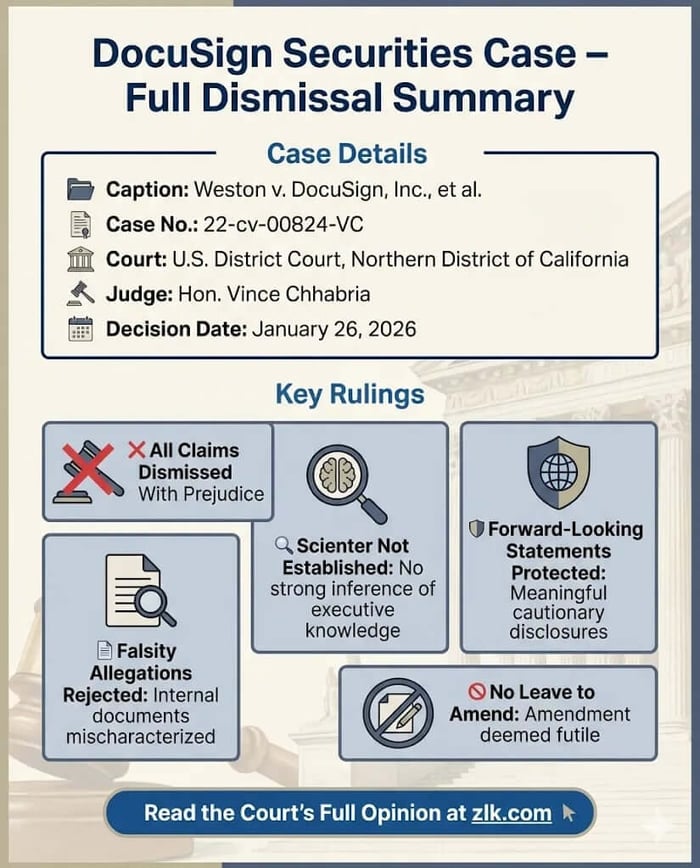
Caption: Weston v. DocuSign, Inc., et al.
Case No.: 22-cv-00824-VC
Jurisdiction: U.S. District Court, Northern District of California
Judge: Hon. Vince Chhabria
Summary
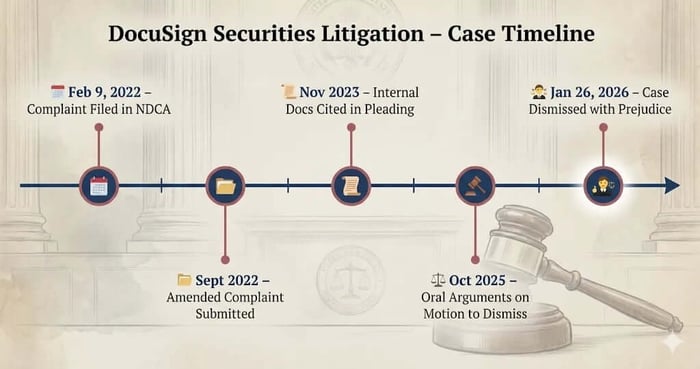
On January 26, 2026, Judge Vince Chhabria granted defendants’ motion to dismiss the securities class action against DocuSign, Inc. The Court dismissed all claims with prejudice. The Court concluded that further amendment would be futile.
Allegations Against DocuSign, Inc.
Plaintiffs alleged that DocuSign and senior executives made misleading public statements about demand for the company’s eSignature product, competition, and the growth prospects of its CLM product. As described in the order, plaintiffs claimed that public assurances conflicted with internal information suggesting slowing demand, customer churn, competitive pressure from Adobe, and weaker CLM performance. The amended complaint relied heavily on internal documents obtained in discovery to support these claims.
Defendants’ Motion to Dismiss
DocuSign and the individual defendants moved to dismiss the amended complaint, arguing that it mischaracterized internal documents and failed to plead falsity and scienter. Defendants contended that most challenged statements were not misleading, were forward-looking, or were accompanied by meaningful cautionary language. They also argued that the complaint failed to raise a strong inference that any executive knew the statements were false.
Plaintiffs’ Opposition
Plaintiffs argued that internal documents supported their claims that public statements about demand, churn, competition, and CLM growth were misleading. They maintained that the documents showed executives were aware of contrary internal data and that at least some statements were actionable misrepresentations rather than puffery or protected forward-looking statements.
Court’s Ruling
The Court granted the motion to dismiss in full. All claims were dismissed with prejudice. No claims survived.
Court’s Rationale
Falsity: The Court found that the complaint repeatedly described internal documents in a misleading way, undermining most falsity allegations. The Court held that only one statement—an earnings call comment that the company was not seeing meaningful differences in churn—was adequately pled as false.
Scienter: The Court held that plaintiffs failed to plead a strong inference that the executive who made the churn statement knew it was false. The internal communications cited involved limited business segments and did not support a core-operations inference. The Court found it more reasonable to infer that the executive did not know about the specific churn issues.
Other Statements: The Court held that statements about competition from Adobe were not misleading because the company acknowledged Adobe’s price competition. Statements about CLM were forward-looking and accompanied by meaningful cautionary disclosures.
Leave to Amend: Given the history of the case and continued problems with the pleadings, the Court concluded that further amendment would be futile.
Case Status
The case has been dismissed with prejudice.