![Krispy Kreme, Inc. (DNUT) Securities Class Action Lawsuit Update [June 11, 2025]](https://dropinblog.net/cdn-cgi/image/fit=scale-down,format=auto,width=700/34260815/files/featured/krispy-kreme-class-action-lawsuit.webp)

Introduction to Krispy Kreme, Inc. (DNUT) Lawsuit
A securities class action lawsuit has been filed against Krispy Kreme, Inc. (NASDAQ: DNUT), alleging the company violated federal securities laws, including the Securities Exchange Act. The Krispy Kreme lawsuit claims executives made false and misleading statements about demand and profitability tied to its McDonald’s partnership, while concealing key risks that impacted growth. Investors who purchased DNUT stock during the Class Period may have suffered significant investment losses.
On May 8, 2025, Krispy Kreme revealed it was pausing expansion at McDonald's locations amidst declining average sales and a substantial revenue loss.
Krispy Kreme, Inc. (DNUT) Case Details
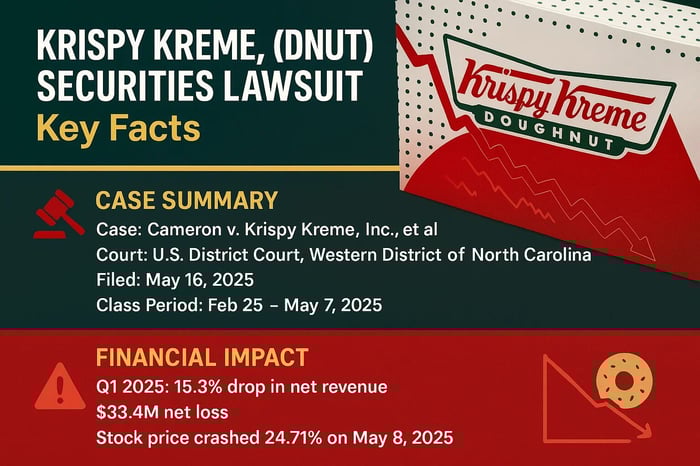
Cameron v. Krispy Kreme, Inc., et al
Case No.: 3-25-cv-00332
U.S. District Court, Western District of North Carolina
Filed on May 16, 2025
Krispy Kreme, Inc. (DNUT) Company Profile
Krispy Kreme, Inc. produces and sells donuts at various locations, including company-operated retail shops, grocery stores, and quick-service restaurants. In 2022, Krispy Kreme began a test program selling donuts at Kentucky McDonald's restaurants. On March 26, 2024, the company announced an expansion of its partnership with McDonald’s.
Class Period:
February 25, 2025 to May 7, 2025, inclusive.
Investors who acquired Krispy Kreme securities during the class period might be eligible to join the Krispy Kreme class action lawsuit.
Allegations in the Krispy Kreme, Inc. (DNUT) Securities Lawsuit
According to the complaint, Krispy Kreme allegedly misled investors about the financial viability of its high-profile McDonald’s partnership, failing to disclose declining demand, profitability issues, and risks to expansion. Despite weakening performance, the company publicly positioned the partnership as a major growth engine.
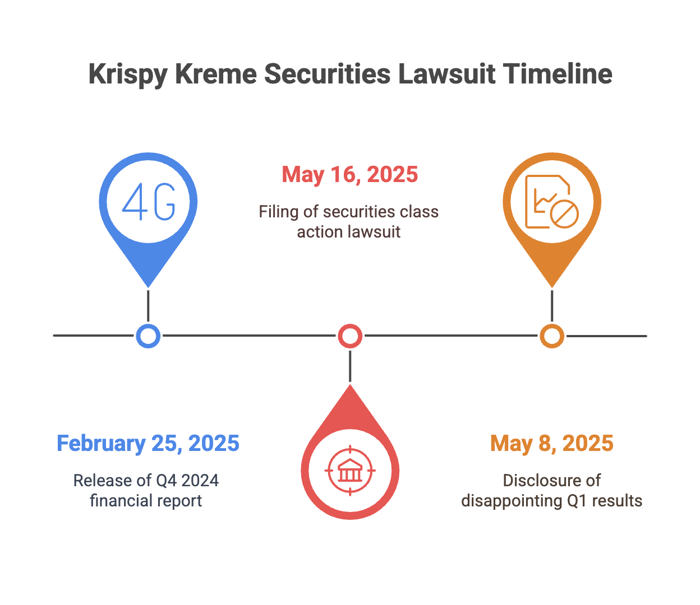
In its Q4 2024 financial report, released on February 25, 2025, Krispy Kreme reported a decline in retail sales and a drop in Delivered Fresh Daily (DFD) average sales per door per week. Despite this setback, the company continued to promote its partnership with McDonald’s as a key driver of growth.
By April 2025, Krispy Kreme’s revenue continued to decline, but the company maintained its positive outlook. The complaint alleges that executives knowingly concealed the fact that demand for Krispy Kreme products at McDonald’s locations had fallen significantly following the initial marketing launch.
The complaint alleges that throughout the Class Period, Krispy Kreme made false and misleading statements and failed to disclose material facts about declining demand at McDonald’s locations, the lack of profitability of the partnership, and risks that led to a pause in expansion. The complaint alleges these misstatements caused Krispy Kreme’s stock to trade at artificially inflated prices.
The Truth Emerges
On May 8, 2025, Krispy Kreme revealed disappointing Q1 results, including a 15.3% drop in net revenue, declining average sales, and a $33.4 million net loss. The company also paused expansion at McDonald's locations, citing uncertainty. It also withdrew its full-year financial forecast. This public disclosure marked a dramatic shift in the company’s narrative and exposed the underlying McDonald’s partnership risks investors had not previously known.
Market Reaction
Investors reacted negatively to this news. Investors quickly dumped their Krispy Kreme shares, causing the stock to plunge 24.71% within a day.
Next Steps
Submissions for lead plaintiff are due July 15, 2025.
The Court will issue its order for lead plaintiff and counsel in the weeks after lead plaintiff submissions are due.
The Court will then consider motion for class certification.
The Court will later consider a Motion to Dismiss.
To learn if you are eligible for recovery under the Krispy Kreme securities class action lawsuit, visit the case submission page here.
Disclaimer: This shareholder alert is for informational purposes only and does not constitute legal advice. Consult a qualified attorney for personalized guidance. No specific outcomes are guaranteed.
![MicroStrategy Inc. (MSTR) Securities Class Action Lawsuit Update [June 14, 2025]](https://dropinblog.net/cdn-cgi/image/fit=scale-down,format=auto,width=700/34260815/files/featured/microstrategy-securities-lawsuit-blog-banner.webp)
![Iovance Biotherapeutics (IOVA) Securities Class Action Lawsuit Update [June 13, 2025]](https://dropinblog.net/cdn-cgi/image/fit=scale-down,format=auto,width=700/34260815/files/featured/iovance-lawsuit-blog-banner.webp)
![Digimarc Corp. (DMRC) Securities Class Action Lawsuit Update [June 6, 2025]](https://dropinblog.net/cdn-cgi/image/fit=scale-down,format=auto,width=700/34260815/files/featured/digimarc-corp-lawsuit-banner.webp)