
Caption: In re Intel Corporation Securities Litigation
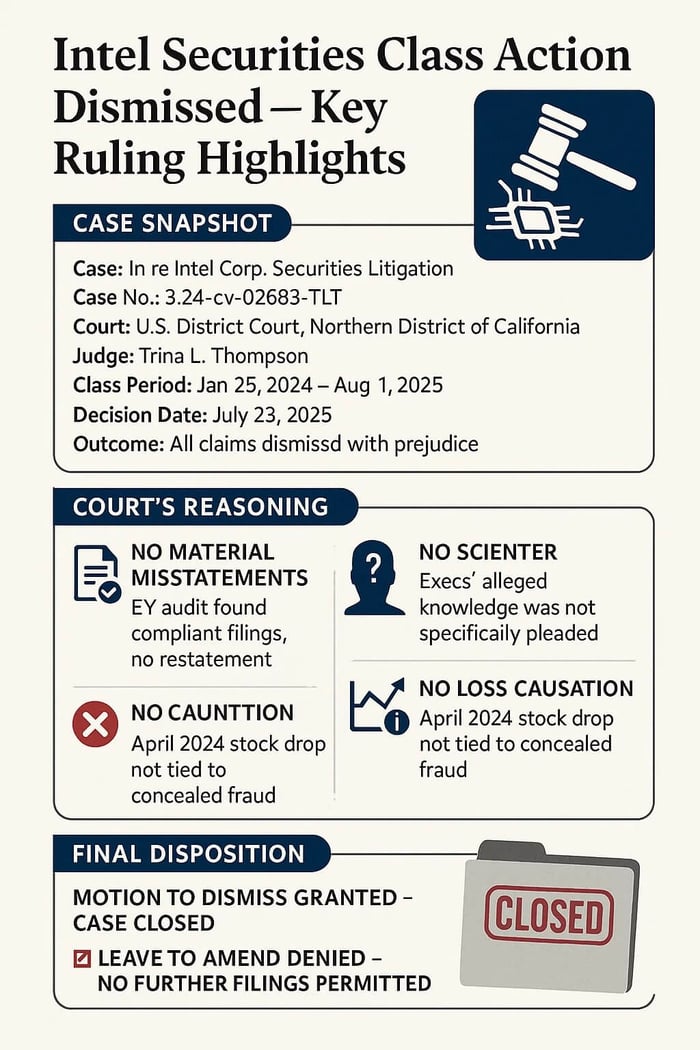
Case No. 3:24-cv-02683-TLT
Jurisdiction: U.S. District Court, Northern District of California
Judge: Hon. Trina L. Thompson
Class Period: January 25, 2024 to August 1, 2025
Summary
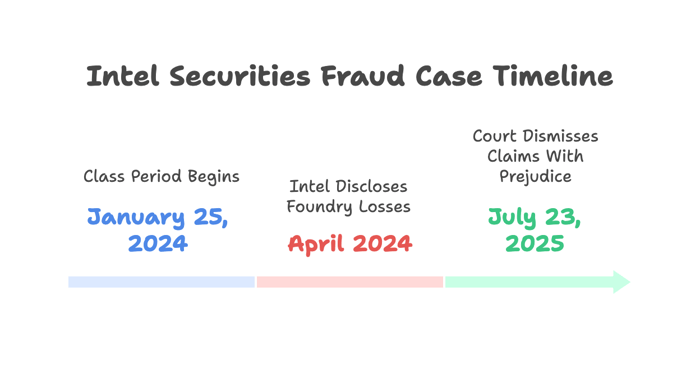
On July 23, 2025,Judge Thompson granted Defendants’ motion to dismiss in In re Intel Corp. Securities Litigation, dismissing all Section 10(b) and 20(a) claims with prejudice. The Court found no material misstatements, scienter, or loss causation in Plaintiffs’ allegations about Intel’s Internal Foundry Model and foundry losses. Judge Landry denied plaintiffs leave to amend.
Underlying Lawsuit
Plaintiffs Intel Investor Group and Byoung Wook Jeon, represented purchasers of Intel common stock, call options, or put options during the Class Period. Plaintiffs said Intel and some of its executives (CEO Patric Gelsinger and CFO David Zinsner) violated of Section 10(b) of the Securities Exchange Act and SEC Rule 10b-5. Plaintiffs also alleged Gelsinger and Zinsner violated Section 20(a) of the Exchange Act. The Second Amended Complaint claimed Defendants misled investors about Intel Foundry’s financials and the Internal Foundry Model’s implementation, obscuring $7 billion in losses until recast results were disclosed in April 2024, causing stock price drops.
Defendants’ Motion to Dismiss Arguments
Defendants moved to dismiss under Rule 12(b)(6), arguing:
Falsity: No GAAP violation, as EY’s clean audit confirmed compliance; statements were forward-looking, puffery, or not misleading.
Scienter: Insufficient facts showed knowledge or recklessness about foundry losses.
Loss Causation: Disclosures did not reveal concealed risks; market already knew issues
Plaintiffs’ Opposition
Plaintiffs said Intel’s FY 2023 financials hid foundry losses by not reporting Internal Foundry results. They also said Gelsinger and Zinsner’s statements on efficiencies were misleading. Scienter stemmed from executives’ access to P&Ls, and loss causation arose from stock drops post-April 2024 recast disclosures.
Court’s Ruling
The Court granted the motion, dismissing all claims with prejudice and denying leave to amend, finding amendment wouldn’t solve the complaint’s problems.
Court’s Rationale
Falsity
The Court rejected Plaintiffs’ GAAP violation claim, citing EY’s clean audit, lack of restatement, and insufficient facts showing Gelsinger regularly reviewed Internal Foundry P&Ls for resource allocation. Statements on efficiencies and prospects were puffery or forward-looking, not actionable.
Scienter
Plaintiffs failed to plead a strong inference of scienter, as allegations of executives’ knowledge were conclusory and unsupported by particularized facts.
Loss Causation
Disclosures did not reveal concealed risks, as the market was aware of foundry challenges; stock drops were not tied to fraud revelations.
Final Disposition and Next Steps
All claims are dismissed with prejudice. The Clerk is directed to terminate the case. No further filings or deadlines apply.