ADMA Biologics, Inc. Class Action Lawsuit - ADMA
Company: ADMA Biologics, Inc.
Ticker: (NASDAQ) ADMA
27
Days Left
Lead Plaintiff Deadline: August 10, 2026
See If You Qualify For Monetary Reward
Join the ADMA Biologics, Inc. Class Action Lawsuit
Please Upload related files below
Add Transactions
Fill in below.
Certification of Plaintiff Pursuant to Federal Securities Laws
Upload Your Stock Tickers
Tell us the stocks you own using SnapTrade, and we will keep you informed about class action litigation related to your stocks. We monitor critical case developments that may affect the price of your shares and your possible monetary recovery. SnapTrade only shares the tickers you own and your transaction history, not your account numbers. Using SnapTrade and participating in our monitoring service is free and does not create any attorney-client relationship or obligation on your part.
Don’t miss out on possible monetary recovery - link your brokerage account with SnapTrade.
Class Period
Begins
09
Aug 2024
Ends
25
Mar 2026
August 09, 2024 - March 25, 2026
Allegations
(1) ADMA Biologics engaged in an undisclosed related party transaction; (2) ADMA Biologics used channel stuffing to create an appearance of revenue; (3) ADMA Biologics lacked adequate internal controls; (4) as a result, defendants’ statements about ADMA Biologics’ business, operations, and prospects were materially false and misleading and/or lacked a reasonable basis at all relevant times.
Eligibility
In order to be eligible to join the ADMA class action lawsuit, you must have incurred a loss on shares of ADMA Biologics, Inc. purchased during the class period listed above.
Lead Plaintiff Deadline
If you suffered a loss in ADMA Biologics, Inc. during the relevant time frame, you have until August 10, 2026 to request that the Court appoint you as lead plaintiff. Your ability to share in any recovery doesn't require that you serve as a lead plaintiff.
ADMA Biologics, Inc.Class Action Lawsuit Details
|
ADMA Class Action Summary |
|
|
Company |
ADMA Biologics, Inc. (NASDAQ: ADMA) |
|
Lead Plaintiff Deadline |
August 10, 2026 |
|
Class Period |
August 9, 2024 – March 25, 2026 |
|
Stock Drop |
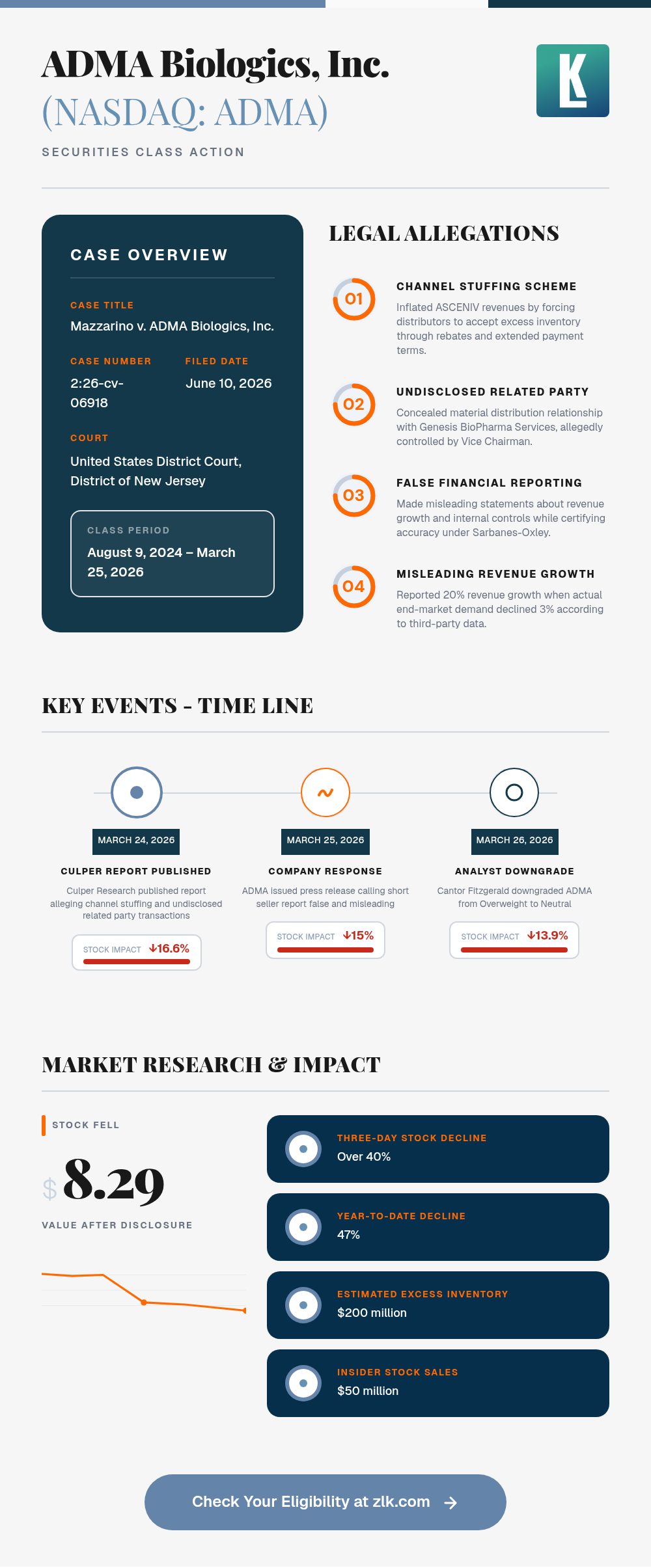
March 24, 2026 – ADMA fell $2.26 (16.6%) to $11.33; March 25, 2026 – ADMA fell a further $1.70 (15%); March 26, 2026 – ADMA fell $1.34 (13.9%) to $8.29 |
|
Lawsuit Type |
Securities Class Action |
Introduction
A securities class action lawsuit has been filed against ADMA Biologics, Inc. (NASDAQ: ADMA) and certain of its senior executives on behalf of investors who purchased ADMA securities between August 9, 2024 and March 25, 2026. The complaint, filed in the United States District Court for the District of New Jersey, alleges that defendants made materially false and misleading statements about the company’s revenue growth, internal controls, and related party transactions, while concealing a channel stuffing scheme that artificially inflated reported ASCENIV sales and an undisclosed related party distribution relationship involving an entity allegedly controlled by the company’s Vice Chairman. After Culper Research published a short-seller report concerning these alleged practices in March 2026, ADMA stock declined over three trading sessions, falling 16.6%, 15%, and 13.9% on consecutive trading days. The complaint also cites analyst commentary stating that ADMA had declined approximately 47% year-to-date, and plaintiffs allege the declines caused significant shareholder losses.
Company Profile
ADMA Biologics, Inc. is a commercial biopharmaceutical company headquartered in Ramsey, New Jersey, dedicated to manufacturing, marketing, and developing specialty biologics for the treatment of immunodeficient patients at risk for infection and others at risk for certain infectious diseases. The company’s flagship product is ASCENIV, an intravenous immunoglobulin (IVIG) therapy, and it also markets BIVIGAM and Nabi-HB, while operating plasma collection centers.
Class Period
August 9, 2024–March 25, 2026
Investors who purchased or acquired ADMA Biologics (ADMA) securities during the Class Period may be entitled to seek recovery under the federal securities laws.
Allegations
The complaint alleges that throughout the Class Period, ADMA Biologics and its senior leadership made materially false and misleading statements in the company’s quarterly and annual SEC filings regarding revenue recognition practices, the effectiveness of internal controls over financial reporting, and the full scope of related party transactions. According to the lawsuit, defendants certified in each filing, pursuant to the Sarbanes-Oxley Act, that the company’s financial reporting was accurate, that internal controls were effective, and that all fraud had been disclosed, when in fact the company was engaged in a scheme to inflate reported revenues and was concealing a material distribution relationship.
The core of the alleged fraud involves ASCENIV, ADMA’s premium-priced IVIG therapy. The complaint alleges that ADMA engaged in channel stuffing by inducing distributors to accept excess, unwanted shipments of ASCENIV through rebates and extended payment terms stretching to 120 days. According to the lawsuit, this practice allowed ADMA to book revenues upon delivery to distributors even though end-market demand was not increasing, creating the appearance that ASCENIV revenues grew from $92.6 million in 2023 to $362.5 million in 2025 when, plaintiffs allege, the underlying growth was nonexistent. The complaint cites Culper’s report, which described accounts from high-level employees at one of ADMA’s two largest distributors who allegedly stated that, starting in 2025, ADMA requested larger orders at different ordering cycles and incentivized compliance with rebates and extended terms. One distributor employee allegedly stated that the activity amounted to “cooking the books a bit,” while Culper also reported that a a former ADMA sales representative said the company would “encourage them to order more to goose the channel, and then it just sits there.”
The complaint further alleges that ADMA concealed what Culper described as an apparent material related-party distribution relationship. While the company disclosed small purchases from GenesisBPS, an equipment provider allegedly owned by Adam Grossman and Jerrold Grossman until September 30, 2025, it allegedly never disclosed sales to Genesis BioPharma Services, a distinct entity that describes itself as a life sciences logistics provider, lists ASCENIV among its product offerings, and operates out of ADMA’s own corporate headquarters at 465 Route 17, Ramsey, New Jersey. Plaintiffs allege this created an “apparent sleight of hand,” giving the impression of transparency about Grossman-controlled entities while concealing what may be a material distribution relationship. Additional red flags cited by the complaint include the 2024 resignation of ADMA’s 17-year auditor CohnReznick (replaced by KPMG, which flagged critical audit matters), the departure of a longstanding director, and the sudden retirement of CFO Brad Tade at age 52, effective immediately, in February 2026. Insiders collectively sold over $50 million in stock over the preceding three years, with CEO Grossman selling over $20 million and pledging more than 712,000 shares against a personal credit facility in January 2025.
The Truth Emerges
On March 24, 2026, Culper Research published a detailed report alleging that ADMA’s reported revenue growth was “a fiction driven more than entirely by a de facto channel stuffing scheme and an undisclosed related party distributor.” The report presented third-party sales data showing a significant and widening gap between ADMA’s reported ASCENIV revenues and actual end-market utilization, estimating that approximately $200 million in ASCENIV inventory was sitting in the distribution channel. Culper further estimated that absent channel stuffing, ADMA’s revenues actually declined 3% in 2025, compared to the 20% growth the company reported. The report also detailed what Culper described as an undisclosed relationship with Genesis BioPharma Services, including Culper’s report that the entity operated from ADMA’s headquarters.
The following day, ADMA issued a press release characterizing the short seller report as “premised on speculative assertions derived from unidentified and unreliable sources” containing “numerous misleading, false and inaccurate statements.” The complaint cites Cantor Fitzgerald commentary stating that investors expressed disappointment in ADMA’s response and that the firm had expected “more specific feedback addressing the direct claims” in the short seller report. On March 26, 2026, Cantor Fitzgerald downgraded ADMA stock from Overweight to Neutral, noting that investors expressed disappointment in the company’s response and that the firm had expected “more specific feedback addressing the direct claims” in the short seller report. The analyst suspended its financial model for the company, citing concerns around increased days sales outstanding and accounts receivable, and stated that the lack of clarity made it “difficult to recommend investors take advantage of stock weakness.”
Market Reaction
The alleged corrective disclosures were followed by a severe three-day decline in ADMA Biologics stock. On March 24, 2026, the day the Culper Research report was published, ADMA shares fell $2.26 per share, or 16.6%, to close at $11.33. The stock declined a further $1.70 per share, or 15%, on March 25, 2026, amid continued market reaction to the Culper report. On March 26, 2026, following the Cantor Fitzgerald downgrade, ADMA shares fell an additional $1.34 per share, or 13.9%, to close at $8.29. The complaint also cites analyst commentary stating that ADMA had declined approximately 47% year-to-date.
Next Steps
● Lead Plaintiff Deadline: August 10, 2026
● After the lead plaintiff deadline, the Court will consider any lead plaintiff motions.
● Defendants may file a motion to dismiss.
● If the case proceeds, the Court may later consider class certification.
Disclaimer: This shareholder alert is for informational purposes only and does not constitute legal advice. Consult a qualified attorney for personalized guidance. No specific outcomes are guaranteed.