
I. Introduction
What Is a Lead Plaintiff?
The Private Securities Litigation Reform Act of 1995 (PSLRA)defines a lead plaintiff, also known as a class representative, as the individual or entity appointed by a court to represent the interests of all class members in a class action lawsuit.
This person is not simply the first to file a claim; instead, they assume a special, court-sanctioned role that entails significant responsibilities and considerable influence over the direction of the litigation.
In the United States,Rule 23 of the Federal Rules of Civil Procedure empowers class actions to be a powerful tool for groups of people with similar grievances to seek justice collectively, particularly when individual claims might be too small to pursue independently.
Why the Lead Plaintiff Role Matters in Class Actions
According to the Private Securities Litigation Reform Act of1995, the lead plaintiff is crucial to the integrity and effectiveness of the class action process.
By consolidating claims, class actions can hold powerful defendants, such as corporations or government entities, accountable for widespread harm.
The lead plaintiff’s willingness to step forward for a class action suit ensures that the interests of the class are vigorously advocated and that settlements or judgments are fair and reasonable for all members.
II. Legal Framework for Lead Plaintiffs
Overview of Class Action Lawsuits
Class action lawsuits are governed by Rule 23 of the Federal Rules of CivilProcedure.
This rule sets forth the requirements for certifying aclass, including numerosity, commonality, typicality, and adequacy of representation.
The class action mechanism enables courts to efficiently handle large numbers of similar claims and prevent inconsistent judgments.
Statutory Basis (e.g., PSLRA for Securities Cases)
For securities class actions,the Private Securities Litigation Reform Act (PSLRA) of 1995established specific procedures for appointing lead plaintiffs.
The PSLRA was enacted to curb abuses in securities litigation and to ensure that the most capable plaintiffs, often institutional investors with significant losses, lead the case.
The law requires that the court appoint as lead plaintiff the person or group with the “largest financialinterest” in the relief sought by the class.
Court Requirements and Approval Process
Courts must approve the appointment of a lead plaintiff. The process involves reviewing motions from prospective candidates and determining whether they meet the legal criteria for adequacy and typicality. (Rule 23(a), Rule 23(a)(3) and Rule 23 (a)(4))
The judge’s goal is to select a plaintiff who will best represent the interests of the class as a whole.
III. How Lead Plaintiffs Are Appointed
Filing a Motion for Appointment
After a class action complaint is filed, a notice is published to inform potential class members of their rights and options. Interested parties typically have 60 days to file amotion to be appointed as lead plaintiff.
This process is especially formalized in securities cases under the PSLRA.
Criteria the Court Considers

Courts consider several factors when appointing a lead plaintiff:
- Largest FinancialInterest: Preference is given to those who have suffered the most significant losses, on the theory that they have the most at stake and will best protect the class’s interests.
- Adequacy: The lead plaintiff must not have conflicts of interest and must be capable ofrepresentingthe class fairly.
- Typicality: The claims of the lead plaintiff must be typical of those of the class.
Competing Motions and Judicial Selection
In high-profile cases, multiple parties may seek appointment as lead plaintiff.
Courts may hold hearings to determine which candidate best meets the statutory requirements. Sometimes, groups of plaintiffs, such as a coalition of pension funds, are appointedjointly to represent their interests.
IV. Core Responsibilities of a Lead Plaintiff
Overseeing Litigation Decisions with Counsel
The lead plaintiff works closely with class counsel (the lawyers representing the class) to make key decisions about the direction of the lawsuit.
As perRule 23(a)(4), this includes choosing litigation strategies, deciding whether to settle, and approving major filings.
Reviewing Key Filings and Settlement Terms
Lead plaintiffs are expected toreview and approve essential court documents, including complaints, motions, and settlement agreements.
Their approval is crucial before any settlement is presented to the court for final approval.
Communicating with Class Counsel
Effective communication between the lead plaintiff and class counsel is essential. The lead plaintiff providesinput, responds to discovery requests, and may participate in depositions or testify at trial.
Representing the Interests of the Class
The lead plaintiff must act in the best interests of the entire class, not just their own. This includes ensuring that any settlement or judgment is fair, reasonable, and adequate for all class members (Rule 23(a)(4) of the Federal Rules of CivilProcedure).
V. Benefits of Serving as a Lead Plaintiff

Ability to Influence Litigation Strategy
Lead plaintiffs have a direct say in how the case is prosecuted. They can influence whether to accept a settlement, proceed to trial, or pursue specific legal arguments.
Enhanced Legal Oversight of the Case
Lead plaintiffs receive regular updates from class counsel and have access to information and evidence obtained during discovery that is not typically shared with ordinary class members.
Access to Legal Updates and Discovery
Serving as lead plaintiff provides insight into the litigation process, access to key documents, and a deeper understanding of the legal issues at stake.
VI. Compensation for Lead Plaintiffs
Court-Approved Incentive Awards
Lead plaintiffs may receive “incentiveawards” for their service, subject to court approval (Rule 23).
These awards recognize the time, effort, and potential risks undertaken by the lead plaintiff.
Such awards typically range from a few thousand to tens of thousands of dollars, depending on the complexity and duration of the case.
Comparison to General Class Member Recovery
While most class members receive only a prorata share of any settlement or judgment, lead plaintiffs often receive an additional incentive award on top of their share.
Legal Fee Reimbursements and Time-Based Awards
Lead plaintiffs may also be reimbursed for expenses incurred in connection with the lawsuit, such as travel for depositions or court appearances.
In rare cases, courts may approve additional compensation based on the time and effort expended.
VII. Risks and Considerations
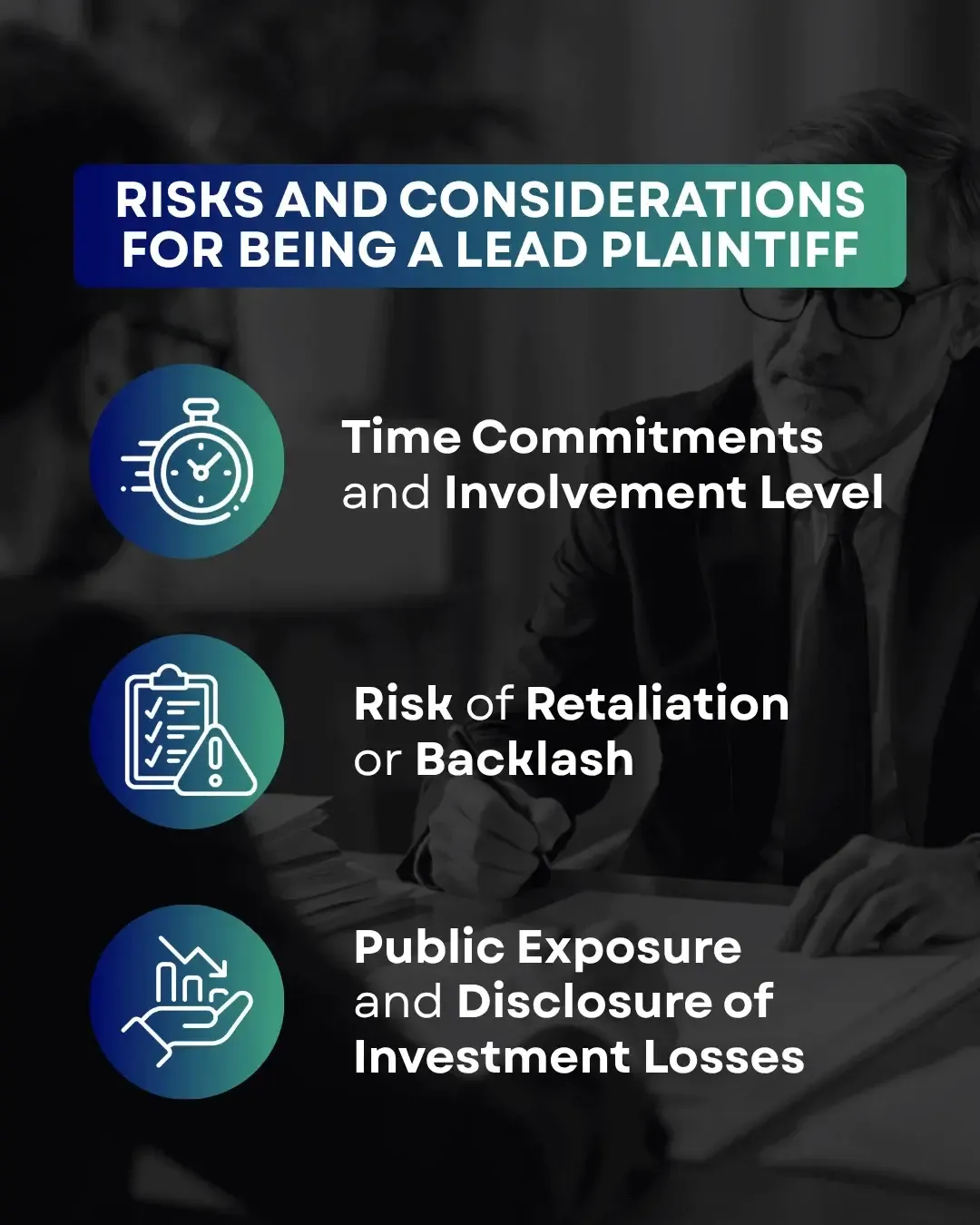
Time Commitments and Involvement Level
Serving as a lead plaintiff can be time-consuming, as it requires participation in discovery, depositions, and court hearings. The commitment can span several years, especially in complex cases.
Risk of Retaliation or Backlash
Although rare, lead plaintiffs, especially employees suing employers, may face retaliation or professional backlash. Legal protections are in place, but the risk cannot be entirely eliminated.
Public Exposure and Disclosure of Investment Losses
Lead plaintiffs’ names and, in some cases, financial losses or other personal information become part of the public record. The PLSRA requires the disclosure of the names of lead plaintiffs through the publication of a publicnotice.
This exposure may be a consideration for individuals who value their privacy.
VIII. The Class Action Settlement Process
How Settlements Are Negotiated
Settlements in class actions are typically negotiated between class counsel and the defendant, often with the input and approval of the lead plaintiff.
The process may involve mediation or direct negotiation.
Role of Lead Plaintiff in Approving Settlement
The lead plaintiff must approve any proposed settlement before it is submitted to the court.
The court then holds a “fairness hearing” to ensure the settlement is reasonable and adequate for all class members.
Distribution of Funds to Class Members
Once approved, settlement funds are distributed to class members following a court-approved plan. Lead plaintiffs receive their incentive awards first, followed by payments to the remaining class members.
At Levi & Korsinsky, LLP, we specialize in legal counsel for investor class action lawsuits, representing shareholders who have suffered financial losses due to securities fraud, corporate misconduct, and deceptive investment practices.
With over 80 collective years of experience, our experienced attorneys are on hand to provide you with the support and legal expertise you need to maximize your recovery.
IX. Case Studies and Examples
Notable Class Actions with Strong Lead Plaintiff Impact
- Enron SecuritiesLitigation:Institutional investors served as lead plaintiffs, resulting in a $7.2 billion settlement, one of the largest in U.S. history. Their oversight was credited with achieving a favorable result for the class.
- Volkswagen EmissionsLitigation: Lead plaintiffs played a key role in negotiating a $14.7 billion settlement for affected vehicle owners.
Lessons from Effective Lead Plaintiff Representation
Studies have shown that cases with active, engaged lead plaintiffs, especially institutionalinvestors, tend to achieve higher settlements and better outcomes for class members.
X. Legal Resources and Next Steps
When to Contact a Class Action Attorney
If you believe you have suffered harm that is shared by others, such as securities fraud, consumer fraud, or employment discrimination, consult a class action attorney to discuss your options.
Resources for Potential Lead Plaintiffs
- American Bar Association: Offers guides on class action law and lead plaintiff responsibilities.
- Federal Judicial Center: Publishes educational materials on class action procedures.
How to Join or Initiate a Class Action Case
To join a class action, you typically do not need to do anything until a settlement is reached; you will be notified if you are a class member. To initiate a class action, work with experienced counsel to file a complaint and seek appointment as lead plaintiff.
Serving as a lead plaintiff in a class action lawsuit is a significant responsibility, offering the opportunity to influence high-stakes litigation and secure justice for a broader group of individuals. While the role comes with risks and demands, the rewards, both financial and in terms of public impact, can be substantial. If you believe you have a claim suitable for a class action, consider consulting a qualified attorney to explore your options.
Disclaimer: The information provided in this blog is for general informational purposes only and does not constitute legal advice. Readers should not act or refrain from acting on any of the information contained in this blog without consulting a qualified legal professional. Levi & Korsinsky LLP is not responsible for any actions taken or not taken based on the information provided in this blog.