Alight, Inc. Class Action Lawsuit – ALIT
Introduction to Alight, Inc. (ALIT) Securities Class Action Lawsuit
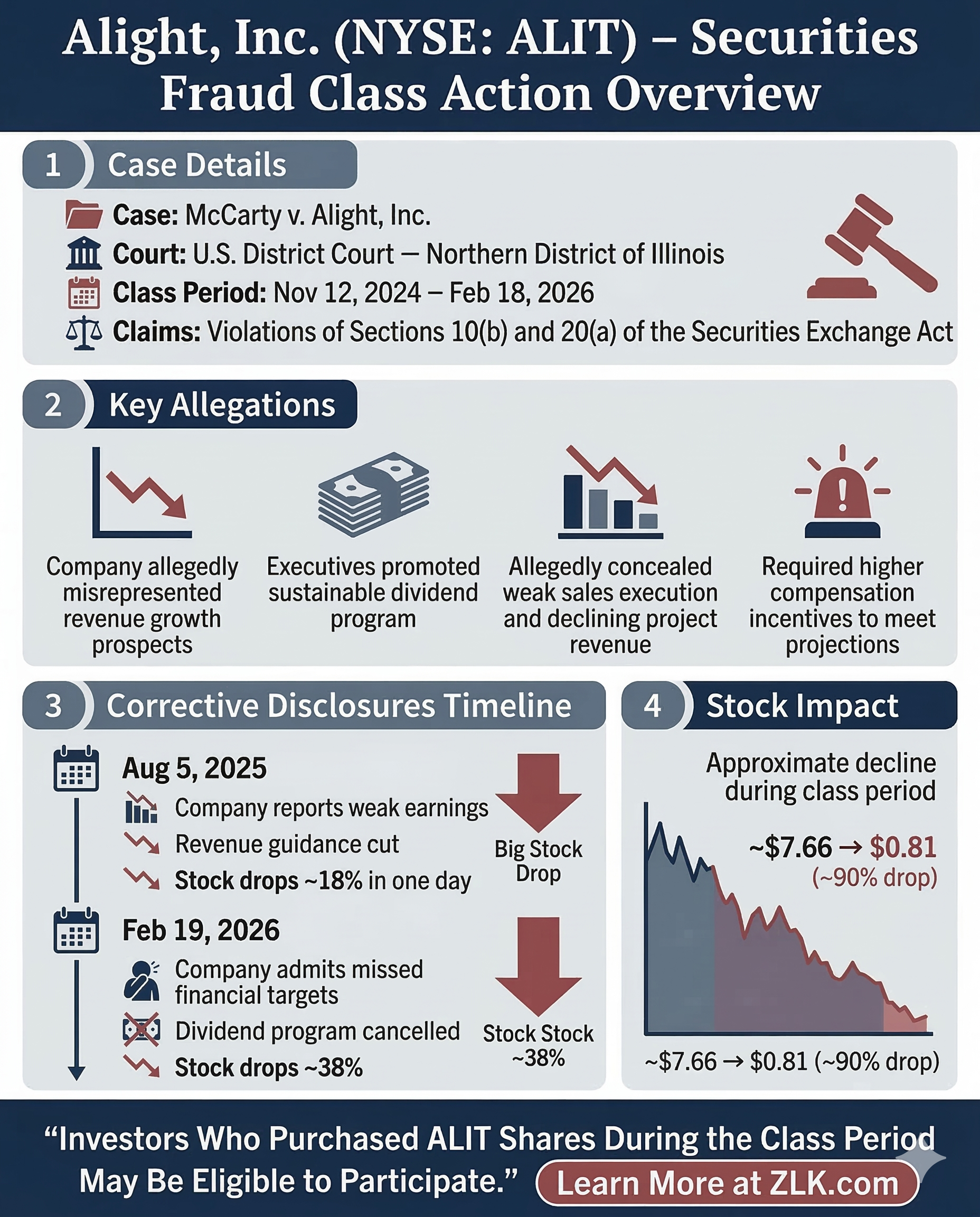
The Alight Inc lawsuit is a federal securities class action filed by plaintiff Jeremy McCarty against Alight, Inc., former CEO David D. Guilmette, and former CFO Jeremy J. Heaton. The complaint alleges that Defendants violated Sections 10(b) and 20(a) of the Securities Exchange Act of 1934 and SEC Rule 10b-5 by disseminating materially misleading business information about the Company's growth trajectory, execution capabilities, and the sustainability of its newly initiated quarterly dividend. According to the complaint, these misstatements artificially inflated ALIT's stock price during a class period that saw the stock lose approximately 90% of its value.
At the heart of this Alight shareholder lawsuit, according to the complaint, is a stark contrast: management repeatedly assured investors that Alight had the commercial team, pipeline strength, and operational discipline to return to profitable growth, while the Company allegedly was not equipped to execute on those promises without significantly higher compensation and incentive spending. According to the complaint, that alleged execution gap became more apparent on February 19, 2026, when new management disclosed additional operational shortfalls, increased compensation expense, and the cancellation of the dividend that prior management had described as a ‘commitment’ to shareholders. The lawsuit seeks to recover damages on behalf of all investors who purchased Alight common stock at artificially inflated prices during the Class Period.
Alight, Inc. (ALIT) Securities Lawsuit Case Details
Case Name: McCarty v. Alight, Inc. et al.
Case No.: 1:26-cv-02924
Jurisdiction: U.S. District Court, Northern District of Illinois
Filed on: March 16, 2026
Alight, Inc. (ALIT) Company Profile
According to the complaint, Alight, Inc. is a Delaware corporation headquartered in Chicago, Illinois. The Company is predominantly an employee benefits solutions provider that delivers technology-enabled services through the Alight Worklife cloud engagement platform. The platform offers integrated benefits administration, healthcare navigation, financial wellbeing, absence management, and retiree healthcare while providing employers with actionable insights through data, analytics, and AI. During the Class Period, Alight's common stock traded on the New York Stock Exchange under the ticker "ALIT."
Alight, Inc. (ALIT) Securities Lawsuit Class Period
The Class Period runs from November 12, 2024, to February 18, 2026.
According to the complaint, the period begins on the date Defendant Guilmette first presented his vision for Alight's future growth, announced the new quarterly dividend, and touted the Company's commercial momentum during the Q3 fiscal 2024 earnings call. The period ends the day before the final corrective disclosure on February 19, 2026, when Alight's new management revealed the full extent of the execution failures, earnings shortfall, and dividend cancellation.
Allegations in the Alight, Inc. (ALIT) Securities Class Action Lawsuit
The ALIT securities fraud class action traces a pattern of optimistic statements followed by repeated disappointments across five quarterly reporting periods.
November 12, 2024: The complaint alleges that CEO Guilmette used Alight's Q3 fiscal 2024 earnings call to paint a rosy picture of the Company's future. He highlighted his 40-plus years of industry experience and declared: "We are the best in the industry at all facets of this business, from digital through managing benefits complexity." He announced a $0.04 per share quarterly dividend, calling it a reflection of the Company's "commitment and shareholder feedback to consistently return capital via dividends and share repurchases over the long term." CFO Heaton echoed that the dividend signified their "commitment to a consistent return of capital."
February 20, 2025: The lawsuit alleges that Defendants issued fiscal 2025 guidance projecting revenue of $2,318 million to $2,388 million and adjusted EBITDA of $620 million to $645 million. Guilmette stated that "our operating trends today are vastly improved with full-year 2024 retention rates up 8 points compared to the prior year." Heaton projected ARR bookings of $130 million to $145 million, claiming the Company benefited from "a strong pipeline."
March 20, 2025: At Investor Day, Defendants set mid-term targets including 4% to 6% total annual revenue growth by 2027, approximately 30% adjusted EBITDA margin by 2027, and cumulative free cash flow of approximately $1 billion between 2025 and 2027. Guilmette asserted: "Our current assets and our current capabilities position us for commercial success."
May 8, 2025: Defendants reaffirmed fiscal 2025 guidance. When asked about macroeconomic impacts on deal cycles, Guilmette stated: "We've not really seen any material shift in the buying patterns to date." The complaint alleges these statements were false because Alight's sales team was not equipped to execute in accordance with management's expectations.
August 5, 2025 (First Partial Corrective Disclosure): The complaint alleges that on this date, Defendants revealed disappointing Q2 results and cut revenue guidance by approximately $47 million at the midpoint. Guilmette acknowledged that "our commercial execution to get deals across the line has not been sufficient" and that ARR bookings "was not at the level we expected." The Company also disclosed a $983 million non-cash goodwill impairment charge. The lawsuit alleges investors reacted immediately to this revelation.
Despite the August 5 disclosures, the complaint alleges Defendants continued misleading investors by expressing confidence in updated targets while failing to disclose the full extent of execution difficulties.
November 5, 2025: Alight cut guidance again, reducing revenue expectations to $2,252 million to $2,282 million and adjusted EBITDA to $595 million to $620 million. A second goodwill impairment charge of $1,338 million was recorded. Both Individual Defendants departed the Company during Q4 2025: Guilmette's exit was announced November 24, 2025 (effective December 31, 2025), and Heaton's was announced December 18, 2025 (effective January 9, 2026). The complaint alleges both were effectively forced out due to the issues underlying the lawsuit.
The Truth Emerges
On February 19, 2026, Alight’s new CEO, Rohit Verma, disclosed additional details about the Company’s 2025 underperformance that, according to the complaint, revealed the scope of the execution issues previously not fully disclosed to investors. During the Alight earnings miss February 2026 call, Verma stated plainly: "In 2025, we did not meet our internal financial targets and new bookings and renewals did not meet our expectations, leading us to miss our forecast to the market." He attributed the underperformance squarely to an execution problem, stating: "This is a change in the execution of the company. So the biggest piece that we need to tighten is around execution."
The financial results confirmed the damage. Full-year 2025 revenue came in at $2,262 million, a 3.0% decline. Project revenue fell 22% for the year. Adjusted EBITDA for Q4 was $178 million versus $217 million in the prior year period, adversely impacted by approximately $45 million in increased compensation expense that new management characterized as "critical to executing on our priorities." The Company also recognized an additional $803 million non-cash goodwill impairment charge, bringing the full-year total to $3,124 million. Perhaps most strikingly, the Company cancelled the quarterly dividend that Defendants had instituted barely a year earlier, stating there were "more efficient capital allocation activities" for driving long-term shareholder value.
Market Reaction
According to the complaint, the ALIT stock price collapse occurred across two corrective events. On August 5, 2025, ALIT fell from $5.13 to $4.19 per share, a decline of approximately 18.32% in a single trading day. On February 19, 2026, the stock fell from $1.31 to $0.81 per share, a decline of nearly 38%. Over the full Class Period, the stock had fallen approximately $6.85, or nearly 90%. The complaint notes that analysts at JP Morgan, UBS, D.A. Davidson, and Citi lowered their price targets following these disclosures. Citi called the situation "the classic definition of a value trap" and slashed its target to $1.00.
Next Steps
● The Court will issue its order for lead plaintiff and counsel in the weeks after submissions are due.
● The Court will then consider motion for class certification.
● The Court will later consider a Motion to Dismiss.
Disclaimer: This shareholder alert is for informational purposes only and does not constitute legal advice. Consult a qualified attorney for personalized guidance. No specific outcomes are guaranteed.
Check Eligibility
✓ No cost or obligation
✓ See if you qualify