
Expired
Lead Plaintiff Deadline
May 22, 2026
Choose your preferred way to stay informed of new case launches and settlement deadlines
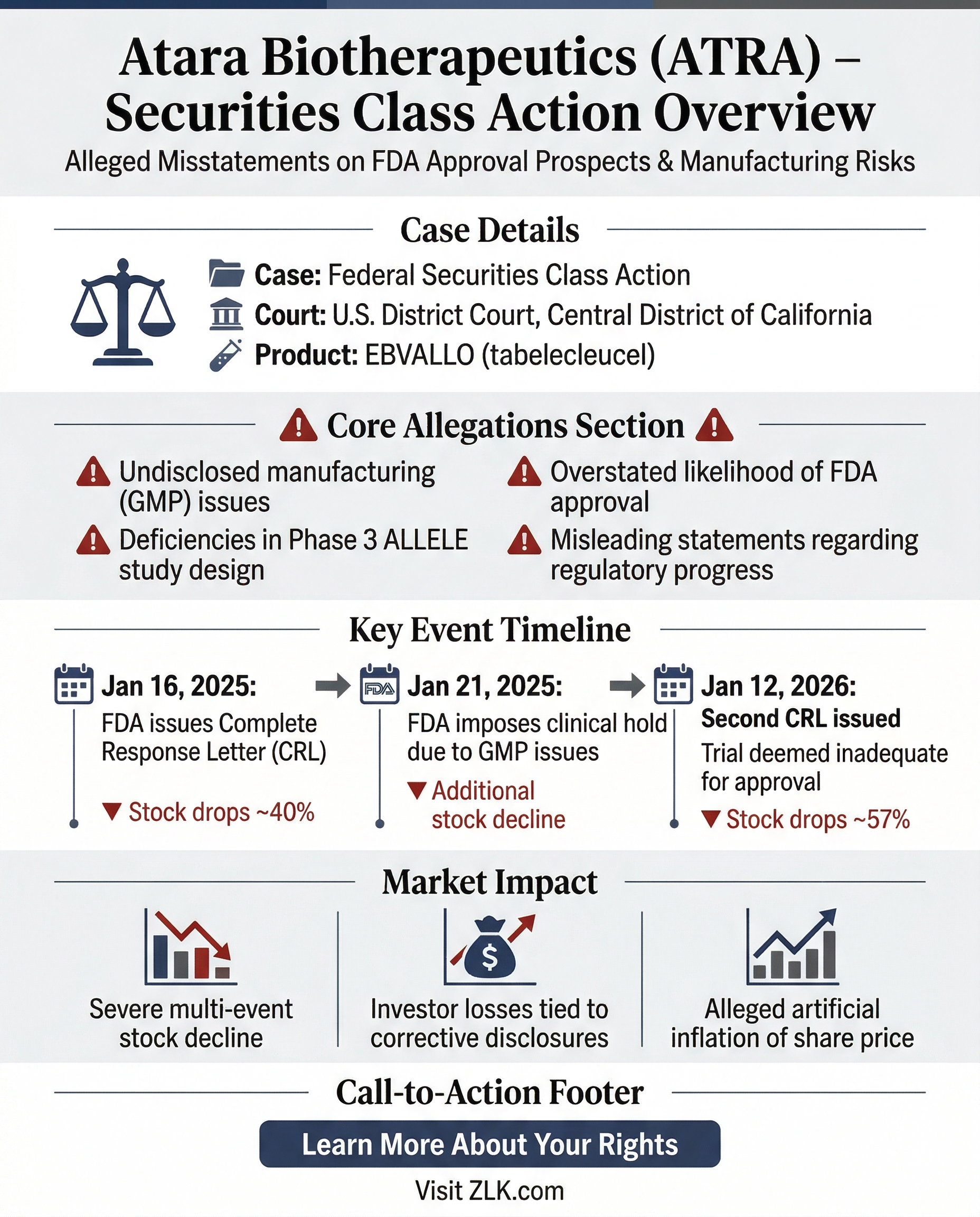
The filed complaint alleges that Atara Biotherapeutics, Inc. made materially false and/or misleading statements and/or failed to disclose that: (i) certain manufacturing issues, as well as deficiencies inherent in the ALLELE study, made it unlikely that the FDA would approve the tabelecleucel BLA; (ii) accordingly, tabelecleucel’s regulatory prospects were overstated; (iii) the aforementioned manufacturing issues also subjected Atara to a heightened risk of regulatory scrutiny, as well as jeopardized its ongoing clinical trials; (iv) all the foregoing was likely to have a significant negative impact on Atara’s business and financial condition; and (v) as a result, defendants’ public statements were materially false and/or misleading at all relevant times.
In order to be eligible to join the ATRA class action lawsuit, you must have incurred a loss on shares of Atara Biotherapeutics, Inc. purchased during the class period listed above.
If you suffered a loss in Atara Biotherapeutics, Inc. during the relevant time frame or pursuant to the relevant offering(s), you have until May 22, 2026 to request that the Court appoint you as lead plaintiff. Your ability to share in any recovery doesn't require that you serve as a lead plaintiff.
A securities fraud class action has been filed against Atara Biotherapeutics, Inc. (NASDAQ: ATRA) on behalf of investors who purchased or acquired securities between May 20, 2024 and January 9, 2026, under Sections 10(b) and 20(a) of the Securities Exchange Act of 1934 and SEC Rule 10b-5. Investors allege that the company and its executives misrepresented the regulatory prospects for tabelecleucel, a T-cell immunotherapy, by concealing manufacturing deficiencies and fundamental flaws in the clinical trial used to support approval from the U.S. Food and Drug Administration, including the accelerated approval pathway. The complaint alleges that manufacturing issues at a third-party facility and design defects in the ALLELE study made FDA approval unlikely, yet executives promoted the product's imminent approval and planned early 2025 launch. When the FDA issued two Complete Response Letters and later placed clinical holds on Atara’s active IND applications, Atara’s stock fell sharply across three separate disclosures, including declines of 40.5%, 7.91%, and 56.99%, according to the complaint.
Case Name: Jeremy Chin Zhi Kuang v. Atara Biotherapeutics, Inc., et al.
Case No.: 2:26-cv-03083
Jurisdiction: U.S. District Court, Central District of California
Filed on: March 23, 2026
Atara Biotherapeutics, a clinical-stage biopharmaceutical company develops therapies for patients with solid tumors, hematologic cancers, and autoimmune diseases in the United States and the United Kingdom. The company's lead product candidate is tabelecleucel (tab-cel, EBVALLO), a T-cell immunotherapy program classified as a biologic for the treatment of Epstein-Barr virus positive post-transplant lymphoproliferative disease, including adult and pediatric patients two years and older, with commercialization support from Pierre Fabre Médicament.
May 20, 2024 – January 9, 2026, inclusive.
All persons and entities other than Defendants that purchased or otherwise acquired Atara securities (ATRA) may be eligible to join the Atara Biotherapeutics, Inc. (ATRA) class action lawsuit, including common stock traded on NASDAQ.
The complaint names Atara Biotherapeutics, Inc. and four executives as defendants: AnhCo Thieu Nguyen (President and CEO since September 2024), Pascal Touchon (CEO during most of the class period and later Chairman), Eric Hyllengren (CFO and COO), and Yanina Grant-Huerta (Chief Accounting Officer). Investors allege these defendants promoted tabelecleucel's regulatory approval prospects for accelerated approval while concealing critical manufacturing problems at a third-party manufacturing facility and clinical trial deficiencies that made FDA approval unlikely for the EBVALLO Biologics License Application.
On May 20, 2024, as Atara submitted its Biologics License Application to the FDA for EBV+ post-transplant lymphoproliferative disease (EBV+PTLD), then-CEO Pascal Touchon called the BLA submission "a significant moment for Atara" and stated the company looked forward "to continued collaboration with the FDA on its review" and preparation "for the potential launch of this innovative therapy in the U.S." Two months later, on July 17, 2024, after the FDA accepted the BLA for priority review, Touchon described the acceptance as "a significant milestone" and said the company continued working "to help prepare for the potential launch in the U.S. in early 2025." On August 12, 2024, Touchon told investors the company was "making significant progress with the agency towards the target action date of January 15, 2025, while supporting our partner Pierre Fabre with their U.S. launch preparation." On November 12, 2024, new CEO AnhCo Thieu Nguyen characterized the first quarter of 2025 as "positioned to be transformational for the company, with the potential for FDA approval of tab-cel and transition of this business to our partner Pierre Fabre."
According to the complaint, these statements were materially false because manufacturing issues at a third-party facility and inherent deficiencies in the ALLELE study design, a single-arm trial, made FDA approval unlikely. The complaint alleges that these manufacturing problems subjected Atara to heightened regulatory scrutiny and jeopardized ongoing clinical trials, while the study defects in design, conduct, and analysis undermined the evidence needed for accelerated approval. Investors allege defendants knew or recklessly disregarded that tabelecleucel's regulatory prospects were overstated and that these issues would have a significant negative impact on the company's business and financial condition, in violation of Sections 10(b) and 20(a) of the Exchange Act and SEC Rule 10b-5.
The truth began surfacing on January 16, 2025, when Atara announced it received a Complete Response Letter from the FDA rejecting the tabelecleucel BLA, stating the application could not be approved in its present form. The company disclosed that the CRL was "solely related to observations as part of a standard pre-license inspection of a third-party manufacturing facility for EBVALLO." Five days later, on January 21, 2025, Atara revealed that the FDA had placed a clinical hold on the company's active Investigational New Drug applications due to "inadequately addressed GMP compliance issues identified during the pre-license inspection of the third-party manufacturing facility." These disclosures contradicted executives' repeated assurances about regulatory progress and launch readiness.
Nearly a year later, on January 12, 2026, the FDA issued a second Complete Response Letter, or CRL, that exposed deeper problems with the tabelecleucel application and reiterated that the BLA could not be approved in its present form. The agency stated that "the single arm ALLELE trial is no longer considered to be adequate to provide evidence of effectiveness for accelerated approval" and that "the trial's interpretability is confounded due to trial study design, conduct, and analysis." This revelation contradicted the company's longstanding representations that the ALLELE study supported approval and that launch was imminent.
The market reacted swiftly to each disclosure. On January 16, 2025, when Atara announced the first Complete Response Letter citing manufacturing facility issues, the stock price fell $5.33 per share, or 40.5%, to close at $7.83 per share. Five days later, on January 21, 2025, when the company disclosed the FDA's clinical hold due to GMP compliance issues, shares fell another $0.52 per share, or 7.91%, to close at $6.05 per share. The most severe decline occurred on January 12, 2026, when Atara revealed the second CRL stating the ALLELE trial was inadequate for approval. The stock plummeted $7.79 per share, or 56.99%, to close at $5.88 per share in a single-day move. Across these three disclosures, investors who purchased during the class period suffered substantial losses as the company's regulatory setbacks unfolded.
● The Court will issue its order for lead plaintiff and counsel in the weeks after submissions are due.
● The Court will then consider motion for class certification.
● The Court will later consider a Motion to Dismiss.
Disclaimer: This shareholder alert is for informational purposes only and does not constitute legal advice. Consult a qualified attorney for personalized guidance. No specific outcomes are guaranteed.
TOP