
Expired
Lead Plaintiff Deadline
Jun 15, 2026
Choose your preferred way to stay informed of new case launches and settlement deadlines
The filed complaint alleges that Babcock & Wilcox Enterprises, Inc. made materially false and/or misleading statements and/or failed to disclose that: (i) B&W’s largest shareholder, BRC, stood on both sides of the power generation contract and had close ties to B&W’s counterparty; (ii) Applied Digital did not need the products and services that B&W would purportedly supply pursuant to the power generation LNTP and contract; (iii) the foregoing, at the very least, would raise questions about the parties’ actual intent behind entering into the power generation LNTP and contract, including whether the Company is likely to recognize revenues from these agreements; (iv) accordingly, the business and financial prospects of the Company were overstated; and (v) as a result, defendants’ public statements were materially false and misleading at all relevant times.
In order to be eligible to join the BW class action lawsuit, you must have incurred a loss on shares of Babcock & Wilcox Enterprises, Inc. purchased during the class period listed above.
If you suffered a loss in Babcock & Wilcox Enterprises, Inc. during the relevant time frame or pursuant to the relevant offering(s), you have until June 15, 2026 to request that the Court appoint you as lead plaintiff. Your ability to share in any recovery doesn't require that you serve as a lead plaintiff.
|
Babcock & Wilcox Class Action Summary |
|
|
Company |
Babcock & Wilcox Enterprises, Inc. (NYSE: BW) |
|
Lead Plaintiff Deadline |
June 15, 2026 |
|
Class Period |
November 5, 2025 – March 11, 2026 |
|
Stock Drop |
March 12, 2026 – BW fell $1.71 (11.59%) to $13.05 |
|
Lawsuit Type |
Securities Class Action |
A securities class action lawsuit has been filed against Babcock & Wilcox Enterprises, Inc. (NYSE: BW) and two of its senior executives in the United States District Court for the Northern District of Ohio on behalf of investors who purchased or acquired BW securities between November 5, 2025 and March 11, 2026. The complaint alleges that defendants made materially false and misleading statements about the company's business prospects by repeatedly touting a purported $2.4 billion power generation contract without disclosing that BW's largest shareholder, BRC Group Holdings, stood on both sides of the transaction and maintained close ties to BW's counterparty. When a short seller report exposed these undisclosed relationships and questioned whether BW would ever recognize revenue from the contract, BW's stock price fell $1.71 per share, or 11.59%, to close at $13.05 on March 12, 2026, causing significant losses for investors who purchased shares at artificially inflated prices.
Babcock & Wilcox Enterprises, Inc., along with its subsidiaries, delivers energy and emissions-control products and services to industrial, electric utility, municipal, and other customers across the United States, Canada, the United Kingdom, Indonesia, and the Philippines. The company's common stock, 6.50% senior notes due 2026, and 7.75% Series A cumulative perpetual preferred stock trade on the New York Stock Exchange under the ticker symbols BW, BWNB, and BW PRA, respectively.
November 5, 2025 – March 11, 2026, inclusive.
Investors who purchased or acquired Babcock & Wilcox Enterprises, Inc. (NYSE: BW) securities during the Class Period may be entitled to seek recovery under the federal securities laws.
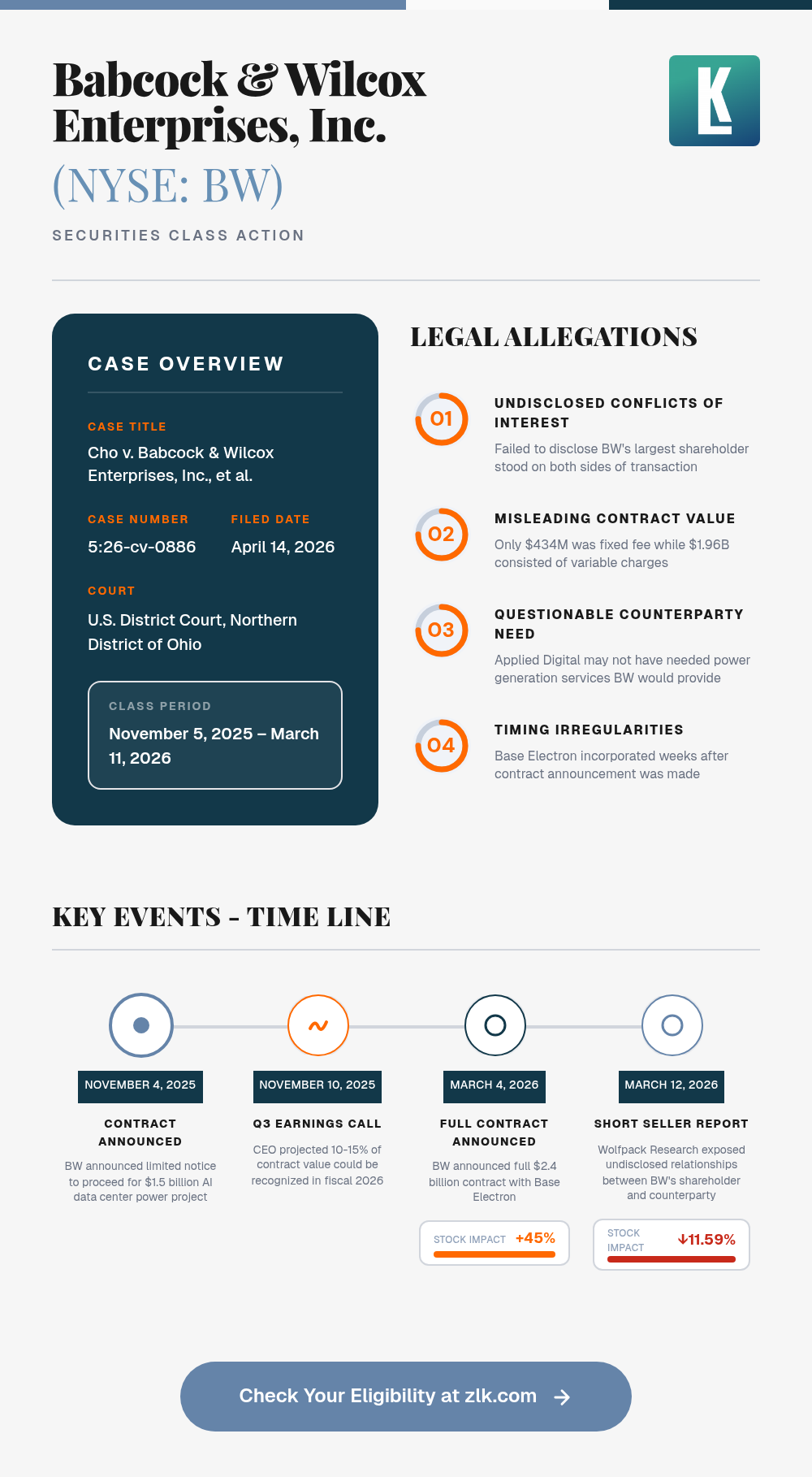
The complaint alleges that throughout the Class Period, defendants made materially false and misleading statements about the value and legitimacy of a major power generation contract that BW presented as a transformational entry into the AI data center power supply market. On November 4, 2025, the company announced a limited notice to proceed for a project valued at over $1.5 billion to deliver one gigawatt of power for an AI factory owned by Applied Digital Corporation. Defendant Kenneth Young, BW's Chairman and CEO, described the deal's impact as "profound," claiming it added over $3 billion to the company's pipeline and brought the total global pipeline to over $10 billion. Defendants simultaneously entered into an at-the-market offering, raising $67.5 million in just two days, capital Defendants explicitly connected to the power generation deal.
According to the complaint, defendants continued to amplify the significance of the contract through multiple SEC filings, press releases, and an earnings conference call. During the Q3 earnings call on November 10, 2025, Defendant Young told investors that BW could recognize between 10% and 15% of the projected $1.5 billion contract value in fiscal year 2026, representing "significant upside" to the company's existing guidance of $70 million to $85 million in adjusted EBITDA. Chief Financial Officer Cameron Frymyer echoed these projections while also announcing that despite initially promising to pause the at-the-market offering, defendants had decided to resume share sales. On March 4, 2026, BW announced it had received full notice to proceed on a $2.4 billion design-build agreement with Base Electron, described as an independent power producer "backed by Applied Digital," sending BW shares up 45% in a single session.
The complaint alleges defendants failed to disclose critical facts that undermined the legitimacy of these representations. BW's largest shareholder, BRC Group Holdings (formerly B. Riley Financial), stood on both sides of the power generation contract: BRC's Co-CEO and Chairman, Bryant R. Riley, was also a director of Base Electron, and Base Electron's registered address matched BRC's headquarters rather than Applied Digital's. Base Electron itself was not incorporated until December 23, 2025, seven weeks after defendants announced the limited notice to proceed with a counterparty that did not yet exist. Meanwhile, Applied Digital's existing data center projects had already secured power through conventional grid agreements, calling into question whether Applied Digital even needed the power generation services BW would purportedly supply.
The complaint further alleges that the purported $2.4 billion contract value was misleading because only approximately $434 million was a fixed fee, while the remaining $1.96 billion consisted of variable charges and other undisclosed amounts. Moreover, Applied Digital could unilaterally terminate its guarantee of Base Electron's obligations under the agreement for as little as $50 million. BRC capitalized on the inflated stock price by selling its entire directly-held position in BW common stock for approximately $10.4 million at $9 per share, 140% above BW's closing price on the last trading session before the power generation deal was announced.
On March 12, 2026, Wolfpack Research published a short report that exposed the undisclosed relationships at the heart of the power generation contract. The report revealed that BRC Co-CEO and Chairman Bryant Riley was a director of Base Electron, that Base Electron's registered address matched BRC's headquarters rather than Applied Digital's, and that Base Electron's articles of incorporation were not filed until December 23, 2025, weeks after BW had announced the limited notice to proceed. Wolfpack alleged that "the ultimate purpose of this deal may be to provide exit liquidity for" BRC, pointing to BRC's $10.4 million sale of its entire directly-held BW position at prices inflated by the very deal announcements defendants had promoted.
The Wolfpack report also undermined the premise that Applied Digital needed the power BW would purportedly generate. According to the report, Applied Digital's more established data center projects had already secured power through conventional grid agreements, and its prospective projects appeared likely to rely on existing grid power rather than new power plants that BW would construct. Combined with the revelation that Applied Digital could terminate its guarantee of Base Electron's obligations for as little as $50 million, the report's findings called into question whether BW was ever likely to recognize meaningful revenue from the contract that defendants had valued at $2.4 billion and used to justify a 470% increase in reported backlog.
Following publication of the Wolfpack Research report on March 12, 2026, BW shares fell $1.71 per share, or 11.59%, to close at $13.05. The decline erased a significant portion of the gains BW had accumulated since defendants first announced the power generation deal on November 4, 2025, when the stock had last closed at $3.74 per share in the prior trading session. The stock had risen over 198% to $11.15 by February 3, 2026, and surged an additional 45% to $11.80 on March 4, 2026, when defendants announced the full $2.4 billion contract, gains that the complaint alleges were built on materially false and misleading statements about the nature and legitimacy of the underlying transaction.
● The Court will issue its order for lead plaintiff and counsel in the weeks after submissions are due.
● The Court will then consider motion for class certification.
● The Court will later consider a motion to dismiss.
TOP