
Expired
Lead Plaintiff Deadline
Aug 7, 2026
Choose your preferred way to stay informed of new case launches and settlement deadlines
The filed complaint alleges that BitGo Holdings, Inc. made materially false and/or misleading statements and/or failed to disclose that: (i) defendants understated the scope and severity of the risk that declining digital asset prices posed to Company’s business and financial performance; (ii) consequently, defendants’ statements regarding, inter alia, BitGo’s financial performance and business prospects as a public company lacked a reasonable basis; and (iii) as a result, the offering documents and defendants’ public statements throughout the Class Period were materially false and/or misleading and/or failed to state information required to be stated therein.
In order to be eligible to join the BTGO class action lawsuit, you must have incurred a loss on shares of BitGo Holdings, Inc. purchased during the class period listed above.
If you suffered a loss in BitGo Holdings, Inc. during the relevant time frame, you have until August 7, 2026 to request that the Court appoint you as lead plaintiff. Your ability to share in any recovery doesn't require that you serve as a lead plaintiff.
|
BTGO Class Action Summary |
|
|
Company |
BitGo Holdings, Inc. (NYSE: BTGO) |
|
Lead Plaintiff Deadline |
August 7, 2026 |
|
Class Period |
January 22, 2025 – May 13, 2026 |
|
Stock Drop |
March 27, 2026 – BTGO fell $1.43 (15.71%) to $7.67; May 14, 2026 – BTGO fell $2.05 (17.2%) to $9.86 |
|
Lawsuit Type |
Securities Class Action |
A securities class action lawsuit has been filed against BitGo Holdings, Inc. (NYSE: BTGO) and several of its officers and directors in the United States District Court for the Eastern District of New York. The complaint, filed on June 8, 2026, asserts claims under both Section 11 of the Securities Act of 1933 in connection with BitGo's January 22, 2026 initial public offering at $18.00 per share, and Section 10(b) of the Securities Exchange Act of 1934 covering a class period from January 22, 2025 through May 13, 2026. The complaint alleges that BitGo's Offering Documents and public statements throughout the Class Period were materially false and misleading because defendants understated the scope and severity of the risk that declining digital asset prices posed to the company's business and financial performance. After disclosures that the complaint characterizes as corrective, including reported net losses and deteriorating Digital Asset Sales margins tied in part to falling digital asset prices, BTGO shares fell 15.71% on March 27, 2026 and 17.2% on May 14, 2026.
BitGo Holdings, Inc. is a digital asset infrastructure company that provides a platform enabling customers to store, trade, and stake digital assets. At the time of its IPO, the company generated revenue through several segments, including Digital Asset Sales (derived from trading volume on its platform) and Staking (comprising rewards issued by blockchain protocols). BitGo is headquartered in Sioux Falls, South Dakota, and its Class A common stock trades on the New York Stock Exchange under the ticker symbol BTGO.
January 22, 2025 through May 13, 2026
Investors who purchased BitGo Holdings securities during the class period, or who purchased BitGo Class A common stock pursuant or traceable to the Offering Documents issued in connection with BitGo's January 22, 2026 initial public offering, might be eligible to join the BitGo Holdings securities class action lawsuit.
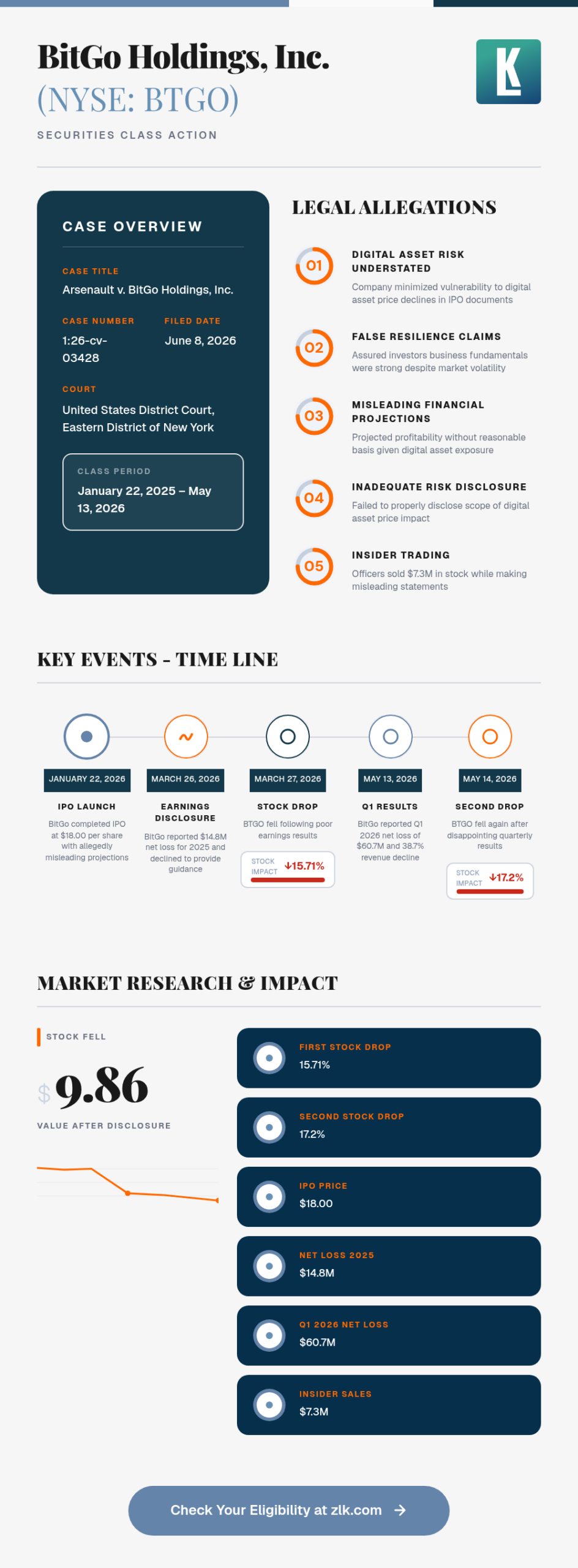
The complaint alleges that BitGo Holdings and its officers and directors made materially false and misleading statements in the company's IPO Offering Documents and in subsequent public statements throughout the Class Period regarding the resilience of BitGo's business model and the risks posed by digital asset price volatility. The Offering Documents, which were declared effective on January 21, 2026, included a letter from CEO and Co-Founder Michael Belshe projecting that "everything will be a digital asset" and asserting that the digital asset market represented a multi-trillion dollar opportunity. The documents repeatedly assured investors that "the fundamentals of our business continue to be strong and resilient over time" despite acknowledging the inherent volatility of digital asset prices. The complaint alleges these reassurances effectively negated the cautionary language about digital asset price risk, leaving investors with a materially misleading picture of the company's vulnerability to market downturns.
According to the complaint, the Offering Documents provided preliminary financial estimates for fiscal year 2025 that projected profitability, including estimated profit from operations between $3.2 million and $3.5 million, representing a claimed $10.3 million improvement from the prior year's operating loss. The documents highlighted that assets on platform had reached $104.0 billion by the quarter ended September 30, 2025, and that digital asset sales revenue was estimated between approximately $15.476 billion and $15.522 billion for fiscal year 2025. Plaintiff alleges these projections and metrics lacked a reasonable basis because defendants understated the severity of the risk that declining digital asset prices posed to BitGo’s business and financial performance.
Following the IPO, defendants continued to issue statements that the complaint characterizes as materially misleading. On January 22, 2026, defendant Belshe declared BitGo was "uniquely positioned" to navigate the road ahead. On January 29, 2026, while announcing the company's approval as a federally chartered national trust bank, Belshe stated that "digital assets are entering a new era where trust, regulation, and resilience are foundational." Subsequent press releases in February and March 2026 touted partnership expansions and referenced BitGo's "longstanding foundation of trust." The complaint alleges these statements failed to disclose the impact of falling digital asset prices on BitGo’s business, including lower Digital Asset Sales margins and declines in staking revenue. Even during the fiscal year 2025 earnings call on March 26, 2026, after acknowledging that BitGo's net loss was "materially driven by declines in digital asset prices," defendant Belshe continued to minimize the risk, claiming BitGo did not have "the same kind of exposure to digital assets that retail platforms do" and asserting that the company's total addressable market would see "huge growth" in the following two years.
The complaint further alleges that the individual defendants, including Belshe, Chief Financial Officer Edward Reginelli, and Chief Revenue Officer Chen Fang, enriched themselves through insider sales of 436,645 shares of BitGo common stock totaling over $7.3 million in proceeds during the Class Period, which the complaint cites as evidence of motive and opportunity. Defendants' failure to adequately disclose the scope and severity of digital asset price risk allegedly violated Item 105 of SEC Regulation S-K, which requires companies to concisely explain how each material risk factor affects the company or securities being offered.
The first significant corrective disclosure came on March 26, 2026, when BitGo filed its annual report on Form 10-K for fiscal year 2025. The filing revealed that BitGo had swung from $156.6 million in net income for 2024 to a net loss of $14.8 million for 2025, a reversal the company attributed to "declines in digital asset prices impacting the Company's Bitcoin treasury." The Digital Asset Sales segment reported a quarterly margin of just 0.21%, less than half the 0.47% margin recorded in the prior year's fourth quarter. During the accompanying earnings call, defendant Reginelli disclosed that assets on platform had decreased 9% year over year to $81.6 billion, while assets staked had plummeted 51% to $15.6 billion, with both declines "driven by lower digital asset prices." Staking revenue in the fourth quarter fell approximately 64% year over year. Compounding investor concern, defendants declined to provide explicit guidance for the first fiscal quarter of 2026, even though only five days remained in the quarter, instead offering only vague commentary about "challenging" macroeconomic conditions that had "carried into the first quarter." Multiple analysts responded by cutting their price targets, with Deutsche Bank, Goldman Sachs, Compass Point, Rosenblatt, and Mizuho all reducing their estimates and citing weaker-than-expected trading margins, declining digital asset prices, and limited forward visibility.
The second corrective disclosure occurred on May 13, 2026, when BitGo reported first quarter 2026 results showing further deterioration. Total revenue of $3.8 billion represented a 38.7% decline from the preceding quarter, and the company reported a net loss of $60.7 million, compared to a net loss of $25.7 million in the same quarter one year earlier. BitGo attributed the results to "a weaker crypto market environment" and acknowledged that the net loss was "primarily driven by non-cash mark-to-market impacts related to the Company's Bitcoin treasury, as well as elevated IPO-related stock-based compensation expense." The complaint alleges these disclosures undermined defendants’ repeated assurances that BitGo’s business fundamentals were “strong and resilient,” as well as statements suggesting BitGo’s infrastructure-focused model had less direct exposure to digital asset prices than retail platforms.
Following the March 26, 2026 earnings disclosure, BitGo's stock price fell $1.43 per share, or 15.71%, to close at $7.67 per share on March 27, 2026. This represented a decline of more than 57% from the $18.00 IPO offering price. The complaint alleges this decline reflected the market’s reaction to information that undermined defendants’ earlier statements about BitGo’s resilience. After the May 13, 2026 disclosure of first quarter 2026 results, BTGO fell an additional $2.05 per share, or 17.2%, to close at $9.86 on May 14, 2026. After the May 14, 2026 decline, BTGO closed approximately 45% below the $18.00 IPO price. The complaint alleges these events caused significant losses for investors who purchased shares in or traceable to the IPO or during the Class Period.
● Lead Plaintiff Deadline: August 7, 2026
● After the lead plaintiff deadline, the Court will consider any lead plaintiff motions.
● Defendants may file a motion to dismiss.
● If the case proceeds, the Court may later consider class certification.
Disclaimer: This shareholder alert is for informational purposes only and does not constitute legal advice. Consult a qualified attorney for personalized guidance. No specific outcomes are guaranteed.
TOP