Enphase Energy, Inc. Class Action Lawsuit – ENPH
Introduction to Enphase Energy, Inc. (ENPH) Securities Class Action Lawsuit
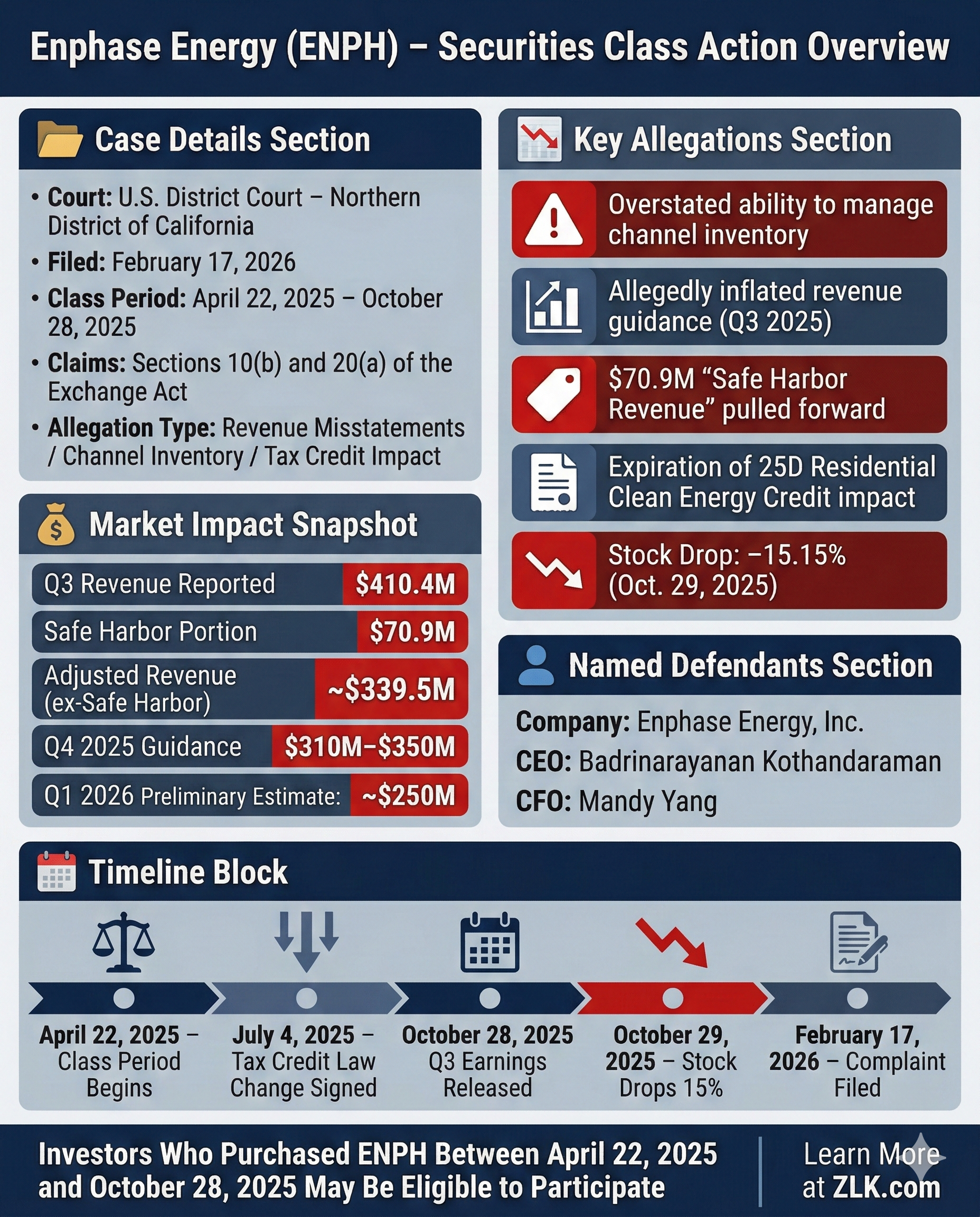
A securities fraud class action has been filed against Enphase Energy, Inc. (NASDAQ: ENPH) and two executives under the Securities Exchange Act of 1934 covering the period from April 22, 2025 through October 28, 2025.
Investors allege the company misrepresented its ability to manage channel inventory levels and mitigate the impact of expiring tax credits, including the Internal Revenue Code Section 25D Residential Clean Energy Credit, painting an overly optimistic picture of its operational control and financial prospects. According to the complaint, channel inventory was actually severely elevated and the company was unprepared for the demand collapse following tax credit expiration, which had provided a 30% deduction until its termination on December 31, 2025, forcing destocking and dramatic revenue guidance cuts. As a result of these allegedly false statements and subsequent corrective disclosures, investors suffered significant losses when the truth emerged, after ENPH securities had traded at artificially inflated prices.
“Most ENPH shareholders never file or join the class action, which means they miss out on potential recovery funds,” said Attorney Joseph Levi.
Enphase Energy, Inc. (ENPH) Securities Lawsuit Case Details
Case Name: Tripathi v. Enphase Energy, Inc. et al.
Case No.: 4:26-cv-01380-JST
Jurisdiction: U.S. District Court, Northern District of California
Filed on: February 17, 2026
Enphase Energy, Inc. (ENPH) Company Profile
Enphase Energy is a global energy technology company headquartered in Fremont, California founded in March 2006, focusing on solutions for solar generation, storage, and communication through its microinverter technology and integrated home energy solutions. The company partners with solar and battery financing companies that offer third-party ownership arrangements to homeowners, including lease and power purchase agreements in the residential clean energy market and is publicly traded on the NASDAQ (NASDAQ: ENPH) with a product portfolio that includes battery storage systems.
Enphase Energy, Inc. (ENPH) Securities Lawsuit Class Period
April 22, 2025 - October 28, 2025, inclusive.
All persons and entities other than defendants that purchased or otherwise acquired Enphase Energy securities (ENPH shares traded on the NASDAQ) during the Class Period are eligible class members and may be eligible to join the Enphase Energy, Inc. (ENPH) class action lawsuit.
Allegations in the Enphase Energy, Inc. (ENPH) Securities Class Action Lawsuit
The complaint targets Enphase Energy, Inc., President and Chief Executive Officer Badrinarayanan Kothandaraman, and Executive Vice President and Chief Financial Officer Mandy Yang for allegedly making materially false statements about the company's channel inventory management and ability to weather policy changes affecting the solar industry, in violation of Sections 10(b) and 20(a) of the Securities Exchange Act of 1934 and Rule 10b-5.
On April 22, 2025, during the first quarter earnings call, Kothandaraman acknowledged that channel inventory had risen above target levels due to declining sell-through, but assured investors the recovery path was simple, reduce shipments and allow seasonal demand in the second quarter to naturally draw down excess inventory. He stated that when sell-through declined more than anticipated, inventory could go slightly up, but with discipline it would come back quickly. The company portrayed elevated inventory as a temporary, manageable situation within normal business cycles and minimized the risk that elevated channel inventory would result in lower shipments.
Throughout the second quarter, management continued to project confidence in its inventory control and market positioning.
On July 22, 2025, Kothandaraman reported that battery channel inventory had returned to normal levels while microinverter inventory remained only slightly elevated despite weakening demand signals in the solar photovoltaic industry. He emphasized the company's deep relationships with third-party financing customers and long-tail installers, claiming these partnerships would prevent overall market erosion as the industry adjusted to changing tax incentives linked to Internal Revenue Code Section 25D, also known as the Residential Clean Energy Credit. When pressed by analysts about channel levels, Kothandaraman was emphatic, stating the company was in very good shape in channel management and that lessons learned from previous years meant they would never again reach problematic inventory levels. He assured investors that any reference to slightly elevated inventory meant only slightly above the eight to ten week target range, and that increased demand from the expiring 25D tax credit would draw down channel inventory to reasonable levels by year end even as microinverter inventory and battery storage shipments required careful management.
According to the complaint, these assurances concealed the reality that Enphase had lost control of its channel inventory and dramatically underestimated the negative impact of the 25D tax credit expiration which provided a 30% deduction until its termination on December 31, 2025. The company allegedly overstated its operational capabilities and financial prospects while inventory problems worsened and demand signals deteriorated throughout the class period and failed to disclose material facts necessary to make its statements about inventory and revenue projections not misleading.
The Truth Emerges
The alleged deception unraveled on October 28, 2025, when Enphase reported third quarter results in a corrective disclosure and provided fourth quarter 2025 guidance that shocked investors. Management revealed the company expected 2025 to close on a weak note, with elevated channel inventory forcing reduced battery storage shipments in the fourth quarter as channel inventory levels affected battery storage systems and microinverter supply to partners.
Kothandaraman admitted the company was reducing product shipments to the channel in order to destock heading into 2026, directly contradicting his earlier denials that Enphase would engage in destocking or undershipment practices. He also acknowledged the company anticipated a larger-than-normal seasonal decline following the expiration of the tax credit, the Residential Clean Energy Credit under Section 25D terminating on December 31, 2025, undermining previous claims about the company's ability to mitigate tax credit impacts through installer relationships and market positioning and signaling pressure on first quarter 2026 revenue.
The guidance provided for the fourth quarter ranged from $310.0 million to $350.0 million, falling well below analyst estimates of $374.4 million to $383 million. The third quarter results themselves included $70.9 million classified as safe harbor revenue not contemplated in prior guidance, meaning the company effectively missed its own projections without this one-time boost. These revelations exposed that the inventory situation was far more severe than management had portrayed and that the company lacked the market control it had claimed during earnings calls throughout the class period as channel inventory resulted in lower shipments and revenue shortfalls.
Market Reaction
On October 29, 2025, following the earnings announcement and conference call and the corrective disclosure, Enphase's stock price fell $5.56 per share, or 15.15%, closing at $31.14 per share on the NASDAQ. The sharp sell-off reflected investor reaction to the significant guidance miss, the revelation of severe channel inventory problems requiring destocking, and management's admission that tax credit expiration would cause larger-than-normal revenue declines, contradicting months of assurances about operational control and market resilience and marking a substantial stock price decline tied to the securities class action allegations.
Next Steps
● The Court will issue its order for lead plaintiff and counsel in the weeks after submissions are due.
● The Court will then consider motion for class certification.
● The Court will later consider a Motion to Dismiss.
Disclaimer: This shareholder alert is for informational purposes only and does not constitute legal advice. Consult a qualified attorney for personalized guidance. No specific outcomes are guaranteed.
Check Eligibility
✓ No cost or obligation
✓ See if you qualify