Eos Energy Enterprises, Inc. Class Action Lawsuit – EOSE
Introduction to Eos Energy Enterprises, Inc. (EOSE) Securities Class Action Lawsuit
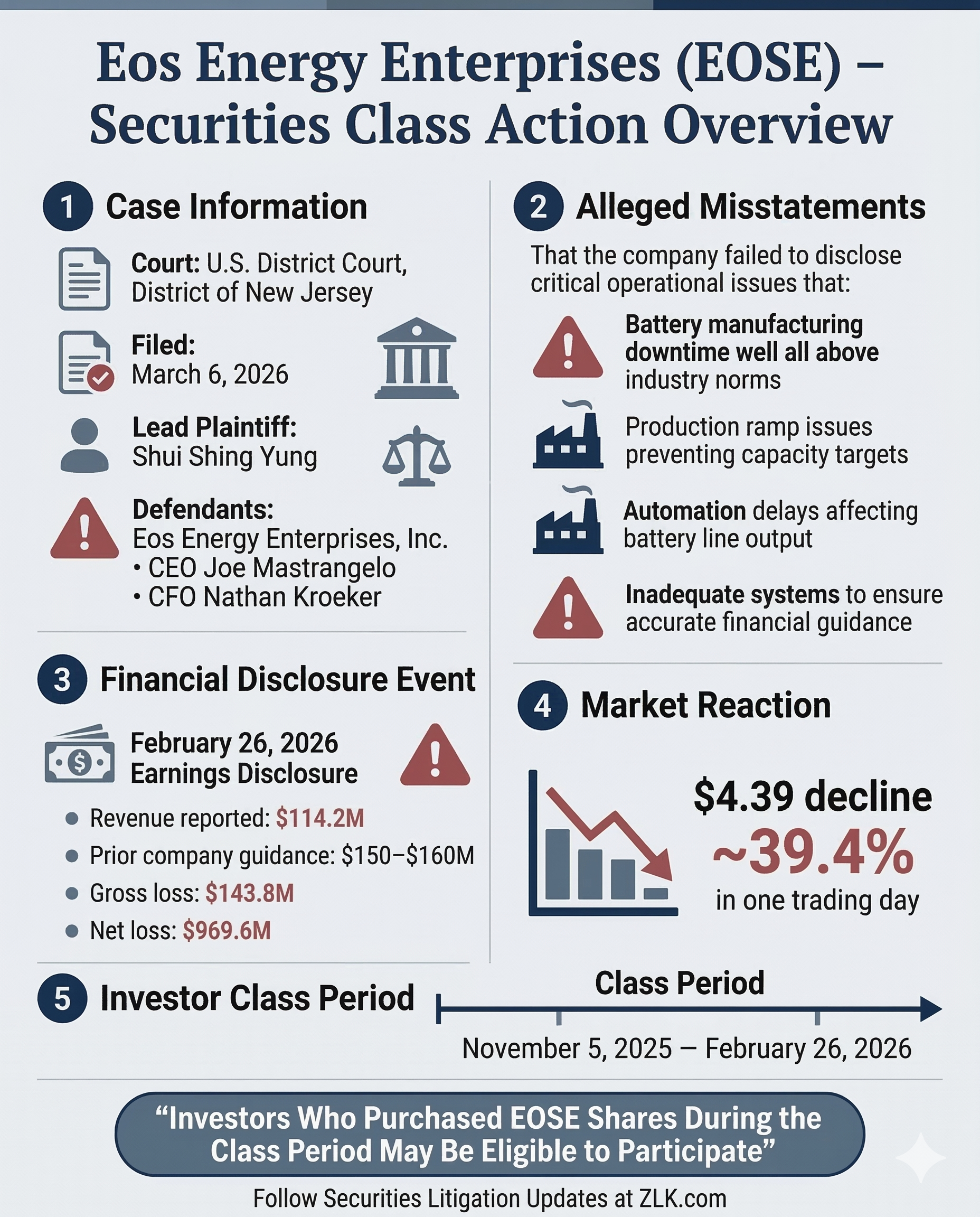
A securities fraud class action has been filed against Eos Energy Enterprises, Inc. (NASDAQ: EOSE) and two of its top executives for alleged violations of Sections 10(b) and 20(a) of the Securities Exchange Act of 1934 and Rule 10b-5 on behalf of investors who purchased company securities between November 5, 2025 and February 26, 2026. Investors allege the company misrepresented its production capabilities, manufacturing automation progress, and revenue guidance, including previously issued full-year guidance of $150 million to $160 million while promoting record quarterly growth and ambitious capacity targets. The complaint alleges that behind these optimistic projections, the company was experiencing severe battery line downtime running well above industry norms, delays in automated production quality, and an inability to achieve the ramp in production and capacity utilization required to meet previously issued guidance. When the company disclosed these operational failures on February 26, 2026, revealing full-year revenue that fell $36 million to $46 million short of guidance, the stock plummeted 39.4% in a single day, erasing significant shareholder value and triggering investor losses.
Eos Energy Enterprises, Inc. (EOSE) Securities Lawsuit Case Details
Case Name: Shui Shing Yung v. Eos Energy Enterprises, Inc., et al.
Case No.: 2:26-cv-02372
Jurisdiction: U.S. District Court, District of New Jersey
Filed on: March 6, 2026
Eos Energy Enterprises, Inc. (EOSE) Company Profile
Eos Energy Enterprises, Inc., with principal executive offices in Edison, New Jersey, designs, manufactures, and markets zinc-based battery energy storage systems intended for utility-scale commercial and industrial applications.
Eos Energy Enterprises, Inc. (EOSE) Securities Lawsuit Class Period
November 5, 2025 – February 26, 2026, inclusive.
This lawsuit seeks to represent all persons and entities that purchased or otherwise acquired Eos Energy (EOSE) securities during the Class Period and suffered damages.
Allegations in the Eos Energy Enterprises, Inc. (EOSE) Securities Class Action Lawsuit
The complaint targets Eos Energy Enterprises, Inc., along with Chief Executive Officer Joe Mastrangelo and Chief Financial Officer Nathan Kroeker, alleging they misled investors by making materially false and misleading statements about the company's manufacturing capabilities and financial prospects during a critical production ramp period.
On November 5, 2025, the company announced record quarterly revenue of $30.5 million, touting a 100% increase from the prior quarter and claiming production efficiencies and capacity utilization continued to improve. That same day, Eos reaffirmed full-year revenue guidance of $150 million to $160 million, emphasizing that it had advanced subassembly automation at its Turtle Creek facility with 88% of bipolar lines in commercial production, positioning the company to ramp production to a rate of two gigawatt-hours in annualized production capacity by year-end and more than triple fourth-quarter output.
During this period, the company continued promoting its manufacturing transition to automated bipolar production. On November 17, 2025, in its Form 10-Q filing, Eos stated that the transition to its Z3 battery was progressing as planned, with the first fully automated manufacturing line installed and in commercial production as part of its automated bipolar production, introducing a new mechanical design aimed at improving performance, reducing costs, and enhancing manufacturability. These statements painted a picture of a company successfully executing its automation strategy and positioned for significant growth.
According to the complaint, the reality behind these optimistic projections was starkly different. Investors allege the company was unable to achieve the production ramp required to meet its guidance, reflecting capacity utilization shortfalls, experiencing battery line downtime running well above industry norms, the design intent of the line, and internal forecasts. The complaint further alleges the company faced delays in getting its automated bipolar production to hit quality targets, and that inadequate systems and processes prevented Eos from ensuring reasonably accurate guidance and timely, accurate public disclosures. As a result, investors allege the defendants' positive statements about the company's business, operations, and prospects were materially misleading, and that revenue guidance lacked a reasonable basis.
The Truth Emerges
The truth began surfacing on February 26, 2026, when Eos Energy announced fourth quarter and full-year 2025 results, including Q4 revenue of $58.0 million, below analyst expectations of roughly $93 million according to market estimates. The company reported full-year 2025 revenue of $114.2 million, falling far short of its previously issued guidance of $150 million to $160 million. The company also disclosed a gross loss of $143.8 million, a net loss attributable to shareholders of $969.6 million, and an adjusted EBITDA loss of $219.1 million, acknowledging that the full year's revenue was below expectations and that its capacity milestone for 2 GWh annualized production was reached five weeks later than initially planned.
During the earnings call that day, Chief Operating Officer John Mahaz disclosed that certain "issues prevented us from delivering our commitments". He disclosed that three very fixable issues prevented the company from delivering its commitments: an isolated supplier nonperformance that cost a week of production, automated bipolar production taking longer than expected to hit quality targets which drove rework and lost revenue, and battery line downtime running well above industry norms. Mahaz admitted that while best-in-class operations should run at roughly 10% equipment downtime, as the company pushed utilization higher throughout the year, downtime was running in the mid-30% range. These admissions directly contradicted the company's prior statements about production efficiencies improving and automated manufacturing progressing as planned.
Market Reaction
On February 26, 2026, following the disclosure of the operational failures and missed revenue guidance, Eos Energy's stock price (NASDAQ: EOSE) fell $4.39, or 39.4%, to close at $6.74 per share on unusually heavy trading volume on the NASDAQ. The single day collapse reflected investor reaction to disclosures that battery line downtime was running well above industry norms and that automated bipolar production took longer than expected to meet quality targets, which led to rework and lost revenue.
Next Steps
● The Court will issue its order for lead plaintiff and counsel in the weeks after submissions are due.
● The Court will then consider motion for class certification.
● The Court will later consider a Motion to Dismiss.
Disclaimer: This shareholder alert is for informational purposes only and does not constitute legal advice. Consult a qualified attorney for personalized guidance. No specific outcomes are guaranteed.
Check Eligibility
✓ No cost or obligation
✓ See if you qualify