Gartner, Inc. Class Action Lawsuit - IT
Introduction to Gartner, Inc. (IT) Securities Class Action Lawsuit
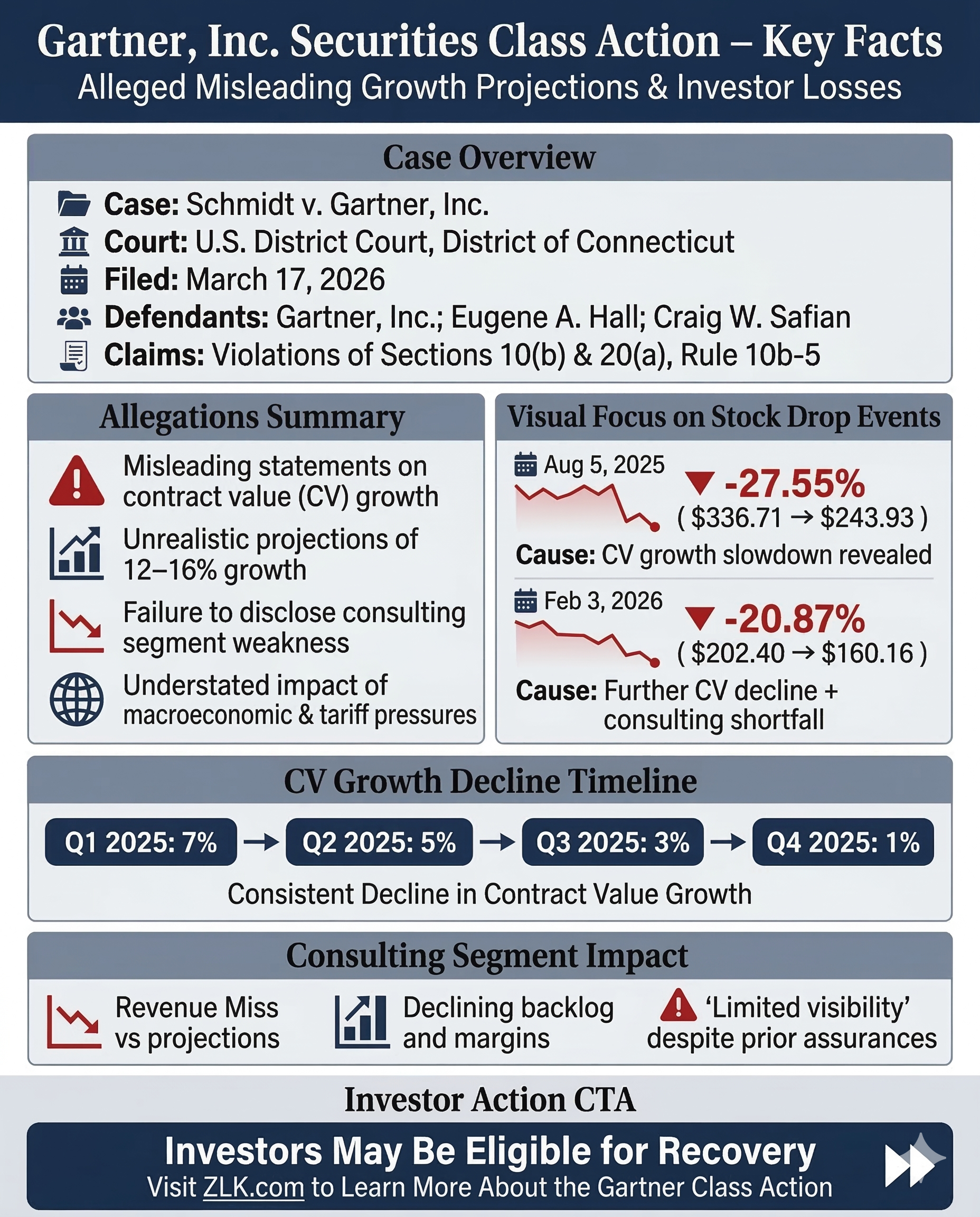
A securities fraud class action has been filed, alleging violations of the federal securities laws, including the Securities Exchange Act of 1934, Section 10(b) and Rule 10b-5 and Section 20(a) against Gartner, Inc. (NYSE: IT) and two of its executives on behalf of investors who purchased Gartner common stock on the New York Stock Exchange, ticker NYSE: IT, between February 4, 2025, and February 2, 2026. Investors allege that the company misrepresented its ability to achieve accelerating contract value growth rates and meet consulting revenue targets through materially false and misleading statements and material omissions in public financial disclosures despite ongoing industry challenges. The truth allegedly emerged in two phases during 2025 and early 2026, when Gartner disclosed significant declines in contract value growth and consulting segment shortfalls that contradicted optimistic projections and prior forward-looking revenue guidance. These revelations resulted in a cumulative decline of approximately 48% across two disclosure dates, an event-driven stock price decline that investors attribute to corrective disclosures.
Gartner, Inc. (IT) Securities Lawsuit Case Details
Case Name: Kevin Schmidt v. Gartner, Inc., et al.
Case No.: 3:26-cv-00394
Jurisdiction: U.S. District Court, District of Connecticut
Filed on: March 17, 2026
Gartner, Inc. (IT) Company Profile
Gartner is a global company operating in the information technology research and advisory sector that provides technology and business insights to its clientele through guidance, tools, conferences, and direct consulting, and is listed on the New York Stock Exchange (NYSE) as NYSE: IT. The Company operates through three segments: Business and Technology Insights, Conferences, and Consulting, generating $6.5 billion in revenue for full year 2025, as reflected in its Q4 2025 financial results.
Gartner, Inc. (IT) Securities Lawsuit Class Period
February 4, 2025-February 2, 2026, inclusive, the putative class period under federal securities laws
All investors who purchased or otherwise acquired Gartner common stock (NYSE: IT) during the Class Period may be eligible to join the Gartner, Inc. (IT) class action lawsuit.
Allegations in the Gartner, Inc. (IT) Securities Class Action Lawsuit
The complaint targets Gartner, Inc., Chief Executive Officer and Chairman Eugene A. Hall, and Executive Vice President and Chief Financial Officer Craig W. Safian for allegedly misrepresenting the company's growth prospects and operational capabilities to investors throughout the class period through materially false and misleading statements and material omissions in their public financial disclosures.
On February 4, 2025, Safian announced during an earnings call that the company's guidance and forward-looking revenue forecast reflected contract value continuing to accelerate during 2025, stating that with 12% to 16% research CV growth, the company would deliver double-digit revenue growth, which investors allege was a misleading statement.
During the same earnings call, Hall reinforced this optimistic outlook, explaining that over the course of 2025 and when exiting the year, he expected CV growth to exceed 7.8% and continue accelerating first to double digits and then to the medium-term objective of 12% to 16%, which, investors allege, artificially inflated the stock price. The company maintained this confident stance throughout the following months, including in SEC disclosures and investor communications.
On May 6, 2025, Hall announced that first quarter financial results were ahead of expectations with contract value growing 7%, and assured investors that the company would continue to provide significant value to clients and emerge from the current environment even stronger, which plaintiffs allege omitted adverse information about the Consulting segment's ability to meet internal targets. He reiterated expectations to reaccelerate CV growth to the target of 12% to 16% when the macroeconomic environment returned to normal, a forward-looking statement that plaintiffs challenge.
By November 4, 2025, Hall told investors during an earnings call that the selling environment with tariff-impacted companies was starting to improve, suggesting there was more tariff certainty and clients were focused on how to deal with it, statements investors allege concealed persisting headwinds to contract value growth.
According to the complaint, these statements concealed that Gartner was not truly equipped to handle ongoing challenges in its industry to either meet consulting revenue targets or to increase or even maintain its CV growth rate, in violation of federal securities laws. The company's repeated claims of being able to achieve 12-16% CV growth rates in a normal macroeconomic environment allegedly proved to be unrealistic, causing investors to purchase Gartner securities at artificially inflated prices and, as a result, investors suffered losses.
The Truth Emerges
The truth began to surface on August 5, 2025, when Gartner announced, in a corrective disclosure to the market, a surprising decline in its CV growth rate during its second quarter fiscal 2025 earnings release and call, which investors identify as the first corrective disclosure. The company revealed that overall CV growth had declined from 7% the previous quarter to only 5%, while CV growth excluding the U.S. federal government had similarly dropped from 8% to merely 6%. Hall acknowledged during the earnings call that the company had a high degree of confidence in what caused these headwinds because they tracked the reason for every loss for both renewals and potential new business, identifying the largest headwind as being with the U.S. federal government.
The full truth finally emerged on February 3, 2026, when Gartner again announced a significant decline in its CV growth rate, as part of its Q4 2025 financial results, which had faltered another 2% both including and excluding federal contracts. For the first time, the company disclosed a significant shortfall of its Consulting segment's performance against internal projections, reporting fourth quarter consulting revenue of $134 million compared with $153 million in the year ago period, and provided a 2026 outlook with a 2026 revenue forecast below analyst expectations. Fourth quarter contract value grew only 1% year-over-year, while CV outside the U.S. federal government grew just 4%, and its 2026 revenue guidance was below consensus analyst expectations. These revelations directly contradicted the company's prior assurances about accelerating CV growth and the ability to meet consulting segment targets.
Market Reaction
The market reacted sharply to these disclosures, with a significant stock price decline on each announcement date. On August 5, 2025, following the earnings call that revealed declining CV growth rates, Gartner's stock price on the New York Stock Exchange fell from a closing price of $336.71 per share on August 4, 2025, to $243.93 per share, a decline of $92.78 or approximately 27.55%, a single-day stock drop consistent with event-driven securities litigation.
The damage continued on February 3, 2026, when the company announced further CV decline and consulting segment shortfalls. The stock fell from a closing price of $202.40 per share on February 2, 2026, to $160.16 per share, a decline of $42.24 or nearly 20.87% in one day, and the stock closed lower following the earnings announcement.
Next Steps
● The Court will issue its order for lead plaintiff and counsel in the weeks after submissions are due.
● The Court will then consider motion for class certification.
● The Court will later consider a Motion to Dismiss.
Disclaimer: This shareholder alert is for informational purposes only and does not constitute legal advice. Consult a qualified attorney for personalized guidance. No specific outcomes are guaranteed.
Check Eligibility
✓ No cost or obligation
✓ See if you qualify