Gemini Space Station, Inc. Class Action Lawsuit – GEMI
Introduction to Gemini Space Station, Inc. (GEMI) Securities Class Action Lawsuit
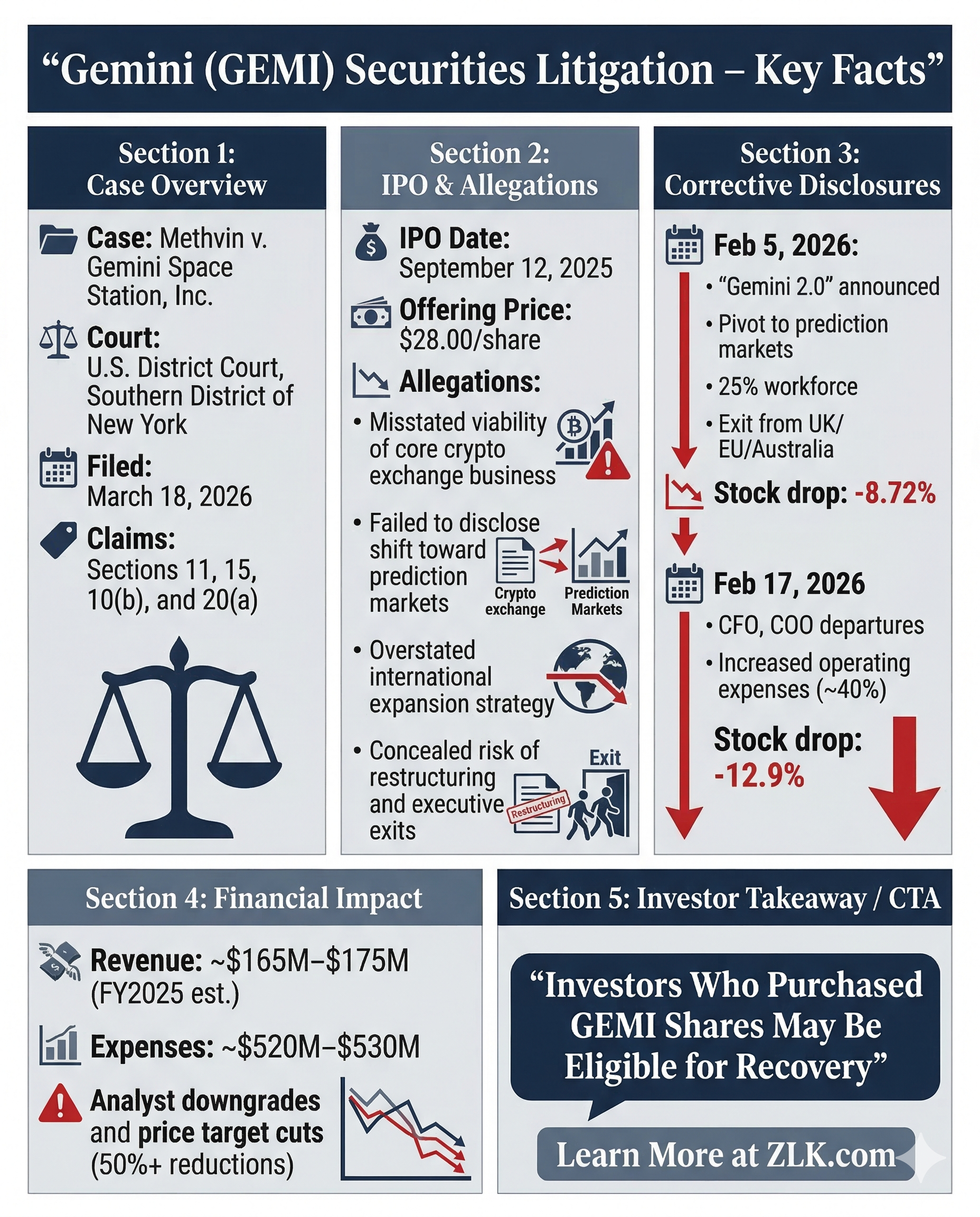
A securities fraud class action has been filed against Gemini Space Station, Inc. (NASDAQ: GEMI) alleging violations of Sections 11 and 15 of the Securities Act of 1933, and Sections 10(b) and 20(a) of the Securities Exchange Act of 1934 in connection with its September 12, 2025 initial public offering and subsequent trading through February 17, 2026, on the NASDAQ Global Select Market under ticker symbol GEMI. The company sold 15,178,572 shares of Class A common stock at $28.00 per share in the IPO. Investors allege that Gemini misrepresented the viability of its core cryptocurrency platform business and its commitment to international expansion from the IPO through the class period. Within five months of going public, the company announced a dramatic corporate pivot, slashed its workforce by 25%, and abandoned the very international markets it had touted as central to growth. Shares fell to $6.585, a decline of approximately 76.5% from the offering price.
Gemini Space Station, Inc. (GEMI) Securities Lawsuit Case Details
Case Name: Marc A. Methvin v. Gemini Space Station, Inc., et al.
Case No.: 1:26-cv-02261
Jurisdiction: U.S. District Court, Southern District of New York
Filed on: March 18, 2026
Gemini Space Station, Inc. (GEMI) Company Profile
Gemini Space Station, Inc. is a Nevada corporation that operates a cryptocurrency platform and is publicly traded on the NASDAQ. Historically, Gemini has primarily generated revenue through transaction, deposit, and other fees charged to users of its crypto platform. The complaint describes Gemini’s core exchange product and related offerings, including a derivatives exchange, staking services, an OTC trading desk, institutional-grade custody, a NYDFS-regulated stablecoin, a U.S. credit card, and a Web3 studio for NFTs.
Gemini Space Station, Inc. (GEMI) Securities Lawsuit Class Period
Class Period: September 12, 2025 through February 17, 2026, inclusive.
Investors who purchased Gemini Class A common stock pursuant and/or traceable to the Offering Documents issued in connection with the company's initial public offering conducted on or about September 12, 2025, including the final prospectus on Form 424B4, and/or Gemini securities during the Class Period might be eligible to join the Gemini Space Station, Inc. (GEMI) class action lawsuit.
Allegations in the Gemini Space Station, Inc. (GEMI) Securities Class Action Lawsuit
On September 12, 2025, Gemini completed its IPO on the NASDAQ Global Select Market, selling shares to the public at $28.00 each. The Registration Statement on Form S-1 and prospectus on Form 424B4 filed September 15, 2025 painted an ambitious vision. Gemini told investors it envisioned a future where crypto would redesign the global financial system and provide greater choice and opportunity for all. The company stated it was predominantly focused on expanding its exchange platform through increased monthly transacting users, increased average daily trading volume, and increasing the number of assets available on its platform. Geographic expansion into new markets and jurisdictions would amplify its global reach, the company promised, noting that crypto is inherently global and operates 24/7, underpinning its focus on investments in both the European and Asia-Pacific regions, including launches in the United Kingdom, the European Union and Australia.
During the months following the IPO, executives reinforced these commitments. On November 10, 2025, President Cameron Winklevoss told investors that Gemini had broadened its global footprint by launching in Australia and securing its MiCA license in Europe, enabling the company to offer staking, derivatives and tokenized stocks to customers across the European Union under a regulated framework. He stated this performance reinforced the strength of the model and the foundation that would continue to power Gemini's long-term growth. Chief Operating Officer Marshall Beard announced the company had received its MiCA license from the Malta Financial Services Authority, enabling it to offer crypto services across all 30 European countries and jurisdictions. Chief Financial Officer Dan Chen told investors the company continued to expect monthly transacting users to grow at a 20% to 25% compound rate over the medium term, supported by new retail customers and expanding engagement from existing customers.
Investors allege that throughout this period, Gemini had overstated the viability of its core business as a crypto platform and its commitment to expanding its international operations, failed to disclose a plan to pivot to a prediction market strategy, and to scale back certain international operations. The company's post-IPO financial and business prospects were overstated, investors claim, the Offering Documents contained untrue statements of material fact, and omitted material information pertinent to investors, actionable under Sections 11 and 15 of the Securities Act of 1933 and Sections 10(b) and 20(a) of the Securities Exchange Act of 1934, and all of this raised a non-speculative risk that Gemini was poised for an expensive and disruptive restructuring.
The Truth Emerges
The truth began to emerge on February 5, 2026, when Gemini, filing a Form 8-K with the U.S. Securities and Exchange Commission announced a corporate pivot to "Gemini 2.0." Co-founders Tyler and Cameron Winklevoss revealed three dramatic changes. The prediction market would be more front and center in the company's experience. Gemini would reduce its workforce by 25%. And the company would exit the United Kingdom, European Union, and Australian markets-markets that executives had recently highlighted; the Offering Documents also described international expansion as creating "a robust foundation for sustained growth". Management stated that in order to have the necessary bandwidth to succeed in the company's new emphasis on prediction markets, Gemini would narrow its focus by exiting the UK, EU, and Australian markets.
On February 17, 2026, via a Form 8-K, Gemini disclosed the departure of three top executives: Marshall Beard, its former Chief Operating Officer; Dan Chen, its former Chief Financial Officer; and Tyler Meade, its former Chief Legal Officer. The company also released preliminary unaudited estimates showing net revenue of $165 million to $175 million and operating expenses of $520 million to $530 million, an increase of approximately 40% from the previous fiscal year. The estimated increase in operating expenses was primarily due to higher personnel-related costs, including stock-based compensation, and investments in technology, general and administrative expenses, and marketing.
Market Reaction
On February 5, 2026, when Gemini announced its corporate pivot and international market exits, shares (NASDAQ: GEMI) fell $0.64 per share, or 8.72%, to close at $6.70 per share, on the NASDAQ Global Select Market-76.1% below the $28.00 offering price.
On February 17, 2026, following the executive departures and expense disclosure, the stock fell another $0.975 per share, or 12.9%, to close at $6.585 per share, and traded below $7 per share intraday.
From the September 12, 2025 IPO through February 17, 2026, Gemini shares suffered a precipitous decline of approximately $21.415 per share, or 76.5%, leaving the stock trading far below the price investors paid just five months earlier.
Next Steps
● The Court will issue its order for lead plaintiff and counsel in the weeks after submissions are due.
● The Court will then consider motion for class certification.
● The Court will later consider a Motion to Dismiss.
Disclaimer: This shareholder alert is for informational purposes only and does not constitute legal advice. Consult a qualified attorney for personalized guidance. No specific outcomes are guaranteed.
Check Eligibility
✓ No cost or obligation
✓ See if you qualify