GRAIL, Inc. Class Action Lawsuit - GRAL
Company: GRAIL, Inc.
Ticker: (NASDAQ) GRAL
13
Days Left
Lead Plaintiff Deadline: August 04, 2026
See If You Qualify For Monetary Reward
Join the GRAIL, Inc. Class Action Lawsuit
Please Upload related files below
Add Transactions
Fill in below.
Certification of Plaintiff Pursuant to Federal Securities Laws
Upload Your Stock Tickers
Tell us the stocks you own using SnapTrade, and we will keep you informed about class action litigation related to your stocks. We monitor critical case developments that may affect the price of your shares and your possible monetary recovery. SnapTrade only shares the tickers you own and your transaction history, not your account numbers. Using SnapTrade and participating in our monitoring service is free and does not create any attorney-client relationship or obligation on your part.
Don’t miss out on possible monetary recovery - link your brokerage account with SnapTrade.
Class Period
Begins
13
May 2025
Ends
19
Feb 2026
May 13, 2025 - February 19, 2026
Allegations
Eligibility
In order to be eligible to join the GRAL class action lawsuit, you must have incurred a loss on shares of GRAIL purchased during the class period listed above.
Lead Plaintiff Deadline
If you suffered a loss in GRAIL during the relevant time frame, you have until August 04, 2026 to request that the Court appoint you as lead plaintiff. Your ability to share in any recovery doesn't require that you serve as a lead plaintiff.
GRAIL, Inc.Class Action Lawsuit Details
|
GRAL Class Action Summary |
|
|
Company |
Grail, Inc. (NASDAQ: GRAL) |
|
Lead Plaintiff Deadline |
August 4, 2026 |
|
Class Period |
May 13, 2025 – February 19, 2026 |
|
Stock Drop |
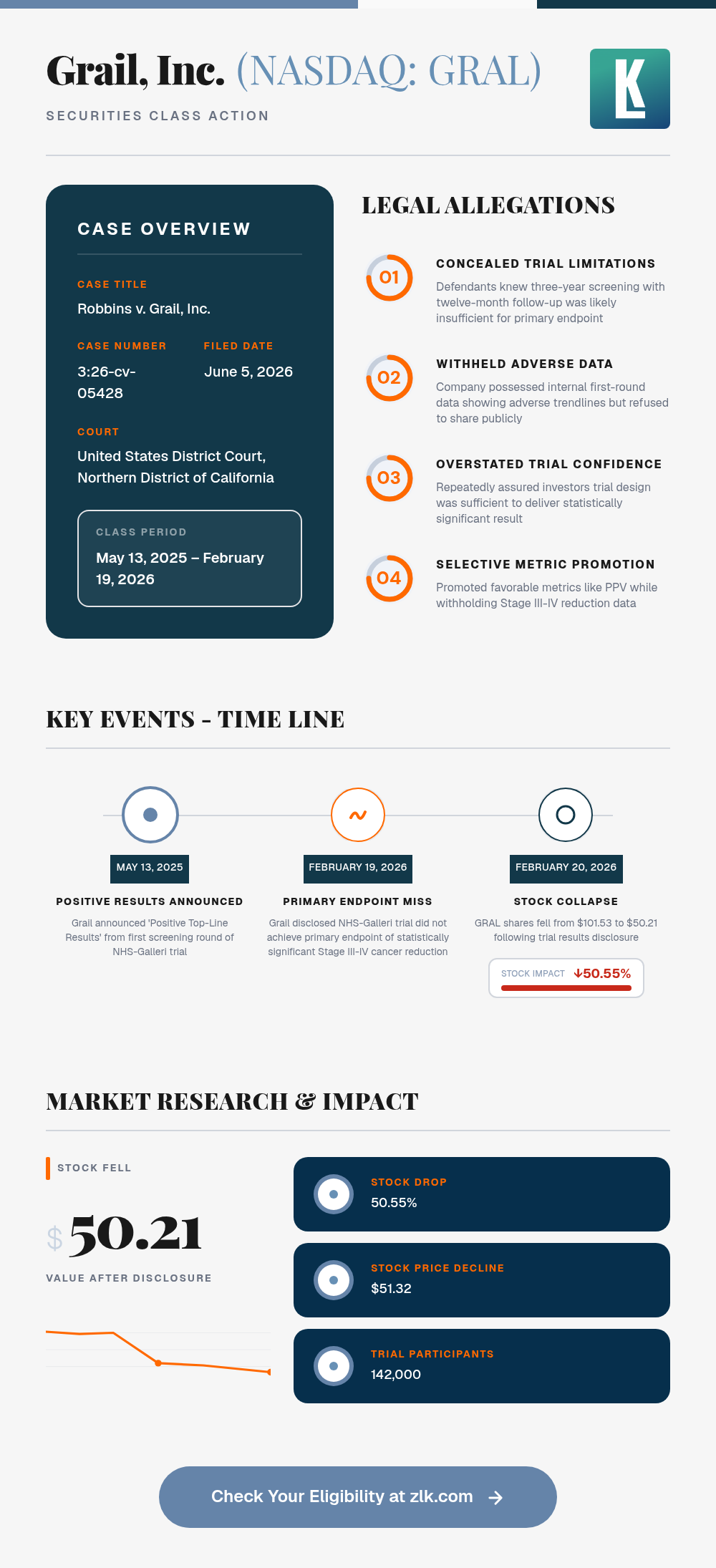
February 20, 2026 – GRAL fell $51.32 (50.55%) to $50.21 |
|
Lawsuit Type |
Securities Class Action |
Introduction
A securities class action lawsuit has been filed by Levi & Korsinsky, LLP on behalf of plaintiff William Robbins against Grail, Inc. (NASDAQ: GRAL) and certain of its senior executives in the United States District Court for the Northern District of California. The lawsuit covers investors who purchased or acquired Grail common stock between May 13, 2025, and February 19, 2026, and alleges that defendants made materially false and misleading statements concerning the likelihood that the Company's landmark NHS-Galleri clinical trial would achieve its primary endpoint of a statistically significant reduction in Stage III and IV cancer diagnoses. On February 19, 2026, Grail disclosed that the primary endpoint was not achieved, attributing the shortfall in part to the need for longer follow-up time. Grail's stock price collapsed the following day, falling approximately 50.55% from $101.53 to $50.21 per share in a single trading session.
Company Profile
Grail, Inc. is a commercial-stage healthcare company focused on early cancer detection through blood-based screening methodology. The Company's core product, Galleri, is a multi-cancer early detection test designed to analyze a blood sample to screen for a multitude of cancers and pinpoint the organ or tissue type of origin.
Class Period
May 13, 2025 – February 19, 2026
Investors who purchased or acquired Grail, Inc. (GRAL) common stock during the Class Period may be entitled to seek recovery under the federal securities laws.
Allegations
The complaint alleges that throughout the Class Period, defendants promoted a confident narrative around the NHS-Galleri trial, a 142,000-participant, three-year randomized controlled trial conducted through England's National Health Service. The trial's primary endpoint was to demonstrate a statistically significant reduction in late-stage (Stage III and IV) cancer diagnoses among participants screened with Galleri compared to those who were not. Defendants repeatedly told investors that the trial was specifically designed and statistically powered to deliver a significant result within the three-year timeframe, and that certain interim findings reinforced their confidence in a positive outcome.
According to the complaint, on May 13, 2025, defendants announced what they characterized as "Positive Top-Line Results" from the first screening round of the NHS-Galleri trial, highlighting a positive predictive value (PPV) "substantially higher" than that observed in the earlier PATHFINDER study. While defendants declined to share detailed data from the first round, citing the need to protect the "integrity" of the trial, they simultaneously used the elevated PPV figure to reinforce investor confidence. Defendant Kumar called the results "very encouraging," while Defendant Ofman stated that "Galleri is working in the real world." In the months that followed, including during the August 12 and November 12, 2025 earnings calls, the September 9, 2025 Morgan Stanley conference, the October 20, 2025 Pathfinder 2 results call, and the November 13, 2025 Analyst/Investor Day, defendants continued to promote Galleri's performance metrics and described the upcoming mid-2026 final readout as a "great calling card" for global expansion. Defendant Kumar confirmed on August 12, 2025, that the study's size "was set to be able to deliver a statistically significant result" on the primary endpoint, while offering no updated assessment of the trial's probability of success based on data defendants had reviewed internally.
The complaint alleges that these statements were materially false and misleading because defendants knew or recklessly disregarded that the trial as designed, with only three years of screening and twelve months of follow-up, was likely insufficient to demonstrate a statistically significant reduction in Stage III and IV cancers. Defendants possessed internal data from the first screening round that they refused to share publicly, potentially concealing adverse trendlines that suggested either a longer timeline was necessary or that the probability of achieving the primary endpoint had diminished. The complaint further notes that the NHS itself had reviewed the same first-year results and declined to accelerate implementation, determining the data was not "exceptional enough" to warrant action before the full trial readout. By selectively promoting favorable metrics like PPV while withholding the more directly relevant Stage III and IV reduction data, and by repeatedly assuring investors that the trial's design was sufficient, defendants allegedly created a materially misleading picture of the trial's prospects.
The Truth Emerges
On February 19, 2026, Grail disclosed the top-line results of the full NHS-Galleri trial, revealing that "the primary endpoint of statistically significant Stage III-IV reduction was not observed." While Grail highlighted secondary findings, including a greater than 20% reduction in Stage IV cancer diagnoses in later screening rounds and a fourfold higher overall cancer detection rate, the trial did not meet its primary endpoint. Defendant Kumar acknowledged during the earnings call that the company "probably need[ed] a longer follow-up time" to adequately compare the study arms, and Grail announced plans to extend passive data collection by six to twelve months.
The disclosures directly contradicted the confident narrative defendants had maintained throughout the Class Period. Defendant Ofman stated during the call that NHS-Galleri was "actually a very short trial with a very ambitious endpoint," a characterization at odds with months of assurances that three years of screening was sufficient to deliver a statistically significant result. Defendant Kumar similarly stated that, “with the benefit of hindsight, we probably should have allowed for a longer follow-up period,” which the complaint cites as support for its allegation that design limitations contributed to the primary endpoint miss.
Market Reaction
The market reacted swiftly and severely to Grail's disclosure. On February 20, 2026, the first trading day after the announcement, GRAL shares fell from a closing price of $101.53 on February 19 to $50.21, a decline of approximately $51.32 per share, or 50.55%, in a single day. Multiple analysts cut their price targets in the wake of the news. Baird, which had initiated coverage just days earlier on February 17, 2026, slashed its price target by more than 27% to $31, noting that the results "likely decrease[] (but do[] not necessarily eliminate) the likelihood of broader NHS adoption in the near-term." Canaccord Genuity reduced its target from $105 to $80, citing "increased risk" and reduced revenue potential despite maintaining a buy rating.
Next Steps
● Lead Plaintiff Deadline: August 4, 2026
● After the lead plaintiff deadline, the Court will consider any lead plaintiff motions.
● Defendants may file a motion to dismiss.
● If the case proceeds, the Court may later consider class certification.
Disclaimer: This shareholder alert is for informational purposes only and does not constitute legal advice. Consult a qualified attorney for personalized guidance. No specific outcomes are guaranteed.