Grocery Outlet Holding Corp. Class Action Lawsuit – GO
Grocery Outlet Class Action Summary
|
Lead Plaintiff Deadline |
May 15, 2026 |
|
Company |
Grocery Outlet Holding Corp. (NASDAQ:GO) |
|
Eligible Securities |
All Grocery Outlet Securities |
|
Class Period |
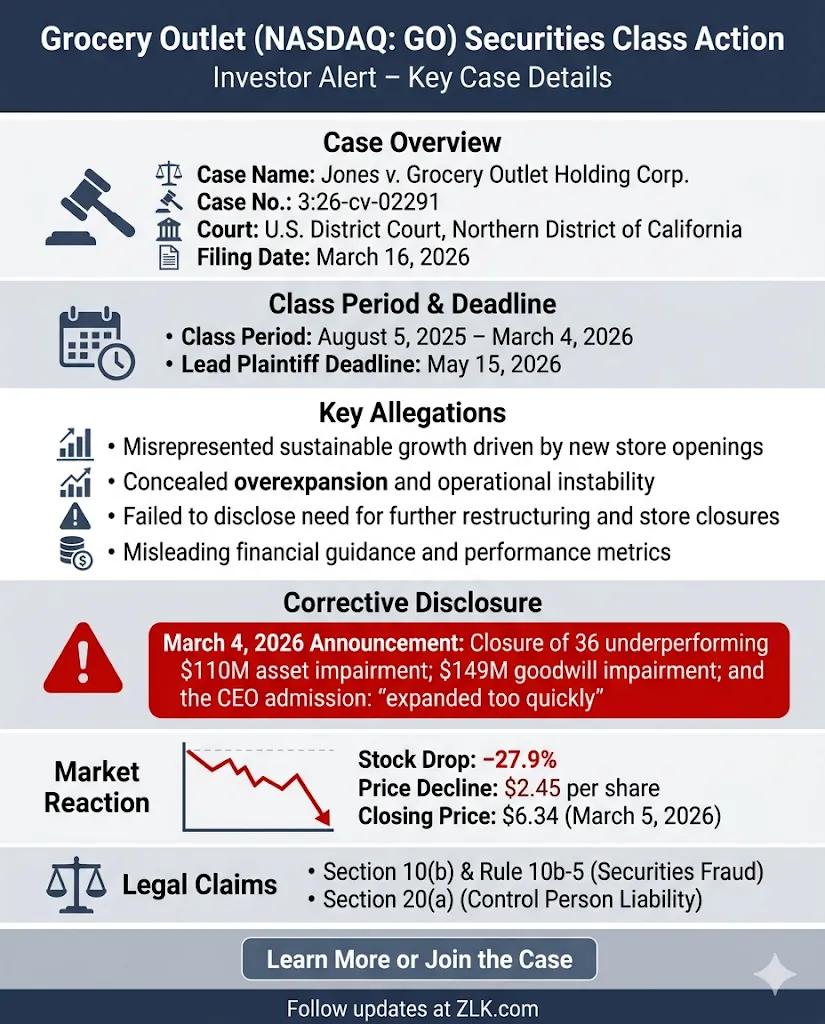
August 5, 2025-March 4, 2026 |
|
Allegations Overview |
Defendants misrepresented the sustainability of financial growth, concealing that rapid store expansion was unsustainable and that the Restructuring Plan required further optimization including significant store closures. |
|
GO Trigger Events |
March 4, 2026 – Grocery Outlet announced Q4 and full fiscal year 2025 results that missed guidance on nearly every major financial metric, revealed an Optimization Plan including the closure of 36 financially underperforming stores, recognized $110 million in non-cash long-lived asset impairment charges, and recorded a $149.0 million non-cash goodwill impairment. CEO Jason Potter admitted on the earnings call "it's clear now that we expanded too quickly, and these closures are a direct correction." |
|
GO Stock Impact |
March 5, 2026 – Grocery Outlet's stock price fell $2.45, or 27.9%, to close at $6.34 per share on unusually heavy trading volume. |
Introduction to Grocery Outlet Holding Corp. (GO) Securities Class Action Lawsuit
A securities fraud class action under the federal securities laws has been filed against Grocery Outlet Holding Corp. (NASDAQ: GO) and two of its executives on behalf of investors who purchased company securities between August 5, 2025 and March 4, 2026.
Investors allege that the company and its officers misrepresented the sustainability of its financial growth, claiming strong performance driven by new store openings while concealing that the company had expanded too quickly and that its purported growth was artificially supported by unsustainable rapid expansion. On March 4, 2026, Grocery Outlet disclosed it was closing 36 underperforming stores as part of an Optimization Plan and taking $110 million in non-cash impairment charges, with CEO Jason Potter admitting "it's clear now that we expanded too quickly, and these closures are a direct correction."
Following this disclosure, the company's stock price fell 27.9% in a single trading session, causing significant losses to investors.
“Most GO shareholders never file or join the class action, which means they miss out on potential recovery funds,” said Attorney Joseph Levi.
Grocery Outlet Holding Corp. (GO) Securities Lawsuit Case Details
Case Name: Jones v. Grocery Outlet Holding Corp.
Case No.: 3:26-cv-02291
Jurisdiction: U.S. District Court, Northern District of California
Filed on: March 16, 2026
Grocery Outlet Holding Corp. (GO) Company Profile
Grocery Outlet Holding Corp., headquartered in Hayward, California, operates as a value retailer of consumables and fresh products (consumer staples sector) sold through independently operated stores across 16 states in the U.S., and is publicly traded on the NASDAQ as GO.
Grocery Outlet Holding Corp. (GO) Securities Lawsuit Class Period
August 5, 2025-March 4, 2026, inclusive.
All persons and entities that purchased or otherwise acquired Grocery Outlet (NASDAQ: GO) securities during the Class Period and were damaged thereby may be eligible to join the Grocery Outlet Holding Corp. (GO) class action lawsuit. Excluded are the defendants, company officers and directors, members of their immediate families, and entities in which defendants have or had a controlling interest.
Allegations in the Grocery Outlet Holding Corp. (GO) Securities Class Action Lawsuit
The complaint targets Grocery Outlet Holding Corp., along with Chief Executive Officer Jason Potter and Chief Financial Officer Christopher M. Miller, alleging they made materially false and misleading statements about the company's business operations and growth strategy during the class period, in violation of the federal securities laws. According to investors, defendants portrayed the company's financial performance as strong and sustainable while concealing fundamental problems with their expansion strategy, creating a false impression of reliable financial information.
On August 5, 2025, Grocery Outlet announced that net sales increased 4.5% to $1.18 billion during the second quarter due to new store sales and a 1.1% increase in comparable store sales, stating the company had opened 11 new stores and closed two stores to end the quarter with 552 stores in 16 states. The company also announced that the actions under its Restructuring Plan were substantially completed in the second quarter of fiscal 2025.
The company continued its positive narrative, and on the November 4, 2025 Q3 2025 earnings call the CEO told investors adjusted EPS exceeded guidance while omitting GAAP EPS, which was $0.12, 43% below consensus, versus adjusted EPS of $0.21, reporting that net sales increased 5.4% versus the prior year to $1.17 billion due to new store sales and a 1.2% increase in comparable store sales, announcing it had opened 13 new stores and closed two stores to end the quarter with 563 stores in 16 states.
Throughout this period, investors allege that defendants failed to disclose that the company had expanded too quickly into new stores, that its purportedly strong financial and operational growth was being artificially supported by excessive rapid store expansion, and that the company was unable to achieve the sustainable growth required to meet its previously set guidance, thereby minimizing the risks associated with rapid over-expansion.
The complaint further alleges that defendants concealed that the company's Restructuring Plan would require further optimization to achieve its operational goals, including significant store closures and substantial asset write-downs, and that a December 3, 2025 Form 8-K stated there was no update to the November 4 outlook, which investors allege was a material omission in light of later-announced closures.
The Truth Emerges
On March 4, 2026, after the market closed, Grocery Outlet announced results for the fourth quarter and full fiscal year 2025 that missed guidance on nearly every major financial metric, and issued FY2026 profit guidance below analyst expectations. The company revealed it was adding an "optimization plan" on top of its "restructuring plan" and was "reshaping its new store growth strategy," including the closure of 36 financially underperforming stores.
The company disclosed it had determined that the long-lived assets of these closure stores were impaired and recognized $110 million in non-cash charges, and also recorded a $149.0 million non-cash goodwill impairment and reported an operating loss of $221.7 million for fiscal year 2025. During the earnings call, CEO Jason Potter admitted "it's clear now that we expanded too quickly, and these closures are a direct correction."
These disclosures undercut the Company's earlier portrayal of strong, sustainable performance driven by rapid new store openings and of a Restructuring Plan said to be substantially completed, by revealing that the Company had expanded too quickly and would need further optimization, including significant store closures and asset write-downs.
Market Reaction
On March 5, 2026, following the previous day's after-market earnings announcement and revelations, Grocery Outlet's (NASDAQ: GO) stock price fell $2.45, or 27.9%, to close at $6.34 per share on unusually heavy trading volume, and analysts downgraded the stock following the announcement. The single-day decline came as investors reacted to Grocery Outlet's disclosure that it would close 36 financially underperforming stores and the recognition of $110 million in non-cash impairment charges, along with CEO Jason Potter's admission that "it's clear now that we expanded too quickly, and these closures are a direct correction."
Next Steps
● The Court will issue its order for lead plaintiff and counsel in the weeks after submissions are due.
● The Court will then consider motion for class certification.
● The Court will later consider a Motion to Dismiss.
Disclaimer: This shareholder alert is for informational purposes only and does not constitute legal advice. Consult a qualified attorney for personalized guidance. No specific outcomes are guaranteed.
Check Eligibility
✓ No cost or obligation
✓ See if you qualify