New Era Energy & Digital Class Action Lawsuit – NUAI
|
New Era Energy Class Action Summary |
|
|
Company |
New Era Energy & Digital, Inc. (NASDAQ: NUAI) |
|
Lead Plaintiff Deadline |
June 1, 2026 |
|
Class Period |
November 6, 2024 – December 29, 2025 |
|
Stock Drop |
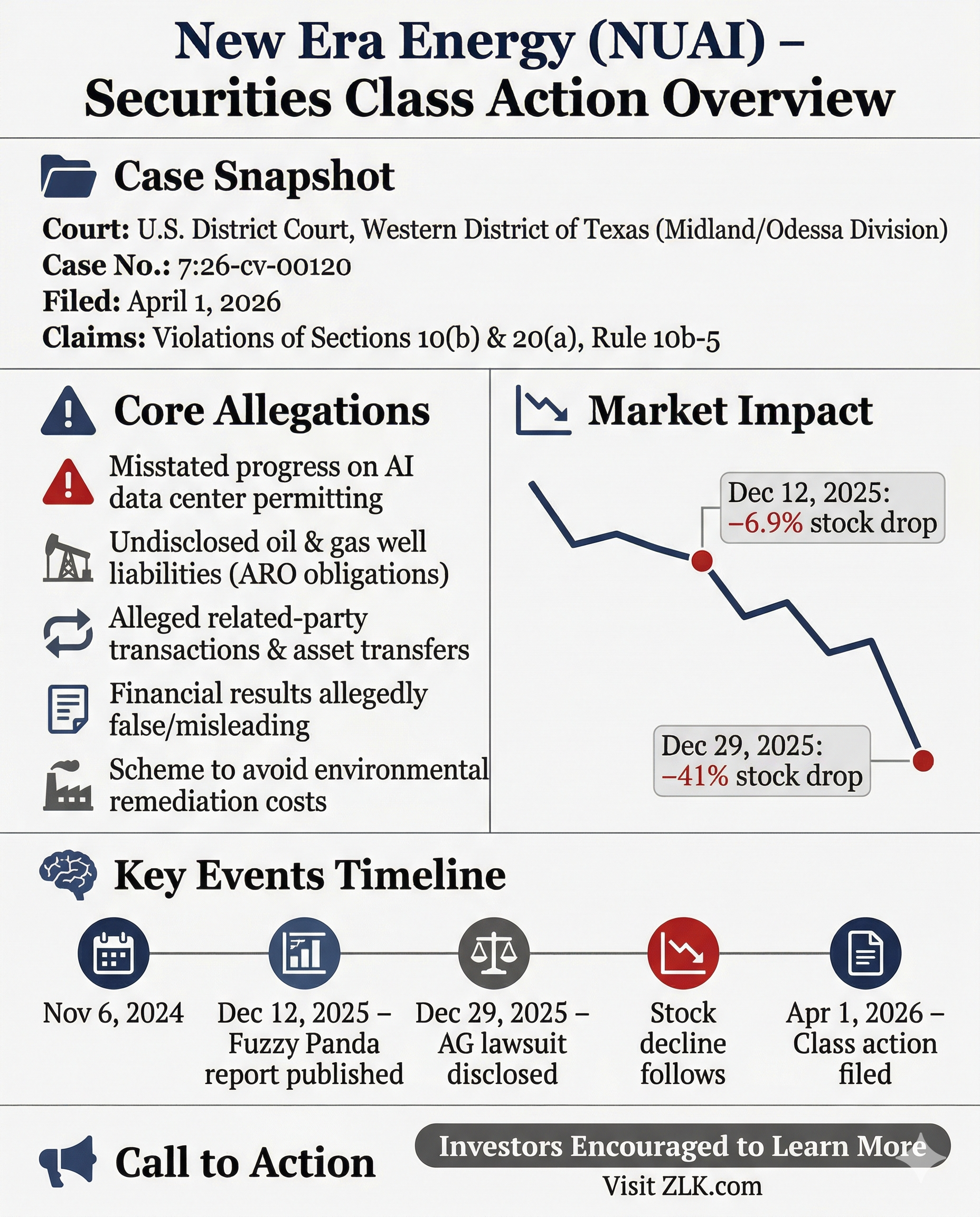
December 12, 2025 – NUAI fell $0.25 (6.9%) to $3.35; December 29, 2025 – NUAI fell $1.87 (41%) to $2.69 |
|
Lawsuit Type |
Securities Class Action |
Introduction
A securities class action lawsuit has been filed against New Era Energy & Digital, Inc. (NASDAQ: NUAI), its CEO Everett Willard Gray II, and former CFO Michael J. Rugen on behalf of investors who purchased New Era Energy securities between November 6, 2024 and December 29, 2025. The complaint alleges that defendants made materially false and misleading statements about the company's business operations, its progress on a flagship AI data center project, and its involvement in a fraudulent oil-and-gas well scheme in New Mexico. According to the complaint, when the truth emerged through a short-seller report on December 12, 2025, and a subsequent report revealing a New Mexico Attorney General lawsuit on December 29, 2025, NUAI shares suffered sharp declines, falling a combined 68% from the Class Period high of $8.50 per share and causing significant losses for investors.
Company Profile
New Era Energy & Digital, Inc., formerly known as New Era Helium Inc., is an oil and natural gas company that became publicly traded on the NASDAQ in December 2024 through a business combination with Roth CH Acquisition V Co. The company's primary revenue source is oil and gas wells located in Chaves County, New Mexico, operated by its subsidiary Solis Partners. During the Class Period, New Era Energy was also pursuing a strategic pivot into AI infrastructure, with its purported flagship venture being the Texas Critical Data Center, a reported large-scale AI and high-performance computing data center campus located in Ector County, Texas.
Class Period
November 6, 2024 – December 29, 2025, inclusive.
Investors who purchased or acquired New Era Energy & Digital, Inc. (NUAI) securities during the Class Period may be entitled to seek recovery under the federal securities laws.
Allegations
The complaint alleges that throughout the Class Period, defendants made materially false and misleading statements about New Era Energy's business, financial condition, and prospects across multiple SEC filings and press releases. Beginning with the November 6, 2024 proxy statement soliciting shareholder approval of the company's business combination with Roth CH Acquisition V Co., through subsequent annual and quarterly reports and investor presentations, defendants allegedly misrepresented the company's financial results, including its asset retirement obligations, and overstated its progress toward developing its flagship Texas Critical Data Center project.
According to the complaint, defendants repeatedly touted "tangible progress across all fronts including engineering, permitting, regulatory filings, and land expansion" for the Texas Critical Data Center. An October 2025 press release highlighted "significant progress on obtaining air permits" and stated the company was "pursuing a minor source air permit." A November 2025 investor presentation filed with the SEC represented that "phase two" of the project, which included regulatory permitting, was "underway." The complaint alleges these statements were materially misleading because no permit applications had been submitted to any relevant state or federal agency.
The complaint further alleges that defendants concealed New Era Energy's involvement in what the New Mexico Attorney General would later characterize as a "fraudulent oil-and-gas scheme." Plaintiffs allege that CEO Gray orchestrated a pattern of transferring oil and gas wells among a network of related entities he controlled, including Remnant Oil, Acacia Resources, and Solis Partners, siphoning revenue from productive wells while strategically placing liability-bearing entities into bankruptcy to avoid plugging and remediation costs that New Mexico law required. Of NUAI's 406 gas wells, 346 were allegedly acquired from companies that went bankrupt operating those same wells, including 87 wells from Remnant Oil, a company Gray co-founded and led into bankruptcy in 2019 after hundreds of regulatory violations. Those 87 wells were reportedly transferred to Solis Partners, a New Era Energy subsidiary allegedly "dominated and controlled" by Gray, for a listed purchase price of just $10, while Acacia was left with the bulk of environmental liabilities.
The complaint alleges defendants knew or recklessly disregarded that the company's reported financial results, including its asset retirement obligations, were materially false and misleading because they failed to account for the true scope of the company's environmental liabilities and the fraudulent nature of the well transfers that generated the company's revenue. Throughout the Class Period, Gray served as CEO, and beginning June 2025, also assumed the role of CFO, a period during which, according to the Fuzzy Panda Research report quoted in the complaint, three of four independent board members and the prior CFO departed the company.
The Truth Emerges
On December 12, 2025, market research outlet Fuzzy Panda Research published a detailed report alleging that Gray had "a long history (~20 years) of incinerating value at oil & gas pink sheet companies" and that his companies declined an average of 98%. The report revealed that the company's AI data center pivot was a "fantasy," disclosing that searches of Texas, New Mexico, and federal government databases for the construction and environmental permits NUAI would need to build its data centers and power plants returned nothing, "not even an application[,]" despite the company's repeated representations to investors of significant permitting progress. The report also detailed Gray's alleged "playbook" of enriching insiders through related-party transactions, including converting related-party loans to equity and paying fees to friends and family.
On December 29, 2025, Hunterbrook Media reported that the New Mexico Attorney General had filed a sweeping enforcement lawsuit against New Era Energy, Solis Partners, and Gray, among others. The lawsuit accused the defendants of orchestrating a fraudulent scheme to "siphon revenue from wells that produce fossil fuels while abandoning environmental cleanup obligations." The Attorney General's complaint alleged a broader pattern of fraudulent transfers, self-dealing, and false statements to regulators, including the use of shell entities and strategic bankruptcies to evade responsibility. The complaint alleged that Gray formed Solis Partners specifically "to receive Remnant's best wells" while ensuring affiliated entities would be unable to meet their environmental obligations, leaving the state as the "plugger of last resort" for hundreds of abandoned wells.
Market Reaction
Following the publication of the Fuzzy Panda Research report on December 12, 2025, NUAI shares fell $0.25, or 6.9%, to close at $3.35 on unusually heavy trading volume, as the market absorbed the report's findings regarding the company's lack of permit applications and Gray's history of value destruction at prior companies.
The more severe decline came on December 29, 2025, when the Hunterbrook Media report revealed the New Mexico Attorney General's fraud lawsuit. NUAI shares plummeted $1.87, or 41%, to close at $2.69 per share on unusually heavy trading volume. The cumulative impact of the two corrective disclosures drove the stock approximately 68% below its Class Period high of $8.50 per share, reached on December 9, 2024, when the company became a public entity through its business combination with Roth CH Acquisition V Co.
Next Steps
● The Court will issue its order for lead plaintiff and counsel in the weeks after submissions are due.
● The Court will then consider motion for class certification.
● The Court will later consider a motion to dismiss.
Disclaimer: This shareholder alert is for informational purposes only and does not constitute legal advice. Consult a qualified attorney for personalized guidance. No specific outcomes are guaranteed.
Check Eligibility
✓ No cost or obligation
✓ See if you qualify