Ostin Technology Group Co., Ltd. Class Action Lawsuit – OST
Introduction to Ostin Technology Group Co., Ltd. (OST) Securities Class Action Lawsuit
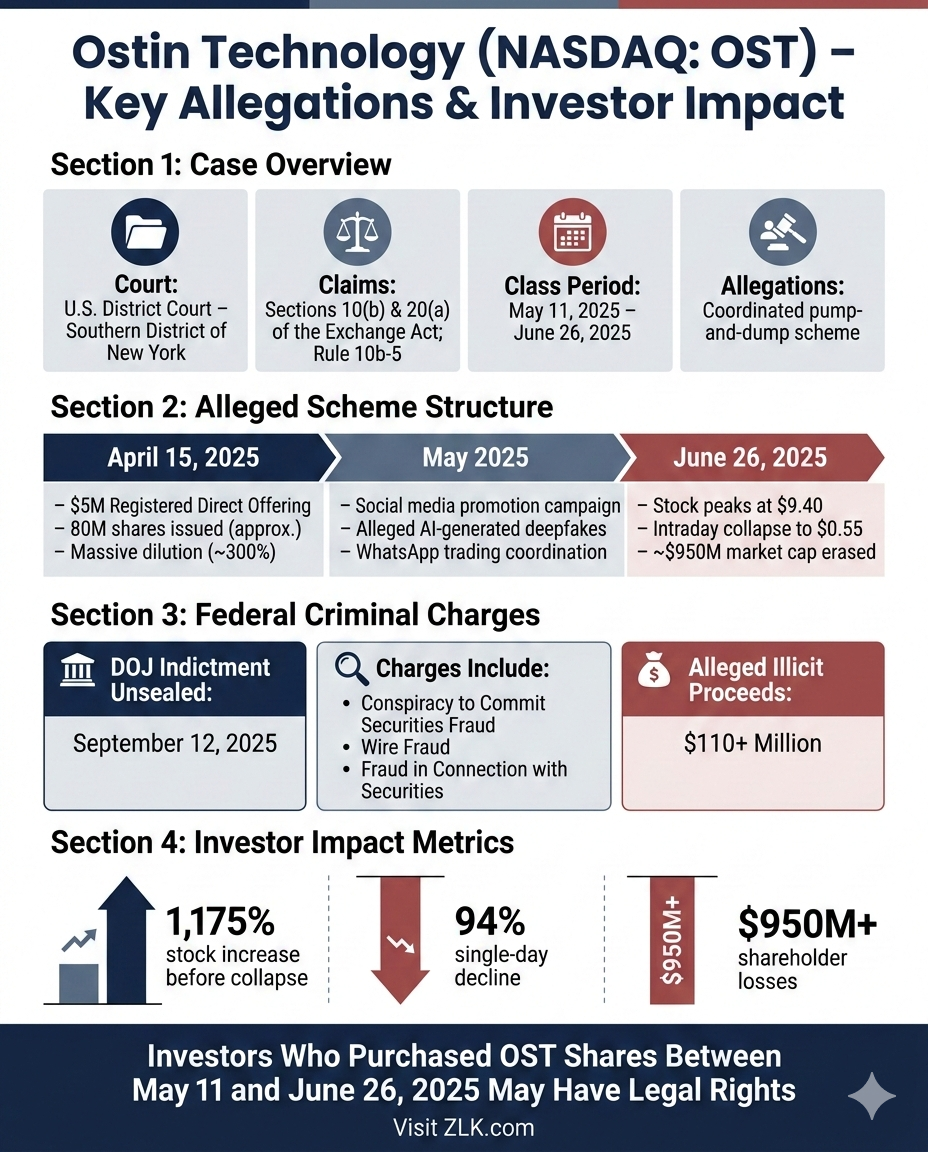
A securities fraud class action has been filed against Ostin Technology Group Co., Ltd. and several individual defendants on behalf of investors who purchased OST ordinary shares (NASDAQ: OST) between May 11, 2025, and June 26, 2025, alleging violations of Sections 10(b) and 20(a) of the Securities Exchange Act of 1934. Investors allege that defendants orchestrated a pump-and-dump scheme that artificially inflated OST's stock price by 1,175% over 73 days, driving market capitalization from approximately $22 million to more than $1 billion, through a registered direct offering executed fraudulently and a coordinated social media campaign.
According to the complaint, while the company claimed the offering would provide legitimate capital for growth, defendants were actually placing shares into the hands of co-conspirators who planned to dump them at inflated prices. When the coordinated selloff occurred on June 26, 2025, the stock crashed 94% in a single day, obliterating over $950 million in market capitalization and leaving retail investors with catastrophic losses.
“Most OST shareholders never file or join the class action, which means they miss out on potential recovery funds,” said Attorney Joseph Levi.
Ostin Technology Group Co., Ltd. (OST) Securities Lawsuit Case Details
Case Name: Gordon v. Ostin Technology Group Co., Ltd. et al.
Case No.: 1:26-cv-01288
Jurisdiction: U.S. District Court, Southern District of New York
Filed on: February 16, 2026
Ostin Technology Group Co., Ltd. (OST) Company Profile
Ostin Technology Group Co., Ltd. is a Cayman Islands corporation operating through subsidiaries with principal executive offices in Nanjing, China that purports to design, develop, and manufacture TFT-LCD (thin-film transistor liquid crystal display) modules and polarizers used in consumer electronics, commercial LCD displays, and automotive displays, with ordinary shares trading on NASDAQ.
Ostin Technology Group Co., Ltd. (OST) Securities Lawsuit Class Period
May 11, 2025-June 26, 2025, inclusive.
Investors who purchased or otherwise acquired OST ordinary shares (ticker: OST) on the Nasdaq Stock Market during the Class Period may be eligible to join the Ostin Technology Group Co., Ltd. (OST) class action lawsuit.
Allegations in the Ostin Technology Group Co., Ltd. (OST) Securities Class Action Lawsuit
The complaint targets Ostin Technology Group Co., Ltd., along with co-CEOs Tao Ling and Lai Kui Sen, CFO Qiaoyun Xie, and six other individual defendants, alleging they orchestrated a sophisticated securities fraud scheme, a classic market manipulation pump-and-dump. On April 15, 2025, when OST stock traded at a 52-week low of $0.78, the company announced a registered direct offering that it claimed would provide capital for the company's growth and operations, a representation investors allege was materially false and misleading.
Behind the scenes, however, co-CEO Lai Kui Sen was coordinating with select investors to execute a pump-and-dump scheme, placing OST ordinary shares in brokerage accounts they controlled. On April 25, 2025, Lai emailed a broker stating that two co-conspirators were participating in the registered direct offering and that their shares would be non-restricted, to facilitate brokerage account openings. On May 12, 2025, Lai provided the broker with updated share count information, and on June 2, 2025, he falsely represented in writing to brokers that certain co-conspirators had no ties to OST, vouching they were unaffiliated to avoid trading restrictions.
According to the complaint, the offering was non-bona fide and designed to place the majority of OST shares (approximately 80 million shares, with over 70 million transferred for zero cash consideration) in the hands of co-conspirators who would artificially inflate the stock price through fraudulent social media promotion, including WhatsApp groups that impersonated investment advisors and issued daily buying instructions, and AI-generated deepfake videos before systematically dumping their shares at inflated prices.
The complaint alleges that defendants and co-conspirators coordinated a promotional campaign that launched the same day the offering closed, showing the offering and promotions were synchronized, indicating premeditation. The offering structure allegedly diluted existing shareholders massively while providing insiders , with at least 15 co-conspirators, with shares at pennies apiece at an average cost of about $0.06 per share that could be immediately sold for enormous profits, generating over $110 million in illicit proceeds, which conspirators laundered through Treasury ETFs.
The Truth Emerges
On June 26, 2025, the truth surfaced when OST's stock price crashed from an intraday high of $9.40 to a closing price of $0.55-a 94% decline in a single day that wiped out over $950 million in market capitalization. The following day, on June 27, 2025, the company issued a press release claiming it had no undisclosed material matters and was not aware of specific reasons for the abnormal stock price fluctuations-a statement the complaint alleges was materially false because OST's co-CEO was directly involved in orchestrating the scheme.
On July 18, 2025, OST disclosed it had received a grand jury subpoena from the U.S. Attorney for the Eastern District of Virginia requesting documents related to the securities offerings and promotional activities. On September 12, 2025, the U.S. Department of Justice unsealed a criminal indictment in the Eastern District of Virginia charging co-CEO Lai Kui Sen and financial advisor Yan Zhao with conspiracy to commit securities and wire fraud, and with substantive counts of securities and wire fraud. That same day, NASDAQ imposed a trading halt on OST shares, and trading was halted indefinitely. These revelations confirmed that the company's prior representations about legitimate business operations and the purpose of the stock offering were false.
The criminal charges and federal investigation directly contradicted management's June 27 claim that there were no undisclosed material matters, exposing the coordinated nature of the social media fraud and stock manipulation.
Market Reaction
On June 26, 2025, OST's stock price suffered a catastrophic collapse, plummeting 94.1% from an intraday peak of $9.40 to close at $0.55, destroying over $950 million in market capitalization in a single trading session. Trading volume that day reached 34.55 million shares-more than five times the average daily volume of 6.07 million shares, reflecting artificially inflated trading volume.
The decline continued over the following days, with the stock opening at $0.45 and closing at $0.35 on June 27, 2025, then falling to $0.16 by July 3, 2025-a 98.3% decline from the peak. By August 2025, the stock had bottomed at $0.08, representing a 99.1% decline from its artificially inflated high. Between April 14, 2025, when the stock closed at $0.78, and June 26, 2025, the stock had artificially risen 1,175% before the coordinated selloff obliterated those gains. On September 12, 2025, when the criminal indictment was unsealed and NASDAQ imposed a trading halt, OST shares were trading at $1.695, with trading halted indefinitely.
Next Steps
● The Court will issue its order for lead plaintiff and counsel in the weeks after submissions are due.
● The Court will then consider motion for class certification.
● The Court will later consider a Motion to Dismiss.
Disclaimer: This shareholder alert is for informational purposes only and does not constitute legal advice. Consult a qualified attorney for personalized guidance. No specific outcomes are guaranteed.
Check Eligibility
✓ No cost or obligation
✓ See if you qualify