Pinterest Class Action Lawsuit – PINS
|
Pinterest Class Action Summary |
|
|
Company |
Pinterest, Inc. (NYSE: PINS) |
|
Lead Plaintiff Deadline |
May 29, 2026 |
|
Class Period |
February 7, 2025 – February 12, 2026 |
|
Stock Drop |
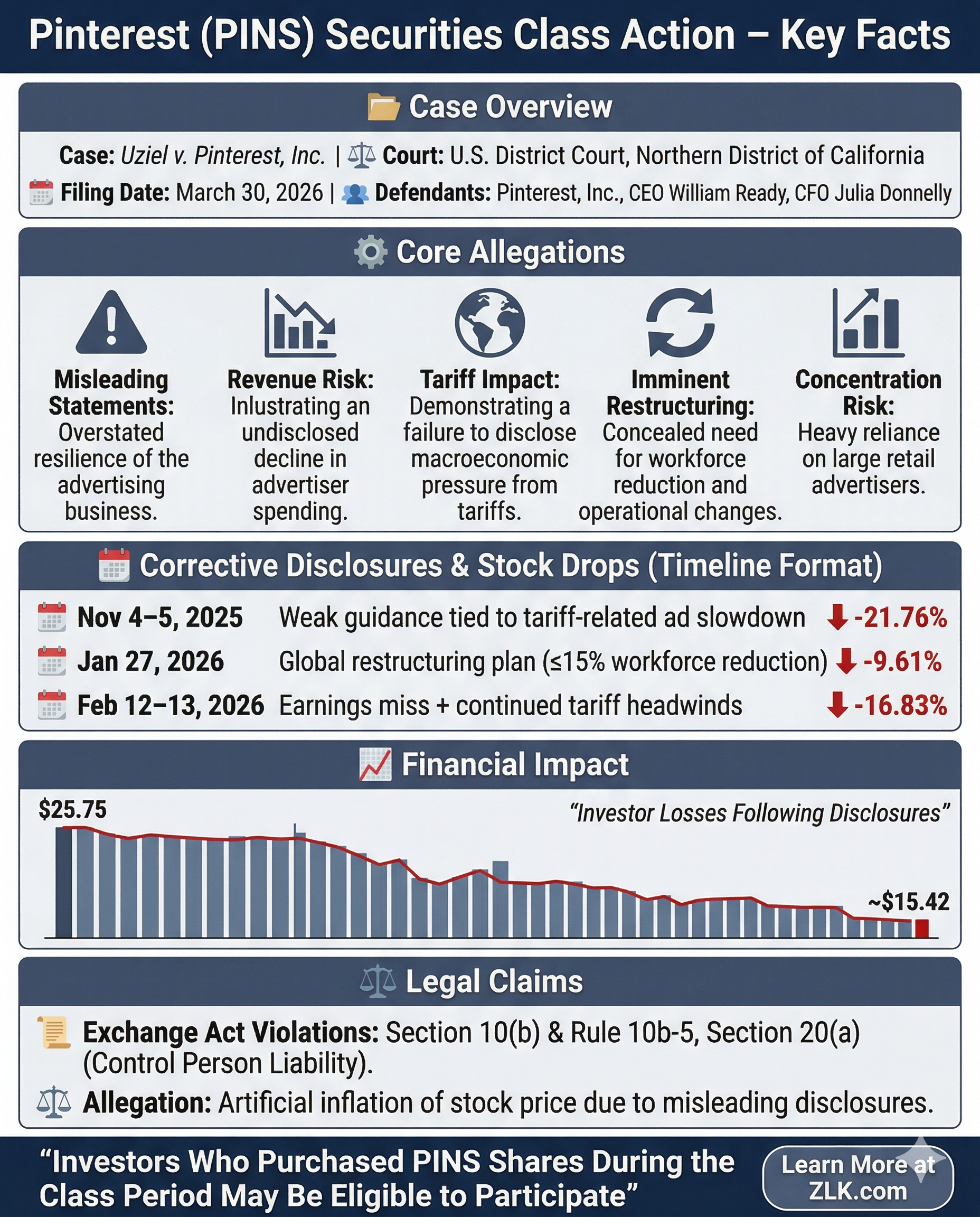
November 5, 2025 – PINS fell $7.16 (21.76%) to $25.75; January 27, 2026 – PINS fell $2.49 (9.61%) to $23.41; February 13, 2026 – PINS fell $3.12 (16.83%) to $15.42 |
|
Lawsuit Type |
Securities Class Action |
Introduction
A securities class action lawsuit has been filed against Pinterest, Inc. (NYSE: PINS), CEO William Ready, and CFO Julia Brau Donnelly on behalf of investors who purchased or acquired Pinterest securities between February 7, 2025 and February 12, 2026. The complaint, filed in the United States District Court for the Northern District of California, alleges that defendants made materially false and misleading statements about Pinterest's ability to navigate macroeconomic headwinds, particularly the impact of U.S. tariffs on its largest advertising partners, while concealing that the company was experiencing or was likely to experience significant revenue declines that would ultimately necessitate a major corporate restructuring. As the truth emerged through a series of disappointing earnings reports and a restructuring announcement involving a nearly 15% workforce reduction, Pinterest's stock price suffered three significant declines, ultimately closing at $15.42 per share on February 13, 2026.
Company Profile
Pinterest is a visual social media platform where users organize content into themed "boards" that reflect their interests in various products and services. The company generates substantially all of its revenue from advertising, with a substantial portion coming from a small number of advertisers, particularly large retail and consumer packaged goods companies, who leverage Pinterest's platform to reach high-intent shoppers across the marketing funnel.
Class Period
February 7, 2025 – February 12, 2026, inclusive.
Investors who purchased or acquired Pinterest, Inc. (PINS) securities during the Class Period may be entitled to seek recovery under the federal securities laws.
Allegations
The complaint alleges that throughout the Class Period, defendants consistently assured investors that Pinterest's business model was resilient, durable, and well-positioned to thrive regardless of the macroeconomic environment. Beginning with the company's Q4 2024 earnings call on February 6, 2025, CEO William Ready told investors that Pinterest's lower-funnel advertising innovations had "compounding effects over not just multiple quarters, but multiple years," while CFO Julia Donnelly described the business as "inherently profitable." Ready emphasized that Pinterest was "demonstrating that we can be a much larger portion of the overall ad market" and pointed to the company's deepening relationships with its largest, most sophisticated advertisers as evidence of sustainable growth.
According to the complaint, defendants continued making these representations even as the macroeconomic landscape deteriorated for Pinterest's core advertising partners. At a Morgan Stanley conference on March 6, 2025, Ready dismissed tariff-related concerns by asserting that "in any environment, people are still going to shop" and claiming Pinterest had "a real secular growth story" with fundamentals that "have just never been better." During the Q1 2025 earnings call on May 8, 2025, Ready declared that Pinterest's "strategy and consistent execution has made Pinterest more resilient than ever," while Donnelly stated that the company was "confident in our multiple revenue initiatives" and its "ability to compete effectively across a number of scenarios." When analysts specifically asked about tariff-exposed categories showing softness, Donnelly acknowledged only "small pockets of spend" had been impacted and reassured the market that "the fundamentals of our business remain strong." By the Q2 2025 earnings call on August 7, 2025, Donnelly identified retail as continuing to be a "sources of strength" and described the macroeconomic environment as "a relatively more constructive environment than feared."
The complaint alleges defendants knew or recklessly disregarded that these statements were materially false and misleading. Specifically, plaintiffs allege that Pinterest was experiencing or was likely to experience materially reduced revenues from its advertising partners, that defendants overstated the company's ability to manage the impact of U.S. tariffs on its largest retail advertisers, and that the severity of these headwinds was significant enough that Pinterest was facing an imminent need to restructure its operations. The complaint further alleges that during the Class Period, the Individual Defendants together sold approximately 421,903 shares of company stock for over $13.5 million in proceeds, with Ready selling 141,126 shares for over $4.3 million and Donnelly selling 280,777 shares for over $9.1 million, providing them with a financial motive to maintain the stock's artificially inflated price.
The Truth Emerges
The truth began to surface on November 4, 2025, when Pinterest reported its Q3 2025 financial results and issued Q4 revenue guidance with a midpoint of $1.325 billion, below the consensus expectation of $1.34 billion. During the earnings call, Donnelly acknowledged that Pinterest "faced pockets of moderating ad spend" as "larger U.S. retailers navigate tariff-related margin pressure in the current environment." This was a stark reversal from the confident assurances defendants had provided throughout the preceding months. Analyst reactions were swift: RBC Capital Markets cut its price target from $45 to $38, writing that "tariff-related weakness showed up for the first time" and would "reinforce PINS' lack of customer diversity for the bears"; Citi slashed its target from $50 to $38, identifying headwinds from "larger U.S. retailers moderating ad spend amid tariff-related margin pressures"; and HSBC reduced its target from $44.30 to $34.50. Yet even during this same earnings call, defendants continued to downplay the severity of the situation, with Donnelly insisting that "overall, we still feel really good about our mid- to high teens kind of revenue growth targets over the medium and long term."
The second corrective disclosure came on January 27, 2026, when Pinterest announced a board-approved global restructuring plan that included a reduction in force affecting nearly 15% of the company's workforce, along with office space reductions. The company estimated pre-tax restructuring charges of approximately $35 million to $45 million. Analysts viewed the announcement as a harbinger of further deterioration: RBC characterized it as "foreshadowing a revenue shortfall," Wells Fargo called it a "cautious early read on '26 revenue outlook," and HSBC bluntly stated, "We hate to say it, but it's not working."
The full extent of the damage became clear on February 12, 2026, when Pinterest reported Q4 2025 revenue of $1.32 billion, below the consensus estimate of $1.33 billion, and provided Q1 2026 revenue guidance of $951 million to $971 million, well below the consensus estimate of $980.6 million. CEO Ready acknowledged an "exogenous shock this year related to tariffs, which are disproportionately affecting ad spend from our top retail advertisers" and admitted that the company's "higher mix of large retailers relative to some of our peers has resulted in us feeling more of an impact." CFO Donnelly conceded that "our largest retail advertisers created a more meaningful headwind than we expected" and warned that "we expect these headwinds will continue and may become slightly more pronounced in Q1."
Market Reaction
The series of corrective disclosures devastated Pinterest's stock price. Following the Q3 2025 earnings report on November 4, 2025, PINS fell $7.16 per share, or 21.76%, to close at $25.75 on November 5, 2025. When the company announced its restructuring plan on January 27, 2026, the stock declined an additional $2.49 per share, or 9.61%, to close at $23.41. The final blow came after the Q4 2025 earnings report on February 12, 2026, when PINS dropped $3.12 per share, or 16.83%, to close at $15.42 on February 13, 2026. HSBC again cut its price target, this time by 30% from $24.90 to $17.40, noting that the "combinations of decelerating revenues and margin pressure in the 1Q26 guidance still caught us off-guard." Over the course of these three corrective events, Pinterest shareholders suffered significant losses and damages as the stock price declined precipitously.
Next Steps
● The Court will issue its order for lead plaintiff and counsel in the weeks after submissions are due.
● The Court will then consider motion for class certification.
● The Court will later consider a Motion to Dismiss.
Disclaimer: This shareholder alert is for informational purposes only and does not constitute legal advice. Consult a qualified attorney for personalized guidance. No specific outcomes are guaranteed.
Check Eligibility
✓ No cost or obligation
✓ See if you qualify