Roblox Corporation Class Action Lawsuit – RBLX
|
RBLX Class Action Summary |
|
|
Company |
Roblox Corporation (NYSE: RBLX) |
|
Lead Plaintiff Deadline |
August 7, 2026 |
|
Class Period |
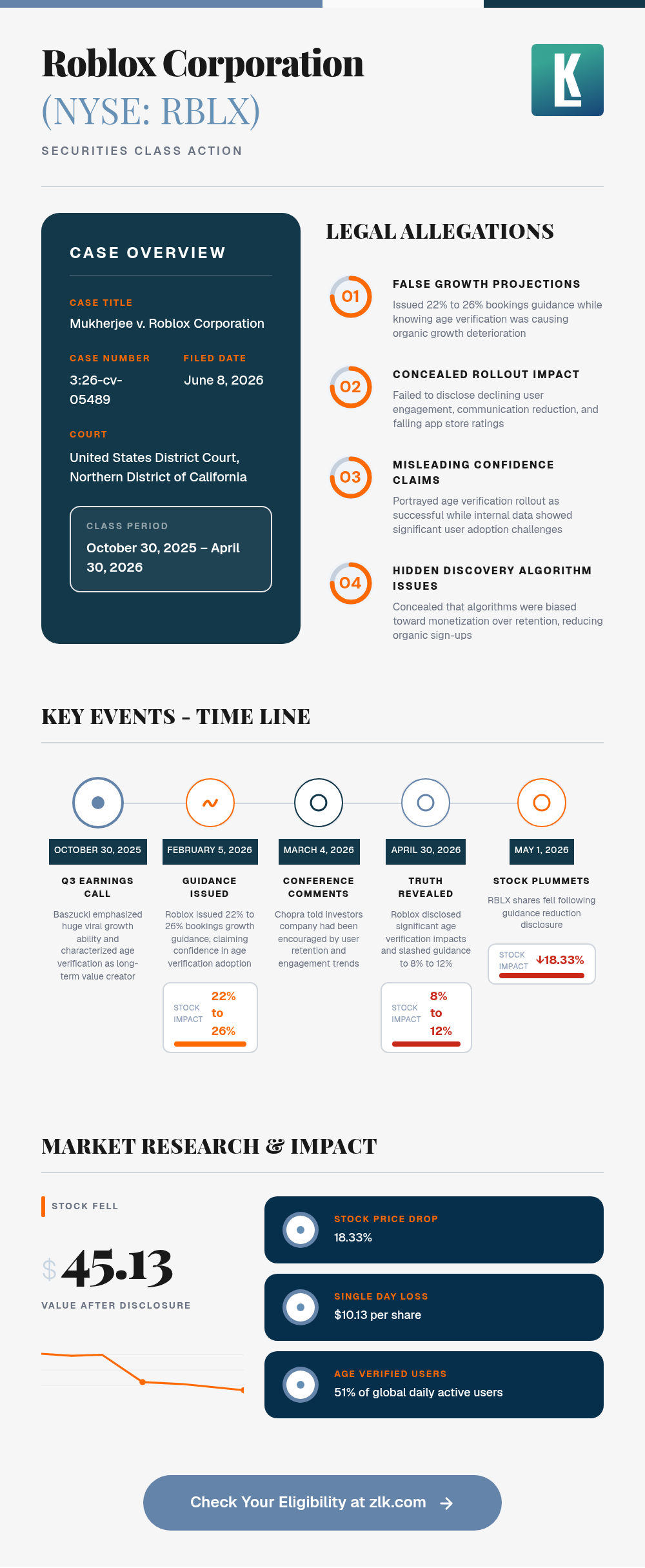
October 30, 2025 – April 30, 2026 |
|
Stock Drop |
May 1, 2026 – RBLX fell $10.13 (18.33%) to $45.13 |
|
Lawsuit Type |
Securities Class Action |
Introduction
A securities class action lawsuit has been filed against Roblox Corporation (NYSE: RBLX), its CEO David Baszucki, and its CFO Naveen K. Chopra by Levi & Korsinsky, LLP on behalf of investors who purchased Roblox common stock between October 30, 2025, and April 30, 2026. The complaint alleges that during the Class Period, defendants made materially false and misleading statements about Roblox's growth potential and the anticipated impact of its mandatory age verification rollout, including issuing bookings growth guidance of 22% to 26% for fiscal year 2026 that allegedly failed to account for significant headwinds from the rollout. On April 30, 2026, Roblox reduced its bookings growth guidance to 8% to 12%, and the complaint alleges the disclosure revealed more significant impacts from the age verification rollout on engagement, organic growth, and app store ratings than management had previously communicated. Following this disclosure, Roblox's stock price plummeted from $55.26 to $45.13 per share in a single trading day, a decline of approximately 18.33%.
Company Profile
Roblox Corporation operates a global gaming and creation platform consisting of the Roblox Client, the Roblox Studio, and the Roblox Cloud. The company, headquartered in San Mateo, California, enables users to create, share, and experience interactive content across devices, and its common stock trades on the New York Stock Exchange under the ticker RBLX.
Class Period
October 30, 2025 – April 30, 2026
Investors who purchased or acquired Roblox Corporation (RBLX) securities during the Class Period may be entitled to seek recovery under the federal securities laws.
Allegations
The complaint alleges that beginning with the third quarter fiscal 2025 earnings call on October 30, 2025, defendants painted an overwhelmingly positive picture of Roblox's growth trajectory heading into 2026, even as the company prepared to mandate age verification across its platform. Defendant Baszucki repeatedly emphasized Roblox's "huge ability to virally attract new users" through organic hits, described the company as capturing only 3% of the global gaming market with vast room for expansion, and characterized the age verification rollout as a long-term value creator for shareholders with only the possibility of "short-term headwinds." Defendant Chopra reinforced this messaging by describing the platform's "tremendous organic growth" as the primary driver of expansion and characterizing potential headwinds from safety policies as uncertain while telling investors it was "too early to put any specific numbers around '26."
On February 5, 2026, defendants issued concrete fiscal 2026 guidance projecting 22% to 26% bookings growth, according to the complaint. Defendant Chopra stated that the guidance directly "reflects our confidence in the adoption of our age-checking technology" and was informed by data from early testing of the age verification rollout. Defendant Baszucki praised the rollout, telling analysts he was "very excited and proud of the way our age verification rollout has gone" and that the company had discovered "a bigger growth opportunity in the 18-plus demographic than previously assumed." When asked directly about challenges with the rollout, Baszucki dismissed concerns, stating "we sure don't think about it that way." Defendant Chopra further framed the guidance as conservative, noting it excluded any potential viral hits and highlighting how previous guidance cycles had underestimated the company's performance.
The complaint alleges these statements were materially false and misleading because defendants created a false impression that they possessed reliable information about the rollout's impact while failing to disclose that Roblox's organic growth was already faltering under the weight of the mandatory age verification process. According to the complaint, defendants knew or recklessly disregarded that age check adoption was tapering quickly, that the rollout was compounding reductions in on-platform communication, that app store ratings were declining as a result, and that these knock-on effects were producing a swift reduction in organic growth. Rather than disclosing these alleged risks, the complaint claims defendants used the exclusion of viral-hit assumptions to make the guidance appear conservative, even though it allegedly depended on a flawless rollout and continued organic momentum that was already deteriorating. On March 4, 2026, Defendant Chopra continued to reinforce this narrative at the Morgan Stanley Technology, Media & Telecom Conference, telling investors the company had been "encouraged" by user retention and engagement trends while acknowledging only that some headwind had been anticipated.
The Truth Emerges
According to the complaint, Roblox’s April 30, 2026 earnings call disclosed more significant impacts from the age verification rollout. Defendant Baszucki revealed that user acquisition and engagement had been significantly impacted, disclosing that only 51% of global daily active users had completed age verification (up from just 45% at the end of the prior quarter), that a "follow-on reduction" in communication engagement had occurred because users who had not age-checked were barred from communicating, and that even age-checked users experienced reduced engagement because they had fewer people to communicate with. The company also disclosed that its discovery algorithms had been biased toward monetization over retention, which, combined with reduced communication, had led to declining app store ratings and a corresponding reduction in organic sign-ups.
Defendant Chopra then discussed the guidance reduction, slashing full-year bookings growth guidance from 22% to 26% down to just 8% to 12%, with corresponding margin reductions. Chopra acknowledged that management now ‘better understand[s]’ the second-order impacts of reduced communication engagement, which the complaint alleges were more disruptive than defendants had previously represented. The company further disclosed that daily active users had come in weaker than anticipated and were expected to continue contracting into the second quarter before returning to sequential growth in the third quarter.
Market Reaction
The market reacted swiftly and sharply to Roblox's disclosures. From a closing price of $55.26 on April 30, 2026, RBLX shares fell to $45.13 on May 1, 2026, a single-day decline of approximately $10.13 per share, or 18.33%. Multiple prominent analysts slashed their price targets in response. Barclays cut its target by 48% to $60, noting the need to "lower estimates across the board." J.P. Morgan's Cory Carpenter reduced his target by 33% to $50, highlighting that "facial age verification has been much more disruptive than expected." Piper Sandler analyst Thomas Champion described himself as "bewildered" by the earnings call, calling attention to the dramatic gap between the guidance issued just one quarter earlier and the reality now confronting investors.
Next Steps
● Lead Plaintiff Deadline: August 7, 2026
● After the lead plaintiff deadline, the Court will consider any lead plaintiff motions.
● Defendants may file a motion to dismiss the complaint.
● If the case proceeds, the Court may later consider class certification.
Disclaimer: This shareholder alert is for informational purposes only and does not constitute legal advice. Consult a qualified attorney for personalized guidance. No specific outcomes are guaranteed.
Check Eligibility
✓ No cost or obligation
✓ See if you qualify