Super Micro Computer, Inc. Class Action Lawsuit – SMCI
Introduction to Super Micro Computer, Inc. (SMCI) Securities Class Action Lawsuit
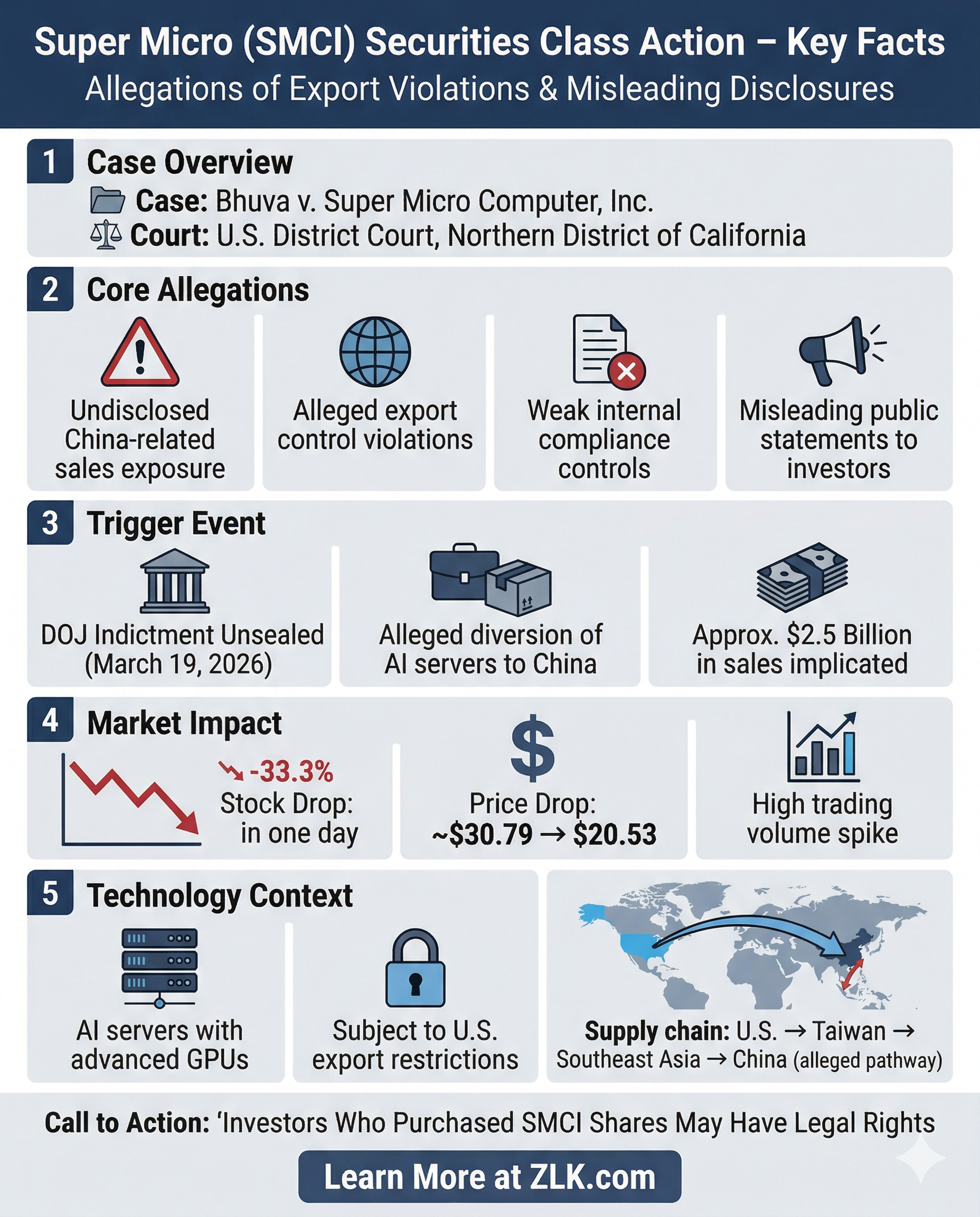
A securities fraud class action has been filed against Super Micro Computer, Inc. (NASDAQ: SMCI), asserting claims under Sections 10(b) and 20(a) of the Securities Exchange Act of 1934 and Rule 10b-5, in the U.S. District Court for the Northern District of California on behalf of investors who purchased or acquired the company’s securities between February 2, 2024 and March 19, 2026. Investors allege that Super Micro and its executives made materially false or misleading statements, and failed to disclose that a significant portion of the Company’s server sales were to China-based companies, that those transactions violated U.S. export control laws, and that there were material weaknesses in the Company’s controls to ensure compliance with those laws and regulations. On March 19, 2026, the U.S. Justice Department announced criminal indictments alleging that approximately $2.5 billion worth of servers housing U.S. artificial intelligence technology were diverted to customers in China in violation of U.S. export control laws. The next day, Super Micro’s stock fell 33.3% to $20.53 per share amid unusually heavy trading.
Super Micro Computer, Inc. (SMCI) Securities Lawsuit Case Details
Case Name: Apurva Bhuva v. Super Micro Computer, Inc., et al.
Case No.: 5:26-cv-02606
Jurisdiction: U.S. District Court, Northern District of California
Filed on: March 25, 2026
Super Micro Computer, Inc. (SMCI) Company Profile
Super Micro Computer is headquartered in San Jose, California, and publicly traded on the Nasdaq exchange under the ticker NASDAQ: SMCI. The company designs, develops, and manufactures high-performance server and storage systems, primarily for artificial intelligence, data center, and cloud solutions customers. The company’s flagship products are servers that integrate Nvidia graphics processing units and are subject to strict U.S. export controls, including regulations governing U.S.-origin GPU technology administered by the U.S. Department of Commerce barring their sale to China without a license.
Super Micro Computer, Inc. (SMCI) Securities Lawsuit Class Period
February 2, 2024 – March 19, 2026, inclusive.
All persons and entities that purchased or otherwise acquired Super Micro securities, including common stock traded on the Nasdaq exchange during the Class Period and were damaged thereby may be eligible to join the Super Micro Computer, Inc. (SMCI) class action lawsuit.
Allegations in the Super Micro Computer, Inc. (SMCI) Securities Class Action Lawsuit
The complaint alleges that Super Micro, CEO Charles Liang, and CFO David Weigand made materially false and misleading statements during the Class Period while failing to disclose that a significant portion of server sales were to China-based companies, that those transactions violated U.S. export control laws, and that there were material weaknesses in the Company’s controls to ensure compliance with those laws and regulations. On April 30, 2024, CEO Charles Liang announced record third quarter revenue of $3.85 billion with year-over-year growth of 200%, attributing the success to strong demand for AI rack scale solutions and the company’s ability to expand its market leadership in AI infrastructure, while he and David Weigand certified the effectiveness of internal controls in SEC filings. The company continued celebrating explosive growth throughout 2024 and into 2025, even as Hindenburg Research published a report on August 27, 2024 highlighting ongoing internal control weaknesses, with Liang announcing on August 6, 2024 that fiscal 2024 revenue surged 110% year over year to $14.9 billion, driven by what he described as record demand for new AI infrastructures.
During this period, the complaint alleges that a significant portion of these celebrated sales were actually servers illegally diverted to companies based in China in violation of U.S. export control laws, including AI servers assembled in the United States with Nvidia GPUs that were routed through Southeast Asia to conceal their ultimate China destination. On August 5, 2025, Liang touted the company’s solid progress in fiscal year 2025, claiming 47% annual growth fueled by AI solution leadership across multiple customer segments including what he termed sovereign entities, while concealing a dependence on China-based sales for a significant portion of revenue. By November 4, 2025, Liang projected at least $36 billion in revenue for fiscal year 2026, citing a rapidly expanding order book that included more than $13 billion in Blackwell Ultra orders, which investors allege lacked a reasonable basis because export compliance controls were deficient. Throughout these announcements, investors allege that defendants concealed material weaknesses in the company’s controls to ensure compliance with applicable export control laws and regulations, even after Ernst & Young LLP resigned as the independent auditor on October 30, 2024 citing concerns about management integrity and board independence, all while the illegal sales scheme allegedly generated approximately $2.5 billion in revenue between 2024 and 2025.
The Truth Emerges
On March 19, 2026, after the market closed, the U.S. Justice Department announced the unsealing of an indictment against three individuals associated with Super Micro for engaging in a scheme to divert massive quantities of servers housing U.S. artificial intelligence technology containing Nvidia GPUs to customers in China in violation of U.S. export control laws by routing shipments through Southeast Asia. The announcement revealed that these activities were conducted to drive sales in violation of U.S. law, enabling the sale of approximately $2.5 billion worth of servers between 2024 and 2025, including more than $510 million diverted in a six-week period between April and May 2025. Super Micro confirmed that the charged individuals had been affiliated with the company, including co-founder Yih-Shyan Wally Liaw, who resigned from the board following the indictment, and reported that two employees were placed on administrative leave and one contractor’s relationship was terminated, and stated that Super Micro was not named as a defendant in the DOJ criminal case, while acknowledging the company had been cooperating fully with the government’s investigation.
These revelations followed the company’s prior statements celebrating record growth and market leadership and supported allegations that significant server sales were illegally diverted to China in violation of U.S. export control laws and that the company lacked adequate export compliance controls. The complaint alleges there were material weaknesses in the companys export compliance controls, and that, during the Class Period, executives highlighted a fast-growing order pipeline, artificially inflating the stock price and significant Blackwell Ultra demand exceeding $13 billion.
Market Reaction
On March 20, 2026, following the Justice Department’s announcement, Super Micro’s stock price (NASDAQ: SMCI) collapsed $10.26, or 33.3%, closing at $20.53 per share on unusually heavy trading volume, wiping out approximately $6.1 billion in market value. The single-day decline came as investors absorbed the DOJ’s disclosures about an alleged scheme to divert servers to China in violation of U.S. export control laws, including the sale of approximately $2.5 billion worth of servers between 2024 and 2025, and the criminal indictments of individuals associated with the company.
Next Steps
● The Court will issue its order for lead plaintiff and counsel in the weeks after submissions are due.
● The Court will then consider motion for class certification.
● The Court will later consider a Motion to Dismiss.
Disclaimer: This shareholder alert is for informational purposes only and does not constitute legal advice. Consult a qualified attorney for personalized guidance. No specific outcomes are guaranteed.
Check Eligibility
✓ No cost or obligation
✓ See if you qualify