Trip.com Group Limited Class Action Lawsuit – TCOM
Introduction to Trip.com Group Limited (TCOM) Securities Class Action Lawsuit
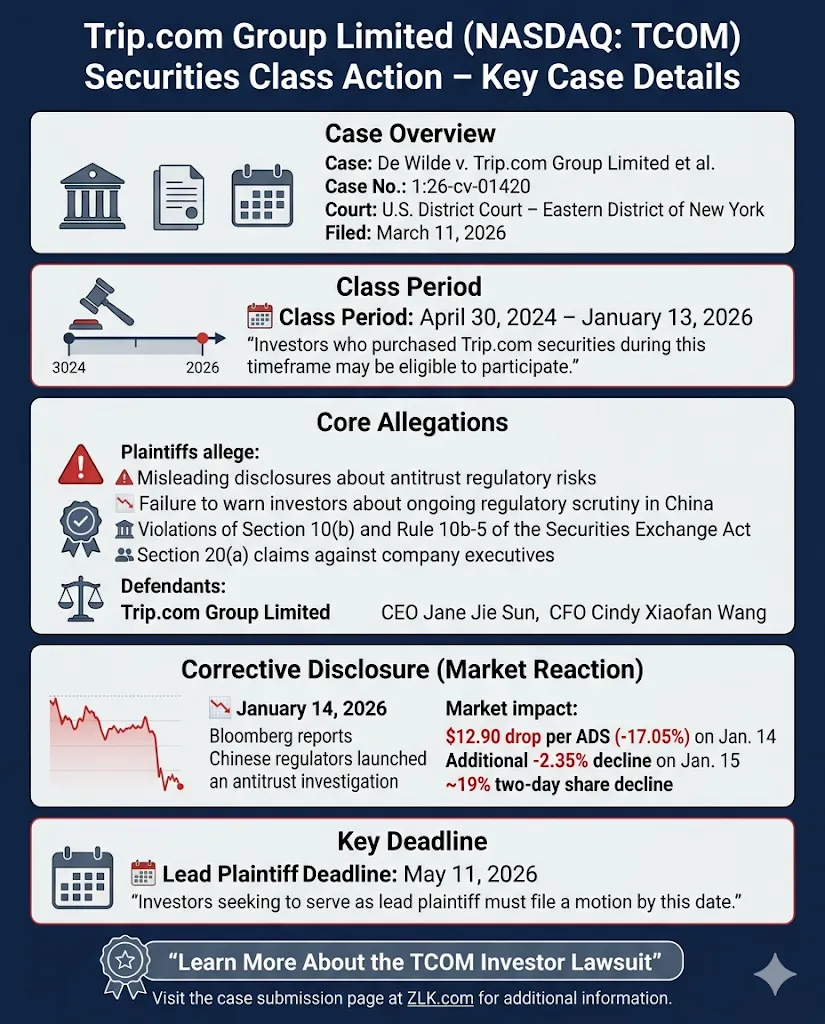
A securities fraud class action under the Securities Exchange Act of 1934 has been filed against Trip.com Group Limited (NASDAQ: TCOM) and two executives for alleged misrepresentations during the period from April 30, 2024 to January 13, 2026. Investors allege that the company and its leadership understated the regulatory risks facing Trip.com stemming from monopolistic business practices and antitrust violations. On January 14, 2026, Bloomberg reported that China’s State Administration for Market Regulation had launched an antitrust investigation into Trip.com, accusing the company of abusing its market position and engaging in monopolistic practices. According to the complaint, the news was followed by a two-day decline in Trip.com’s ADS price.
Trip.com Group Limited (TCOM) Securities Lawsuit Case Details
Case Name: De Wilde v. Trip.com Group Limited et al.
Case No.: 1:26-cv-01420
Jurisdiction: U.S. District Court, Eastern District of New York
Filed on: March 11, 2026
Trip.com Group Limited (TCOM) Company Profile
Trip.com Group Limited is a leading global one-stop travel service provider that integrates a comprehensive suite of travel products and services as an online travel platform with differentiated travel content. The company serves as the go-to destination for travelers in Asia and increasingly for travelers worldwide, leveraging its one-stop-shop model, high-quality service, and advanced technology across accommodation reservation, transportation ticketing, packaged tours, and corporate travel management to expand its global reach in China and other key markets.
Trip.com Group Limited (TCOM) Securities Lawsuit Class Period
April 30, 2024 - January 13, 2026, inclusive.
Investors who purchased or otherwise acquired publicly traded Trip.com securities during the Class Period and suffered losses may be eligible to join the Trip.com Group Limited (TCOM) class action lawsuit as class members, including purchasers of American Depositary Shares listed on the NASDAQ under the ticker TCOM.
Allegations in the Trip.com Group Limited (TCOM) Securities Class Action Lawsuit
The complaint targets Trip.com Group Limited, Chief Executive Officer Jane Jie Sun, and Chief Financial Officer Cindy Xiaofan Wang for allegedly misleading investors about the regulatory threats facing the company in violation of federal securities laws. According to investors, the defendants recklessly understated the antitrust risks stemming from Trip.com's monopolistic business activities and failed to disclose material regulatory risk during a period when regulatory scrutiny was intensifying.
On April 29, 2024, Sun and Wang signed the company's 2023 Annual Report on Form 20-F, which acknowledged that Trip.com's strategy to invest in complementary businesses and establish strategic alliances "involves significant risks and uncertainties that may have a material adverse effect on our business, reputation, financial condition, and results of operations" but, according to the complaint, those statements were misleading because they allegedly understated the regulatory risk facing Trip.com in light of its alleged monopolistic business activities and China’s anti-monopoly enforcement environment.
Nearly a year later, on April 11, 2025, the executives repeated virtually identical language in the 2024 Annual Report on Form 20-F, again presenting antitrust risks as contingent concerns. The complaint alleges those statements were materially false and misleading because defendants allegedly understated the regulatory risk Trip.com faced as a result of its alleged monopolistic business activities.
Regulatory scrutiny had been building for months, with authorities convening a meeting of five online tourism platforms in August to discuss antitrust concerns and summoning Trip.com in September by the Zhengzhou market regulator for violations of rules against unfair restrictions on merchants. Rather than acknowledge this mounting pressure, investors allege the company continued to frame regulatory risk as hypothetical and concealed the scope of the antitrust investigation risk.
The Truth Emerges
On January 14, 2026, Bloomberg published an article entitled "China Starts Antitrust Probe of Trip.com Ahead of Travel Peak," revealing that China's State Administration for Market Regulation (the national market regulator) had launched a formal investigation into the company as an antitrust probe. The regulator accused Trip.com of abusing its market position and engaging in monopolistic practices, taking aim at what it described as "the country's dominant online travel platform" and citing alleged unfair restrictions.
Trip.com issued a brief statement saying it would cooperate with the investigation initiated by SAMR. According to the complaint, the news contradicted the company’s prior disclosures, which had framed antitrust risk as a potential future concern. Instead, investors learned that Trip.com was already under active investigation for allegedly monopolistic conduct, exposing the gap between what executives had disclosed and the regulatory reality the company faced in China.
Market Reaction
According to the complaint, Trip.com’s ADS price fell sharply following the antitrust investigation announcement. On January 14, 2026, the company's American Depositary Shares (NASDAQ: TCOM) plummeted $12.90 per ADS, a decline of 17.05%, closing at $62.78 in heavy trading. The selloff continued the following day as shares fell an additional $1.48 per ADS, or 2.35%, to close at $61.30 on January 15, 2026 marking an approximately 19% stock price decline over two trading sessions.
Next Steps
● The Court will issue its order for lead plaintiff and counsel in the weeks after submissions are due.
● The Court will then consider motion for class certification.
● The Court will later consider a Motion to Dismiss.
Disclaimer: This shareholder alert is for informational purposes only and does not constitute legal advice. Consult a qualified attorney for personalized guidance. No specific outcomes are guaranteed.
Check Eligibility
✓ No cost or obligation
✓ See if you qualify