
Expired
Lead Plaintiff Deadline
Jun 9, 2026
Choose your preferred way to stay informed of new case launches and settlement deadlines
The filed complaint alleges that United Homes Group, Inc. made materially false and/or misleading statements and/or failed to disclose that: (1) the Company’s controlling shareholder, Nieri, intended to force a sale of the Company; (2) Nieri was taking actions to devalue the Company and its financial condition; (3) Nieri leveraged his controlling interest to effectuate that sale, including by effectively forcing the dissident directors to resign; and (4) as a result of the foregoing, Nieri was not acting in the best interests of the Company and public investors.
In order to be eligible to join the UHG class action lawsuit, you must have incurred a loss on shares of United Homes Group, Inc. purchased during the class period listed above.
If you suffered a loss in United Homes Group, Inc. during the relevant time frame or pursuant to the relevant offering(s), you have until June 9, 2026 to request that the Court appoint you as lead plaintiff. Your ability to share in any recovery doesn't require that you serve as a lead plaintiff.
|
Company |
United Homes Group, Inc. (NASDAQ: UHG) |
|
Lead Plaintiff Deadline |
June 9, 2026 |
|
Class Period |
May 19, 2025 – February 22, 2026 |
|
Stock Drop |
October 20, 2025 – UHG fell $2.23 (52.46%) to $2.03; November 6, 2025 – UHG fell $0.11 (7.6%) to $1.34; February 23, 2026 – UHG fell $1.23 (51.68%) to $1.15 |
|
Lawsuit Type |
Securities Class Action |
A securities class action lawsuit has been filed against United Homes Group, Inc. (NASDAQ: UHG) and certain of its current and former executives in the United States District Court for the Southern District of New York. The complaint alleges violations of Sections 10(b) and 20(a) of the Securities Exchange Act of 1934 on behalf of investors who purchased or acquired United Homes securities between May 19, 2025 and February 22, 2026. The lawsuit alleges that defendants made materially false and misleading statements by concealing that the Company's controlling shareholder, founder Michael Nieri, was pursuing a course of conduct designed to force a sale of the Company at a steep discount to shareholders, including by effectively driving the resignation of six of seven board members and leveraging his controlling interest to devalue the Company. When the full scope of Nieri's alleged scheme was revealed through a series of disclosures culminating in a February 2026 acquisition announcement at $1.18 per share, an over 50% discount to the prior trading price, United Homes' stock suffered devastating cumulative losses.
United Homes Group, Inc. is a residential home building company incorporated in Delaware and headquartered in Chapin, South Carolina. The Company's Class A common shares trade on the NASDAQ exchange under the ticker symbol UHG. As of April 2025, founder Michael Nieri and his family members held 100% of Class B shares, representing 79% of voting power, and 68.8% of Class A shares.
May 19, 2025 – February 22, 2026, inclusive.
Investors who purchased or acquired United Homes Group, Inc. (UHG) securities during the Class Period may be entitled to seek recovery under the federal securities laws.
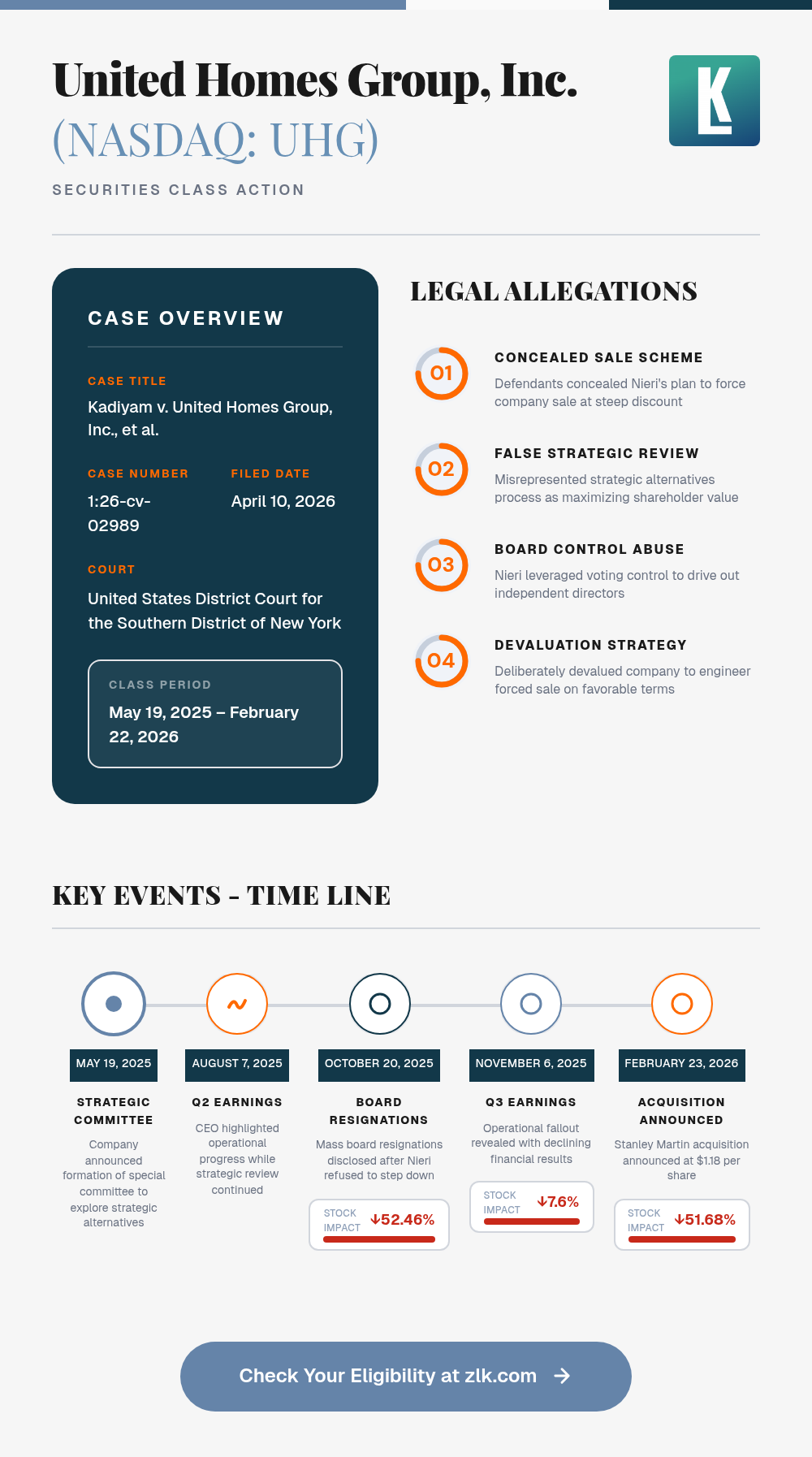
The complaint alleges that throughout the Class Period, defendants concealed that United Homes' founder, Executive Chairman, and controlling shareholder Michael Nieri intended to force a sale of the Company on terms detrimental to public investors. Beginning on May 19, 2025, the Company announced the formation of a special committee of independent directors to explore strategic alternatives "to maximize shareholder value," including a potential sale, asset disposition, or refinancing. Nieri publicly stated the Company was "committed to maximizing value for all of our shareholders." According to the complaint, these representations were materially false and misleading because they concealed Nieri's actual intentions and the actions he was taking to devalue the Company and engineer a forced sale.
The complaint further alleges that throughout the summer of 2025, the Company continued to present an image of good-faith strategic exploration. In its second quarter 2025 earnings release on August 7, 2025, CEO Jack Micenko highlighted operational progress and product initiatives, while the Company reiterated that the strategic alternatives review was ongoing and aimed at maximizing shareholder value. The Company's Form 10-Q filed August 8, 2025 affirmed effective internal disclosure controls and procedures, and included a risk factor warning that the strategic alternatives process "may not be successful[,]" a warning the complaint characterizes as misleading given what defendants allegedly knew about Nieri's plans. Throughout these disclosures, the complaint alleges defendants failed to reveal that Nieri was not acting in the best interests of the Company and its public investors.
At the core of the alleged scheme, the complaint contends that Nieri leveraged his 79% voting control to effectively force the resignation of the Company's independent directors when they attempted to check his authority. When the special committee concluded its review and unanimously determined that remaining independent was in shareholders' best interests, the dissident directors conditioned their continued service on Nieri stepping down as Executive Chairman and forgoing remaining compensation. Nieri refused, and six of seven board members resigned, leaving Nieri as the sole remaining director with control over the Company's fate. The complaint alleges this was not an unexpected governance crisis but rather the predictable result of Nieri's deliberate campaign to consolidate control and force a sale on his terms.
The truth began to surface on October 20, 2025, when United Homes filed a Form 8-K revealing the outcome of the special committee's review. While the committee had unanimously concluded that continuing as an independent public company was in shareholders' best interests, the filing disclosed a dramatic corporate governance breakdown: the entire board, except Nieri, had either resigned immediately or announced their intention to resign by November 14, 2025, after Nieri refused to step down as Executive Chairman. The revelation that the Company's controlling shareholder had effectively driven out the independent board members who disagreed with him stunned the market.
The damage deepened on November 6, 2025, when the Company's third quarter earnings release revealed the operational fallout from the mass board resignations. United Homes disclosed it had been "engaged in discussions with various key counterparties, including its lenders, land banking partners, and insurers" about maintaining compliance with loan covenants and "the pressing need to identify replacement directors." The Company further reported a 29% year-over-year decline in home closings and a 23% decline in revenue. The subsequent Form 10-Q filed November 7, 2025 disclosed that key counterparties including auditors had "expressed concern regarding UHG's ongoing corporate governance" and warned that failure to seat replacement directors could result in NASDAQ delisting, inability to obtain audit opinions, and default under debt arrangements.
The full extent of the alleged scheme became clear on February 23, 2026, when United Homes announced it had agreed to become a wholly owned subsidiary of Stanley Martin Homes, LLC in an all-cash transaction valuing the enterprise at approximately $221 million. Shareholders would receive just $1.18 per share, an over 50% discount to the $2.38 closing price on the last trading day before the announcement. The complaint alleges this fire-sale acquisition was the culmination of Nieri's deliberate strategy to devalue the Company and force a sale that served his interests at the expense of public shareholders.
United Homes' stock suffered three devastating declines as the truth emerged. On October 20, 2025, following disclosure of the mass board resignations and Nieri's refusal to step down, UHG shares fell $2.23 per share, or 52.46%, to close at $2.03 on unusually heavy trading volume. On November 6, 2025, after the Company revealed deteriorating financial results and significant operational difficulties stemming from the governance crisis, UHG fell an additional $0.11 per share, or 7.6%, to close at $1.34 on unusually heavy volume.
The most damaging blow came on February 23, 2026, when the Stanley Martin acquisition was announced at $1.18 per share. UHG shares fell $1.23, or 51.68%, to close at $1.15 on unusually heavy trading volume. The $1.18 deal price represented an over 50% discount to the prior day's $2.38 closing price, and a precipitous decline from the Class Period high of $4.49 reached on August 22, 2025.
Next Steps
● The Court will issue its order for lead plaintiff and counsel in the weeks after submissions are due.
● The Court will then consider motion for class certification.
● The Court will later consider a motion to dismiss.
Disclaimer: This shareholder alert is for informational purposes only and does not constitute legal advice. Consult a qualified attorney for personalized guidance. No specific outcomes are guaranteed.
TOP