Upstart Holdings Class Action Lawsuit – UPST
|
Company |
Upstart Holdings, Inc. (NASDAQ: UPST) |
|
Lead Plaintiff Deadline |
June 8, 2026 |
|
Class Period |
May 14, 2025 – November 4, 2025 |
|
Stock Drop |
November 5, 2025 – UPST fell $4.49 (9.71%) to $41.75 |
|
Lawsuit Type |
Securities Class Action |
Introduction
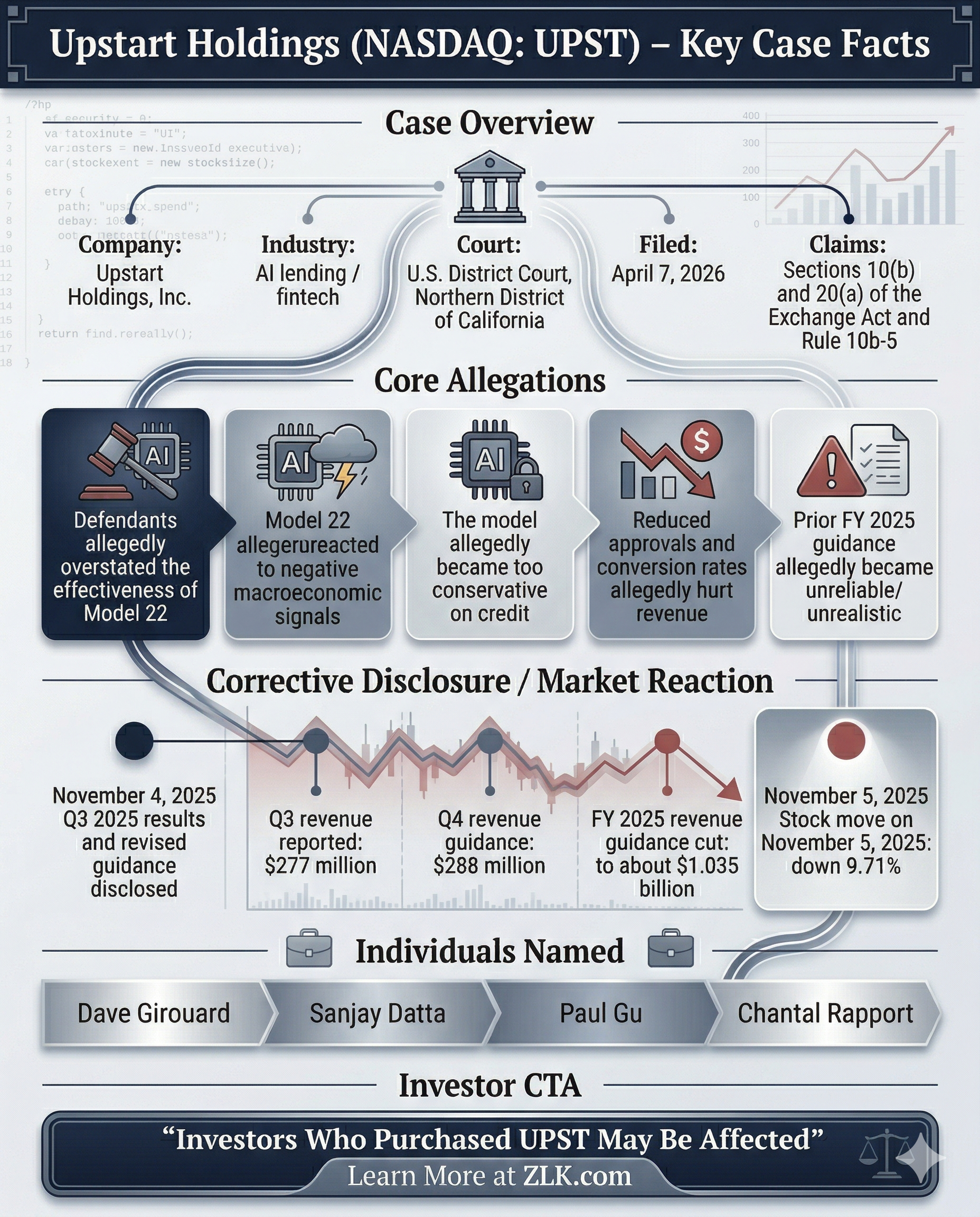
A securities class action lawsuit has been filed against Upstart Holdings, Inc. (NASDAQ: UPST) and several of its senior executives on behalf of investors who purchased or acquired Upstart securities between May 14, 2025 and November 4, 2025. The complaint, filedin the United States District Court for the Northern District of California, alleges that defendants made materially false and misleading statements about the accuracy and performance of the company's flagship AI underwriting model, Model 22, and its impact on loan approval rates, conversion rates, and revenue growth. According to the lawsuit, defendants concealed that Model 22 frequently overreacted to negative macroeconomic signals, producing overly conservative credit assessments that materially undermined Upstart's revenue results and rendered its repeatedly raised full-year 2025 revenue guidance unreliable. When these issues surfaced on November 4, 2025, during Upstart's third-quarter earnings release and conference call, the company's stock price fell $4.49 per share, or 9.71%, to close at $41.75 the following day, causing significant losses to investors.
Company Profile
Upstart Holdings, Inc. operates a cloud-based artificial intelligence lending platform in the United States. The company's platform facilitates unsecured personal loans, small dollar loans, auto refinance and retail loans, auto secured personal loans, and home equity lines of credit, using proprietary AI models to assess borrower risk through a process the company calls "risk separation."
Class Period
May 14, 2025 – November 4, 2025, both dates inclusive.
Investors who purchased or acquired Upstart Holdings, Inc. (UPST) securities during the Class Period may be entitled to seek recovery under the federal securities laws.
Allegations
The complaint alleges that throughout the Class Period, Upstart's senior leadership, CEO Dave Girouard, CFO Sanjay Datta, CTO Paul Gu, and CMO Chantal Rapport, aggressively promoted the capabilities of Model 22, the latest iteration of Upstart's AI underwriting system launched in early May 2025. Defendants portrayed Model 22 as a breakthrough that was driving substantially higher loan approval rates, improved conversion rates, and accelerating revenue growth. On the strength of these representations, Upstart raised its full-year 2025 revenue guidance twice during the Class Period, first in May to approximately $1.01 billion and then again in August to approximately $1.055 billion, including an increase of $70 million in expected fee revenue, citing improvements driven specifically by Model 22.
At Upstart's inaugural AI Day on May 14, 2025, the Individual Defendants highlighted the model's purported superiority over traditional underwriting, with investor presentations depicting how the company's proprietary AI purportedly drove higher approval rates than traditional underwriting models. During the second-quarter earnings call on August 5, 2025, Defendant Girouard attributed the company's growth "primarily" to Model 22, while Defendant Datta credited the model for improving contribution margins and take rates. Defendant Gu described Model 22's ability to identify "many, many small subtle relationships in the data" as the source of higher approval rates. The Q2 2025 Form 10-Q, certified by Defendants Girouard and Datta under the Sarbanes-Oxley Act, attributed substantial increases in transaction volume and conversion rates to "model improvements." According to the complaint, these statements created an increasingly optimistic picture of Upstart's trajectory that was disconnected from what defendants knew about Model 22's actual behavior.
The lawsuit alleges that defendants knew or recklessly disregarded that Model 22 frequently overreacted to negative macroeconomic signals in performing its risk-separation processes, resulting in overly conservative credit assessments that reduced loan approvals and conversion rates. Defendant Gu later admitted on the Q3 2025 earnings call that defendants had "knowingly" chosen to make the model "more conservative on the credit side in earlier parts of the quarter." The complaint further alleges that defendants' failure to disclose these material deficiencies in Model 22 violated Item 303 of SEC Regulation S-K, which required disclosure of known trends or uncertainties reasonably likely to have a material unfavorable impact on revenues. Meanwhile, during the Class Period, Defendant Girouard sold 208,335 shares of Upstart stock for proceeds exceeding $13.5 million, Defendant Datta sold 26,985 shares for over $1.4 million, and Defendant Gu sold 5,000 shares for over $344,000.
The Truth Emerges
On November 4, 2025, after the market closed, Upstart reported third-quarter 2025 results that revealed the scope of Model 22's problems. The company reported Q3 revenue of $277 million, missing both its own guidance of approximately $280 million and consensus estimates by $2.62 million. Upstart also guided for Q4 2025 revenue of only $288 million, significantly below the $303.7 million consensus estimate, and cut its full-year 2025 revenue guidance to approximately $1.035 billion from the $1.055 billion it had projected just three months earlier. Expected full-year fee revenue was slashed to approximately $946 million from the prior outlook of approximately $990 million.
During the accompanying earnings call, the defendants directly attributed the shortfall to Model 22. Defendant Girouard acknowledged that the company's "risk models responded to macroeconomic signals they observed by moderately reducing approvals and increasing interest rates," driving a decline in conversion rates from 23.9% in Q2 to 20.6% in Q3. He conceded the model may have been "overreacting" and that the negative impact would continue into Q4. Defendant Gu went further, admitting that the model was "overly responsive" to changes and plagued by "measurement error," and that defendants had been "knowingly making a choice" to run the model more conservatively, a disclosure that directly contradicted the confident assurances made throughout the Class Period about Model 22's accuracy and its ability to drive sustained growth.
Market Reaction
Following these disclosures, Upstart's stock price fell $4.49 per share, or 9.71%, to close at $41.75 on November 5, 2025. The reaction was swift and severe across Wall Street: Morgan Stanley slashed its price target on UPST to $45 from $70, noting that Upstart needed to demonstrate its AI model and forecasting could "sufficiently adapt to UMI volatility." Goldman Sachs cut its target to $40 from $54, warning that "recent trends in volume are likely to underscore the limited forward visibility in the model." Citigroup reduced its target to $80 from $100, Bank of America cut to $71 from $81, Needham lowered to $56 from $82, and Stephens & Co. dropped to $40 from $55. American Banker reported that Upstart's stock had "plummeted" not because of poor profits, but because "its own AI model intentionally tightened the credit box, causing a miss on loan origination volume."
Next Steps
● The Court will issue its order for lead plaintiff and counsel in the weeks after submissions are due.
● The Court will then consider motion for class certification.
● The Court will later consider a motion to dismiss.
Disclaimer: This shareholder alert is for informational purposes only and does not constitute legal advice. Consult a qualified attorney for personalized guidance. No specific outcomes are guaranteed.
Check Eligibility
✓ No cost or obligation
✓ See if you qualify