Vital Farms Class Action Lawsuit – VITL
|
Vital Farms Class Action Summary |
|
|
Company |
Vital Farms, Inc. (NASDAQ: VITL) |
|
Lead Plaintiff Deadline |
May 26, 2026 |
|
Class Period |
May 8, 2025 – February 26, 2026 |
|
Stock Drop |
February 26, 2026 – VITL fell $2.68 (10.8%) to $22.11 |
|
Lawsuit Type |
Securities Class Action |
Introduction
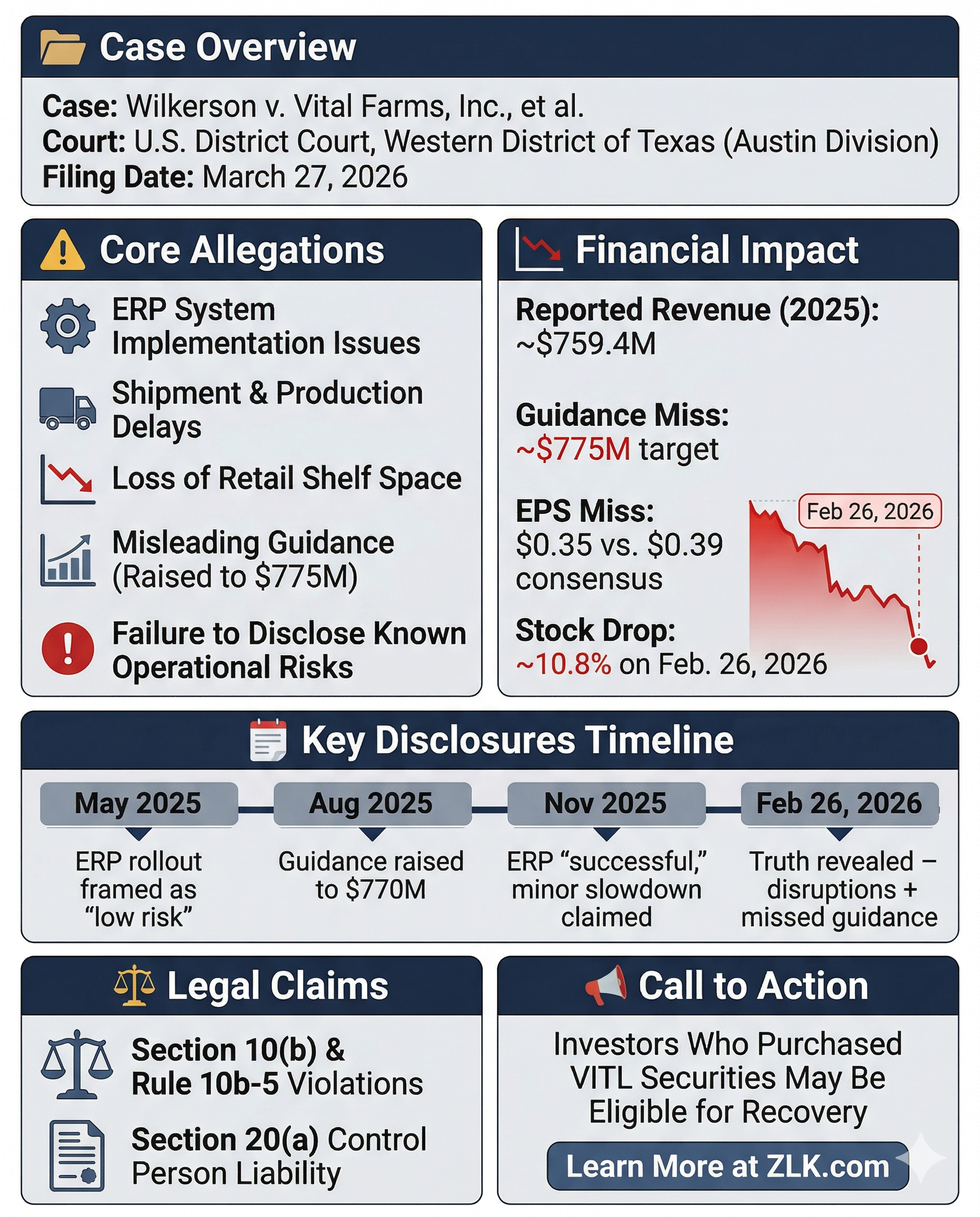
A securities class action lawsuit has been filed against Vital Farms, Inc. (NASDAQ: VITL), its CEO Russel Diez-Canseco, and its CFO Thilo Wrede on behalf of investors who purchased Vital Farms securities between May 8, 2025 and February 26, 2026. The complaint, filed in the U.S. District Court for the Western District of Texas, alleges that defendants made materially false and misleading statements about the company's transition to a new enterprise resource planning (ERP) system, failing to disclose that the implementation would cause significant disruptions to shipments and production and result in the loss of critical retail shelf space. When Vital Farms revealed on February 26, 2026 that it had missed its own revenue guidance and was still struggling to recapture shelf space lost during the ERP transition, VITL shares fell $2.68, or 10.8%, to close at $22.11.
Company Profile
Vital Farms is the leading U.S. brand of pasture-raised eggs and butter, headquartered in Austin, Texas. The company focuses on ethical food production, animal welfare, and sustainable farming, and its common stock trades on NASDAQ under the ticker symbol VITL.
Class Period
May 8, 2025 – February 26, 2026, inclusive.
Investors who purchased or acquired Vital Farms (VITL) securities during the Class Period may be entitled to seek recovery under the federal securities laws.
Allegations
The complaint alleges that throughout the Class Period, Vital Farms and its senior executives misled investors about the risks and consequences of the company's multi-year transition to a new ERP system. Vital Farms had repeatedly disclosed that the ERP implementation was "fundamental" to its planned operational improvements and required the significant time and attention of management and key crew members. Yet according to the complaint, defendants knew or recklessly disregarded that the ERP rollout would cause material disruptions to the company's shipments and production, disruptions they failed to disclose to investors, instead presenting the risks only as hypothetical possibilities in boilerplate risk disclosures.
The alleged misrepresentations began with Vital Farms' first quarter 2025 10-Q, filed May 8, 2025, when CFO Thilo Wrede announced the ERP launch date had been pushed from summer to early fall 2025 to "ensure flawless switchover." The complaint alleges that this delay itself signaled the complexity and risk of the transition, yet defendants continued to present the implementation in optimistic terms while signing Sarbanes-Oxley certifications attesting to the accuracy of the company's financial reporting and internal controls. In the second quarter 2025 earnings call on August 7, 2025, Wrede confirmed the ERP remained on track for early fall and raised full-year 2025 revenue guidance from $740 million to $770 million, further reinforcing investor confidence in the company's trajectory.
By the third quarter 2025 earnings call on November 4, 2025, the ERP had gone live and production had already slowed. The complaint alleges defendants sought to minimize these disruptions, with Wrede characterizing the slowdown as lasting only "the first two weeks of the fourth quarter" and claiming it was "always part of our plan." Wrede further assured investors that "the business has quickly bounced back and we are now operating at pre go live shipment levels" and raised guidance again to $775 million.
According to the complaint, these statements were materially false and misleading because the production disruptions were more severe and longer-lasting than defendants acknowledged, resulting in delayed shipments during the critical holiday period that cost Vital Farms valuable retail shelf space, a consequence defendants failed to disclose.
The Truth Emerges
On February 26, 2026, before markets opened, Vital Farms filed its 2025 annual report revealing that fiscal year 2025 revenue came in at $759.4 million, missing the company's own raised guidance of $775 million. The company also reported earnings per share of $0.35, falling short of the $0.39 market consensus. The 2025 10-K acknowledged what the complaint alleges defendants had concealed for months: that Vital Farms "experienced temporary disruptions in order and fulfillment levels following the launch date of the new ERP system" in the fourth quarter of fiscal 2025.
During the accompanying earnings call, CFO Wrede admitted that "volume growth so far is lagging our initial expectations" and revealed that the company was "still recapturing shelf space" lost after "several weeks of slow shipments following our ERP implementation last year during the lead-up to the peak holiday period." CEO Diez-Canseco acknowledged the "short-term dislocation" and described ongoing efforts to rebuild retailer relationships, telling analysts the company was shifting from retailers asking "can you ship what you're talking about" to conversations about how to "grow together." These admissions directly contradicted the third quarter assurances that the business had "quickly bounced back" and that the slowdown had "no impact" on full-year guidance.
Market Reaction
Following the February 26, 2026 disclosures, Vital Farms stock declined $2.68 per share, or 10.8%, to close at $22.11. The sharp sell-off reflected the market's reassessment of the company's operational condition after learning that the ERP-related disruptions were materially worse than defendants had represented, that revenue had missed guidance, and that the company was still working to recapture lost retail shelf space months after the ERP went live.
Next Steps
· The Court will issue its order for lead plaintiff and counsel in the weeks after submissions are due.
· The Court will then consider motion for class certification.
· The Court will later consider a Motion to Dismiss.
Disclaimer: This shareholder alert is for informational purposes only and does not constitute legal advice. Consult a qualified attorney for personalized guidance. No specific outcomes are guaranteed.
Check Eligibility
✓ No cost or obligation
✓ See if you qualify