
When faced with legal disputes, individuals often must decide whether to pursue a class action lawsuit or an individual lawsuit.
Both legal avenues have distinct characteristics, advantages, and challenges. Understanding these differences is crucial for making an informed decision that best suits the nature of the claim and the plaintiff’s circumstances.
This blog examines the definitions, key differences, advantages, disadvantages, and situational considerations of class actions versus individual lawsuits.
Defining Class Actions and Individual Lawsuits
What is a Class Action Lawsuit?
A class action lawsuit is a legal procedure where one or more plaintiffs file a lawsuit on behalf of a larger group, or "class," of people who have suffered similar harm from the same defendant.
Thiscollective approach allows courts to manage cases that would be impractical to litigate individually due to the number of affected parties or the relatively small damages per individual.
The outcome of a class action applies to all members of the class, binding them to the judgment or settlement unless they opt out.
Class actions are commonly used in cases involving consumer fraud, defective products, environmental harm, securities fraud, and civil rights violations.
The legal framework for class actions in the U.S. is primarily governed by Rule 23 of the Federal Rules of Civil Procedure, which sets criteria for class certification, including numerosity, commonality, typicality, and adequacy of representation.
What Constitutes an Individual Lawsuit?
An individual lawsuit is a legal action initiated by a single plaintiff who seeks redress for personal harm or damages caused by another party.
Unlike class actions, individual lawsuits focus solely on the plaintiff’s unique circumstances and claims.
The plaintiff has complete control over the legal strategy, settlement decisions, and the pursuit of compensation tailored to their specific losses.
Individual lawsuits are appropriate when the damages are substantial enough to justify the cost and effort of litigation or when the plaintiff’s situation is distinct from others who might have similar claims.
Key Differences Between Class Actions and Individual Lawsuits
| Aspect | Class Action Lawsuit | Individual Lawsuit |
| Number of Plaintiffs | Multiple plaintiffs represented collectively | Single plaintiff |
| Filing Process | Requires court certification of the class | Filed by an individual plaintiff |
| Cost Implications | Shared legal costs among class members | The plaintiff bears full legal costs |
| Fee Structures | Typically, contingency fees are paid from the settlement | Often, contingency or hourly fees are paid by the plaintiff |
| Control Over Legal Strategy | Lead counsel controls case direction | The plaintiff controls legal decisions |
| Settlement | The settlement applies to all class members | Settlement tailored to the individual plaintiff |
Advantages of Class Actions
Cost Efficiency and Resource Sharing
Class actions pool resources, allowing plaintiffs to share the costs of litigation, including court fees, expert witnesses, and legal representation.
This cost-sharing makes it feasible for individuals with small claims to seek justice, which might otherwise be prohibitively expensive.
Accessibility for Individuals with Small Claims
Many plaintiffs have claims too small to justify individual lawsuits.
Class actions aggregate these claims, enabling the collective pursuit of compensation and holding defendants accountable for widespread harm.
Potential for Greater Legal Impact and Visibility
Class actions can bring significant public attention to corporate misconduct or systemic issues, potentially leading to regulatory changes and deterrence of future wrongdoing.
The collective nature of class actions also exerts greater pressure on defendants to settle or change practices.
Advantages of Individual Lawsuits
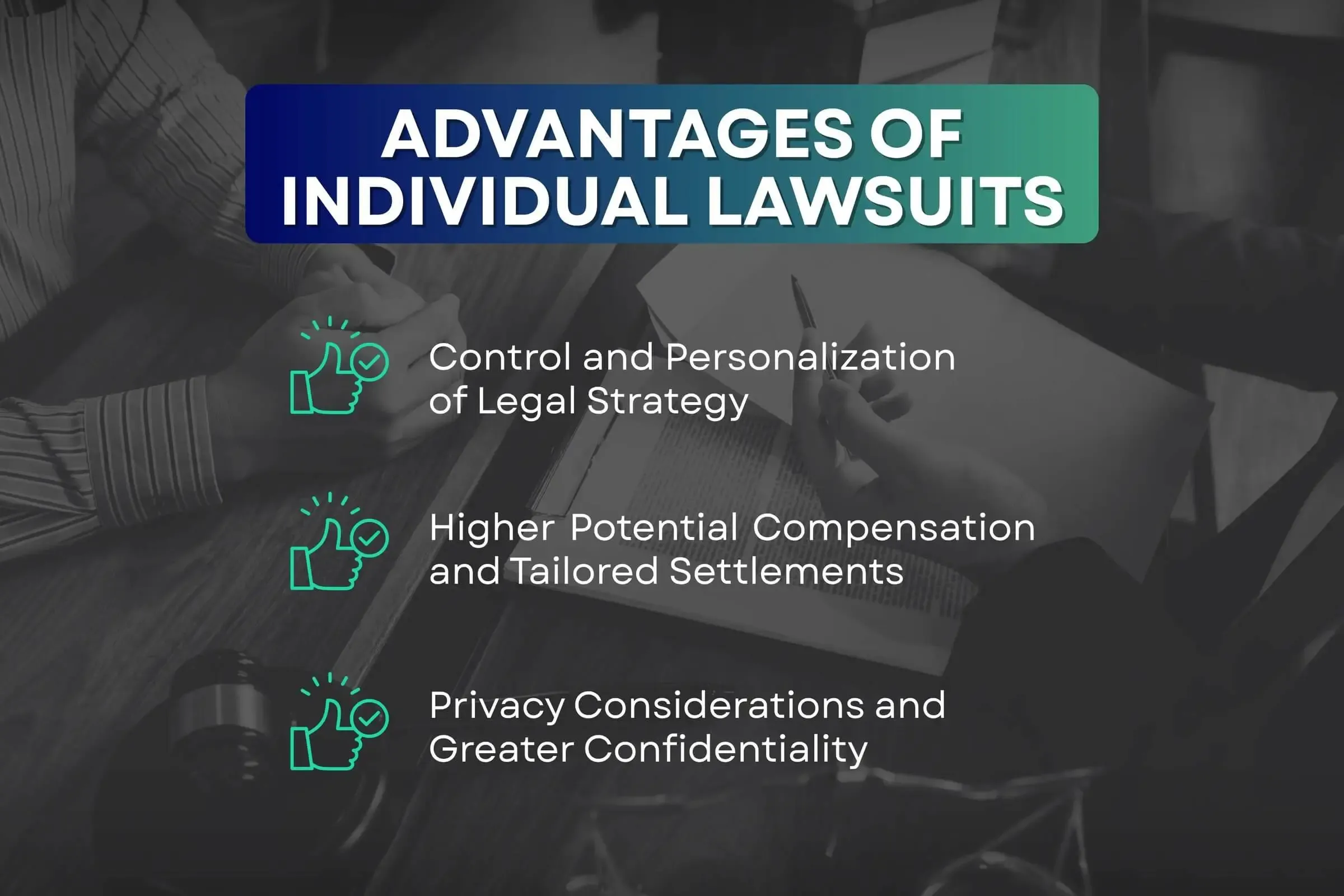
Control and Personalization of Legal Strategy
Individual lawsuits allow plaintiffs to tailor their legal approach to their specific circumstances. They have the autonomy to make decisions about settlement offers, trial strategies, and the scope of claims pursued.
Higher Potential Compensation and Tailored Settlements
Unlike class actions, where settlements are divided among many plaintiffs, individual lawsuits can result in compensation that directly reflects the plaintiff’s unique damages, potentially leading to higher awards.
Privacy Considerations and Greater Confidentiality
Individual lawsuits often afford greater privacy, as the details of the case and settlement can remain confidential. In contrast, class actions are public and involve multiple parties, which can result in less privacy for individual plaintiffs.
Challenges Associated with Class Actions
Limited Control Over Case Direction
Class members typically have little say in the legal strategy or settlement negotiations, which lead counsel manages. This can lead to dissatisfaction if individual interests are not fully represented.
Possibility of Reduced Individual Recovery
Because settlements are divided among all class members, individual compensation may be relatively small, especially in cases with large classes or coupon settlements that offer limited monetary value.
Extended Timeframes and Uncertain Outcomes
Class actions can take years to resolve due to their complexity, the need for class certification, and the extensive discovery processes involved.
The outcome is also uncertain, and plaintiffs must wait for the collective resolution.
Challenges of Individual Lawsuits
Higher Financial Risk for Plaintiffs
Individual lawsuits require plaintiffs to bear the full cost of litigation, which can be substantial. If the case is unsuccessful, plaintiffs may face significant financial losses.
Extended Litigation Processes and Costs
While sometimes faster than class actions, individual lawsuits can still be lengthy and expensive, especially if the defendant contests the claims vigorously.
Potential Isolation from Collective Action Benefits
Plaintiffs in individual lawsuits do not benefit from the collective bargaining power or resource sharing that class actions provide, which can limit their leverage against well-funded defendants.
When to Choose a Class Action vs. an Individual Lawsuit
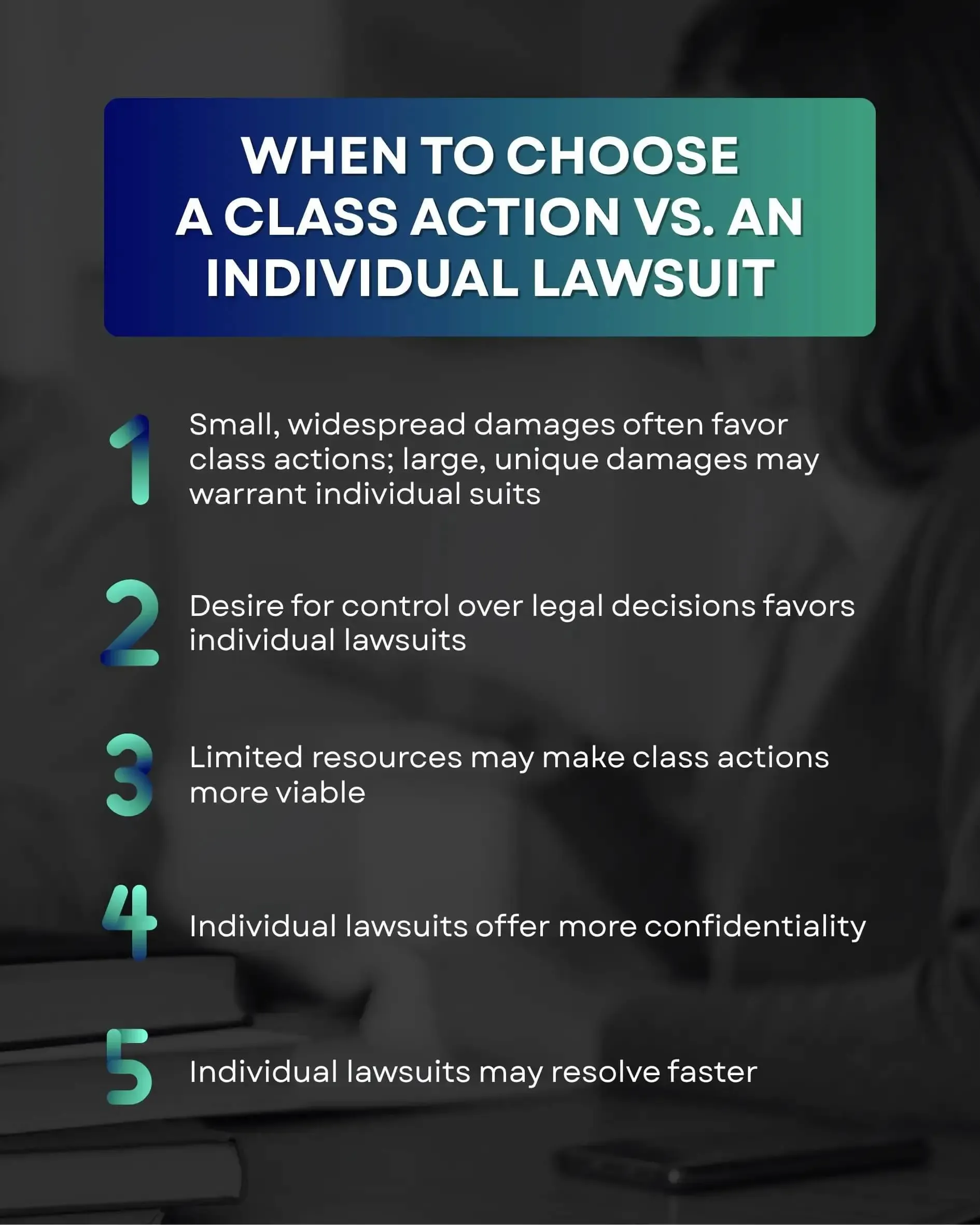
Evaluating Your Case: Factors to Consider
- Size and nature of damages: Small, widespread damages often favor class actions; large, unique damages may warrant individual suits.
- Control preferences: Desire for control over legal decisions favors individual lawsuits.
- Financial resources: Limited resources may make class actions more viable.
- Privacy concerns: Individual lawsuits offer more confidentiality.
- Time sensitivity: Individual lawsuits may be resolved more quickly.
Situational Examples
- Class Action: Consumers affected by a defective product sold by a large corporation, where individual damages are small but numerous.
- Individual Lawsuit: A person suffering severe injury from medical malpractice seeks substantial compensation.
Making an Informed Decision on the Right Legal Procedure
Choosing between a class action and an individual lawsuit depends on the specifics of the case, the plaintiff’s goals, and resources. Consulting with experienced legal experts is essential to evaluate the best course of action.
Consulting with Legal Experts for Guidance
Legal professionals can assess the merits of the claim, potential damages, and strategic considerations to recommend the most effective course of action.
At Levi & Korsinsky, LLP, we specialize in legal counsel for investor class action lawsuits, representing shareholders who have suffered financial losses due to securities fraud, corporate misconduct, and deceptive investment practices.
With over 80 collective years of experience, our experienced attorneys are on hand to provide you with the support and legal expertise you need to maximize your recovery.
Steps to Initiate Your Legal Process
- Consult an attorney to evaluate your case.
- Gather evidence supporting your claim.
- Decide on the legal approach (class action or individual).
- File the lawsuit with the appropriate jurisdiction.
- Engage in discovery and settlement negotiations or trial.
Class actions and individual lawsuits each serve essential roles in the legal system. Understanding their differences, benefits, and challenges empowers plaintiffs to make choices that best protect their rights and interests.
Disclaimer: The information provided in this blog is for general informational purposes only and does not constitute legal advice. We advise readers not to take any action or inaction based on the information contained in this blog without consulting a qualified legal professional. Levi & Korsinsky LLP is not responsible for any actions taken or not taken based on the information provided in this blog.