
Class action lawsuits are a cornerstone of the American legal system. They enable groups of individuals with similar claims to unite and seek justice against powerful defendants.
These collective actions level the playing field for individuals facing large corporations or institutions and promote judicial efficiency by resolving similar claims in a single proceeding.
However, a common question arises. How many people are needed to start a class action lawsuit?
The answer is nuanced and depends on several legal requirements and practical considerations. This article explores the requirements for initiating a class action, focusing on the number of people required.
Introduction
A class action lawsuit enables a group of people who have suffered similar harm to bring a claim against a defendant collectively. The primary benefits of class actions include:
Efficiency: Avoid inconsistent rulings and save judicial resources by resolving multiple similar claims in a single lawsuit.
Access to Justice: Individuals with small claims that would be uneconomical to litigate individually can seek redress as part of a group.
Deterrence: Class actions can hold powerful entities accountable for widespread harm.
Class Action Lawsuit Requirements
To proceed as a class action in federal court, a lawsuit must satisfy the requirements outlined in Rule 23 of the Federal Rules of Civil Procedure . These criteria ensure that a class action is fair to all parties and an efficient way to resolve the claims. The four key requirements are numerosity, commonality, typicality, and adequacy of representation.
1. Numerosity Requirement
The class must be so large that joining all members individually would be impractical. While there is no strict minimum, courts often presume that classes with 40 or more members meet this requirement .
The rationale is that when the group is sufficiently large, handling each claim separately becomes inefficient and burdensome.
2. Commonality and Typicality Requirements
Commonality: There must be questions of law or fact common to the class. This means the claims of all class members must share a central issue or arise from the same event or practice.
The resolution of this common question should drive the outcome for the entire class, ensuring that the case can be handled collectively rather than as a series of individual lawsuits.
Typicality: The claims or defenses of the named plaintiffs must be typical of those of the class . In other words, the representative parties’ situations must reflect the experiences and legal arguments of the broader group.
This requirement helps ensure that the named plaintiffs' interests align with those of the class as a whole .
Adequacy of Representation
The adequacy requirement ensures that the named plaintiffs and their counsel will fairly and adequately protect the interests of the class.
This means:
- The named plaintiffs’ interests must not conflict with those of the class.
- The attorneys must be qualified, experienced, and capable of conducting the litigation .
Class Certification Process
Class certification is a pivotal stage in any class action suit. It is the judicial process by which the court determines whether a case meets the legal standards to proceed as a class action.
Overview of Class Certification
Before a lawsuit can proceed as a class action, plaintiffs must formally request the court to certify the class.
Certification is not automatic; it requires plaintiffs to demonstrate that their case satisfies all the requirements of Rule 23 of the Federal Rules of Civil Procedure .
The court undertakes a rigorous analysis, often involving a hearing where both sides can present arguments and evidence.
Key elements of the certification order include:
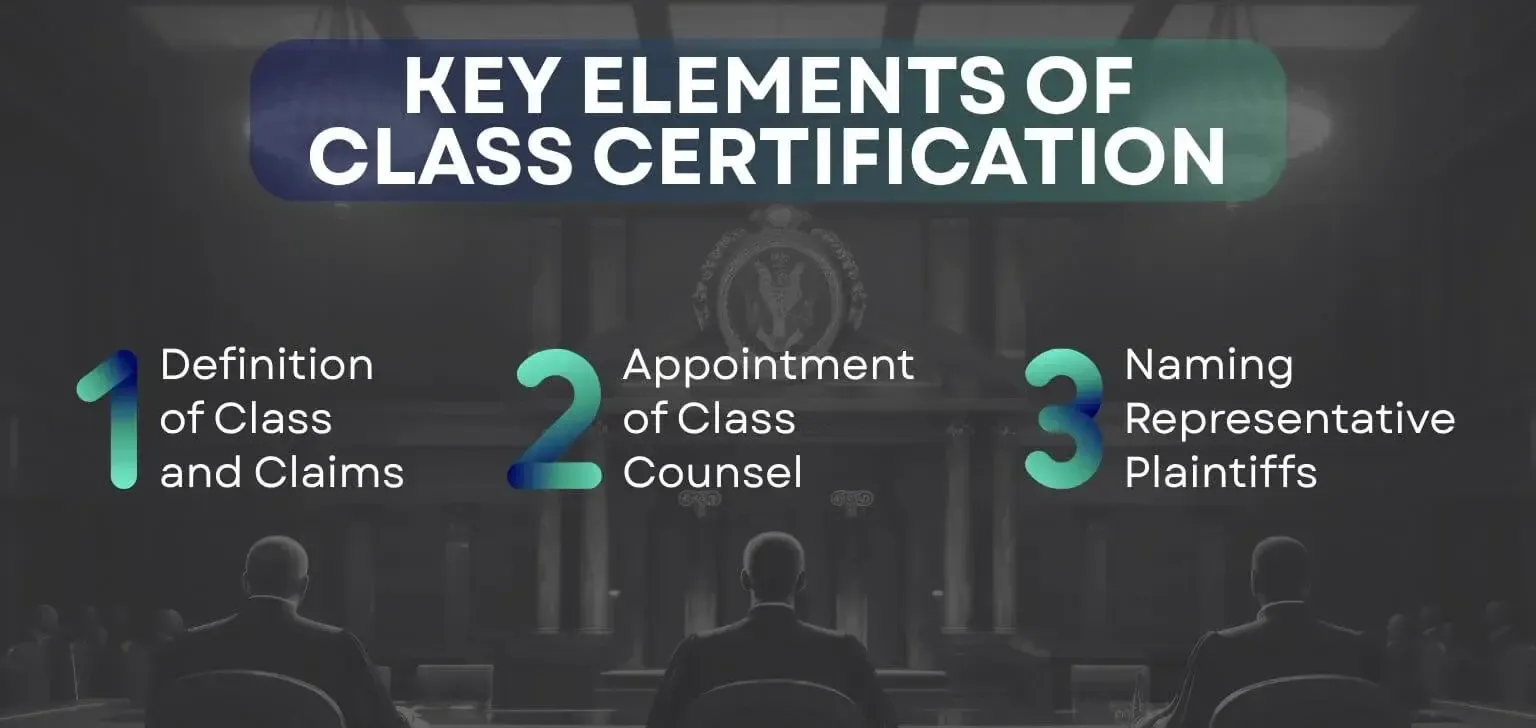
1. Defining the Class and Claims: The court must identify who is included in the class and the specific claims, issues, or defenses that will be addressed collectively. This definition is crucial for determining who is bound by the outcome of the class action suit.
2. Appointing Class Counsel: The court designates qualified attorneys to represent the interests of the class. This ensures that the class members have competent legal representation throughout the litigation.
3. Naming Representative Plaintiffs: The plaintiffs who initiated the lawsuit are officially named as class representatives. Their role is to act in the best interests of all class members.
Certification is a critical gatekeeping function. The court will only grant certification if convinced that the class action mechanism is the most appropriate and efficient way to resolve the common issues at stake.
If certification is denied, plaintiffs may have to pursue their claims individually.
Role of a Class Action Lawsuit Lawyer
Class action lawyers play an essential role in the certification process, including:
Demonstrating Compliance with Legal Requirements: Attorneys must show that the class satisfies the requirements of numerosity, commonality, typicality, and adequacy of representation.
This often involves presenting detailed evidence and legal arguments to the court.
Filing in the Proper Court: Lawyers ensure the lawsuit is filed in the correct jurisdiction and that all procedural rules are followed.
Managing Procedural Complexities: Class actions involve unique procedural steps, such as notifying potential class members, handling opt- outs, and coordinating discovery. Skilled class action lawyers navigate these complexities to protect the class's interests and move the case forward efficiently.
Factors Affecting the Number of Plaintiffs Needed
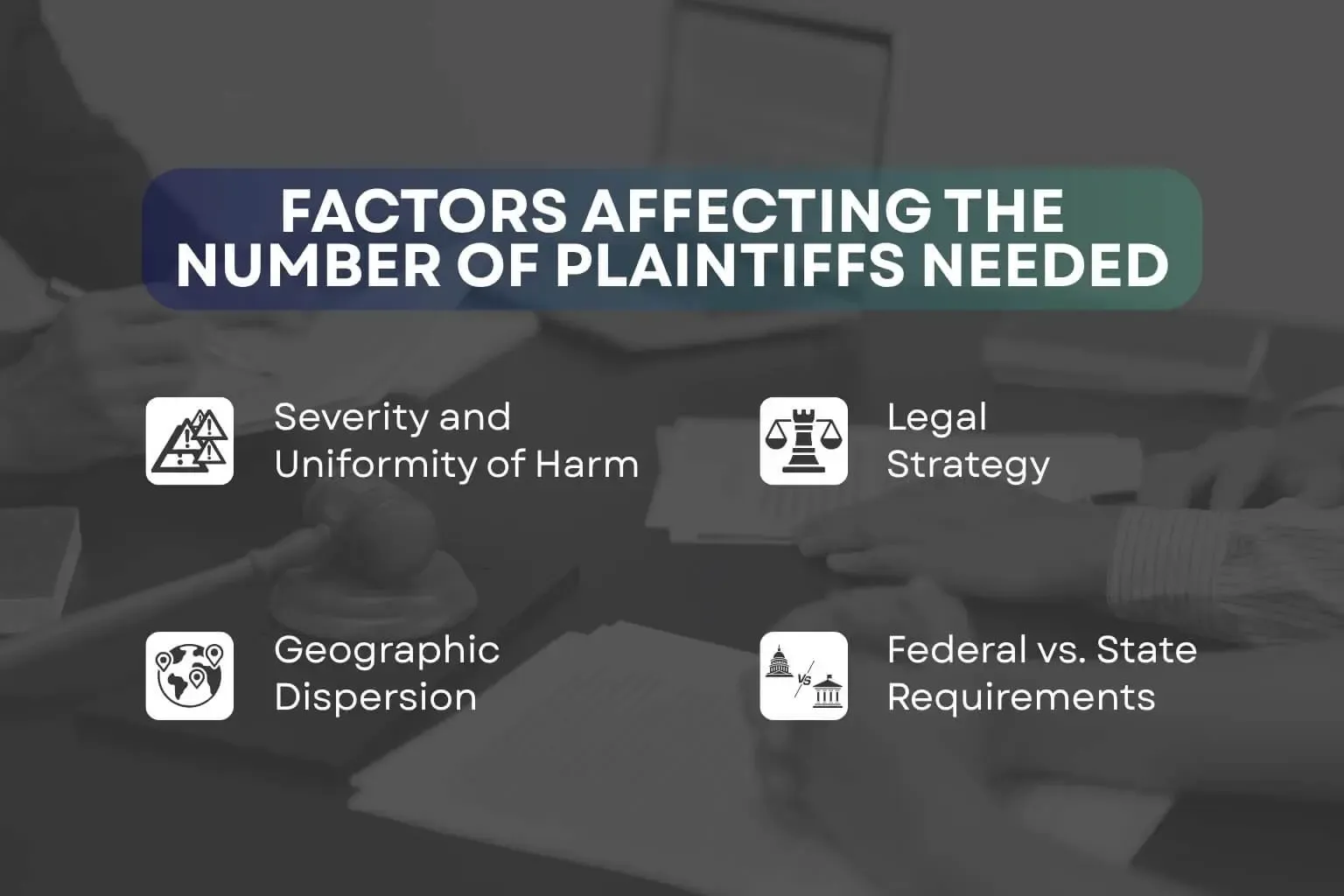
Several factors influence how many people are needed for a class action:
1. Severity and Uniformity of Harm: More severe or widespread harm may make smaller classes appropriate .
2. Geographic Dispersion: If class members are spread across numerous different jurisdictions, joining is more impractical, supporting numerosity.
3. Legal Strategy: Sometimes, a smaller class may be justified if the claims are particularly complex or individualized.
4. Federal vs. State Requirements: While federal courts follow Rule 23, some states have class action rules , which may set different thresholds or standards.
Benefits of a Class Action

A certified class action delivers a range of advantages for plaintiffs, the courts, and society. By consolidating similar claims into a single lawsuit, a class action transforms individual grievances into a collective force for justice.
Below are the key benefits of a certified class action, structured for clarity and impact:
1. Efficiency and Judicial Economy
Class actions streamline the legal process by resolving similar claims in one coordinated proceeding.
This consolidation saves significant time and resources for both the courts and the parties involved, reducing repetitive hearings and minimizing the risk of inconsistent verdicts.
2. Cost Savings for Plaintiffs
Participating in a class action allows individuals to share litigation costs, including attorney fees and court expenses.
This shared financial burden makes it feasible for people with limited resources or small claims to pursue legal action they might otherwise forgo.
3. Consistency and Uniform Outcomes
Class actions ensure that all members receive a uniform resolution to their class action claim. This consistency avoids the risk of conflicting judgments if each member pursued a separate lawsuit.
4. Increased Leverage in Class Action Settlement Negotiations
The collective strength of a certified class gives plaintiffs greater bargaining power when negotiating class action settlements.
Defendants are often more willing to settle for substantial amounts when facing the risk of a large, unified group of claimants.
5. Access to Justice for Small Claims
Class actions allow individuals with modest damages—claims too small to justify the expense of individual lawsuits—to seek compensation.
By aggregating these small claims, class actions ensure that even minimal harms are addressed and wrongdoers are held accountable.
6. Deterrence and Corporate Accountability
Successful class actions can deter future misconduct by holding defendants publicly accountable for widespread harm. This compensates victims and encourages companies and institutions to adopt fairer practices and comply with the law.
7. Addressing Systemic Issues
Class actions are particularly effective in tackling systemic problems that affect large groups, such as consumer fraud, employment discrimination, or environmental harm.
By addressing these issues collectively, class actions can drive meaningful change and promote fairness on a broader scale.
Class Action Settlement
A class action settlement is the resolution of a lawsuit before trial, but it is only finalized with court approval. The process typically involves:
Negotiation: Class counsel and the defendant negotiate the terms of the settlement.
Court Review: The court carefully reviews the proposed class action settlement to ensure it is fair, reasonable, and adequate for all class members. This includes a hearing where class members can voice support or objections.
Distribution: Once approved, compensation is distributed to class members, often pro rata, depending on the specifics of the class action settlement.
In deciding whether to approve a settlement, the court considers factors such as the strength of the plaintiffs’ case, the risks and costs of continued litigation, and the amount offered in settlement.
This oversight helps protect the interests of all class members and ensures transparency in the process.
Federal Court and Class Actions
Filing a Class Action Lawsuit in Federal Court
To file a class action in federal court, plaintiffs must satisfy Rule 23 of the Federal Rules of Civil Procedure . Additionally, the Class Action Fairness Act (CAFA) expands federal jurisdiction to cases where:
- The amount in controversy exceeds $5 million .
- There is minimal diversity (at least one plaintiff is from a different state than the defendant).
Federal courts have original jurisdiction over class actions involving federal law or constitutional issues.
Final Words on Class Action Lawsuits
Class action lawsuits are vital for addressing widespread harm and promoting justice. While no strict minimum number of plaintiffs is required, courts generally find that 40 or more members satisfy the numerosity requirement.
The ultimate decision depends on the facts of each case, including the impracticability of joining all members individually. Meeting the requirements of numerosity, commonality, typicality, and adequacy is essential for class certification.
Consulting with experienced legal counsel and understanding the legal framework is crucial for anyone considering a class action.
At Levi & Korsinsky, LLP , we specialize in legal counsel for investor class action lawsuits, representing shareholders who have suffered financial losses due to securities fraud, corporate misconduct, and deceptive investment practices.
With over 80 collective years of experience, our experienced attorneys are on hand to provide you with the support and legal expertise you need to maximize your recovery.
Disclaimer: The information provided in this blog is for general informational purposes only and does not constitute legal advice. Readers should not act or refrain from acting on any of the information contained in this blog without consulting a qualified legal professional. Levi & Korsinsky LLP is not responsible for any actions taken or not taken based on the information provided in this blog.