![DoubleVerify Holdings, Inc. (DV) Securities Class Action Lawsuit Update [June 20, 2025]](https://dropinblog.net/cdn-cgi/image/fit=scale-down,format=auto,width=700/34260815/files/featured/doubleverify-lawsuit-banner.webp)

Introduction to DoubleVerify Holdings, Inc. (DV) Lawsuit
A securities fraud class action lawsuit has been filed against DoubleVerify Holdings, Inc. (“DoubleVerify”) (NYSE: DV) on behalf of investors who purchased DoubleVerify common stock between November 10, 2023, and February 27, 2025 (the “Class Period”). Plaintiffs say DoubleVerify and some of its senior executives violated federal securities laws (such as the Securities Exchange Act) by making materially false and misleading statements. Those statements concerned the company’s Activation Services, AI capabilities, and fraud detection tools; meanwhile, the Company concealed the growing limitations of its platform amidst a broader industry shift toward closed digital advertising ecosystems. These allegedly false and misleading statements artificially inflated DV’s stock price, harming investors.
DoubleVerify Holdings, Inc. (DV) Lawsuit Case Details
Caption: Electrical Workers Pension Fund, Local 103, I.B.E.W. v. DoubleVerify Holdings, Inc., et al.
Case No.: 1-25-cv-04332
Jurisdiction: U.S. District Court, Southern District of New York
Filed on: May 22, 2025
DoubleVerify Holdings, Inc. (DV) Company Profile
DoubleVerify Holdings, Inc. is a digital media analytics company. It provides advertisers with tools to measure and optimize the quality and performance of their digital ad campaigns. The company’s revenue is primarily derived from two service lines. The first line is “Measurement Services,” which verifies ad viewability and brand safety. The other line is “Activation Services,” which uses AI-powered tools to optimize ad placements in real time. Activation Services, particularly those tied to open programmatic exchanges, have usually generated better margins for Double Verify.
Class Period:
November 10, 2023 to February 27, 2025, inclusive
Investors who purchased DoubleVerify common stock during the class period might be eligible to join the Doubleverify securities lawsuit.
Allegations in the DoubleVertify Holdings, Inc. (DV) Securities Lawsuit
The complaint asserts that DoubleVerify issued materially false statements about the scalability and profitability of its Activation Services, particularly as the digital advertising industry shifted away from open exchanges toward closed platforms like Meta, Amazon, and TikTok.
On November 9, 2023, DoubleVerify issued its Q3-2023 earnings report. The company emphasized strong growth in programmatic Activation Services and touted new integrations with demand-side platforms. In the accompanying Form 10-Q, the company stated there were “no material changes” to its risk factors, claiming competitive threats and platform limitations were hypothetical.
Throughout Q4 2023 and early 2024, CEO Mark Zagorski and CFO Nicola Allais repeatedly highlighted the company’s expansion into social and retail media. For instance, at the RBC Capital Markets Conference, CEO Zagorski assured investors “[w]e’ve got lots of different catalysts pushing social ahead.” DV also presented at Raymond James Conference a few weeks later. There, Zagorski said ABS was “still growing after five years.” At the Needham Growth Conference in January 2024 DoubleVerify repeatedly emphasized the scalability and near-term monetization of its Activation Services segment.
However, according to the complaint, those statements omitted key facts. Namely, DV and its executives neglected to tell analysts and investors that Activation Services on closed platforms were significantly more expensive and time-consuming to develop; that monetization timelines stretched years into the future; and that DoubleVerify’s competitors were better positioned to incorporate AI into these environments. The company also allegedly failed to disclose that it was systematically overbilling customers for ad impressions served to bots operating from known data center server farms: an issue that undermined its core fraud detection claims.
The filed complaint alleges violations of Sections 10(b) and 20(a) of the Securities Exchange Act of 1934. Plaintiffs claim that DoubleVerify’s materially false misleading statements and omissions artificially inflated its stock price and caused significant investor losses when the truth emerged.
The Truth Emerges
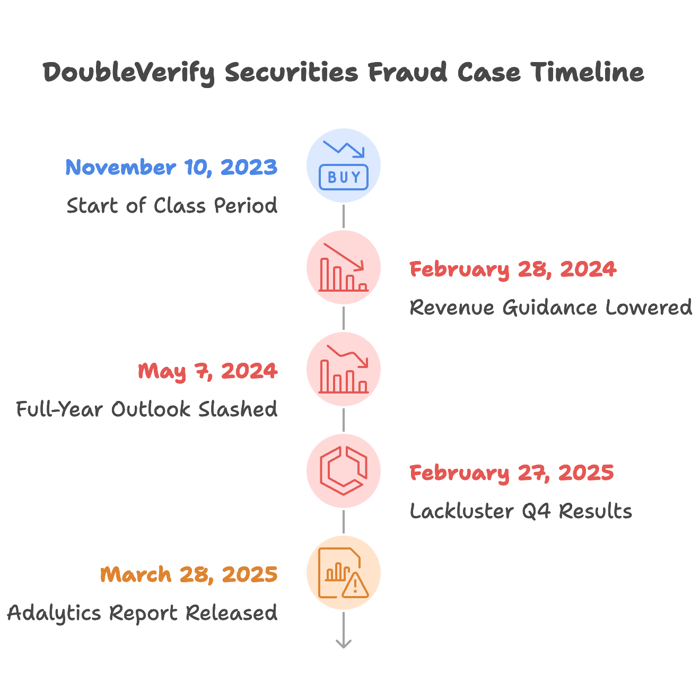
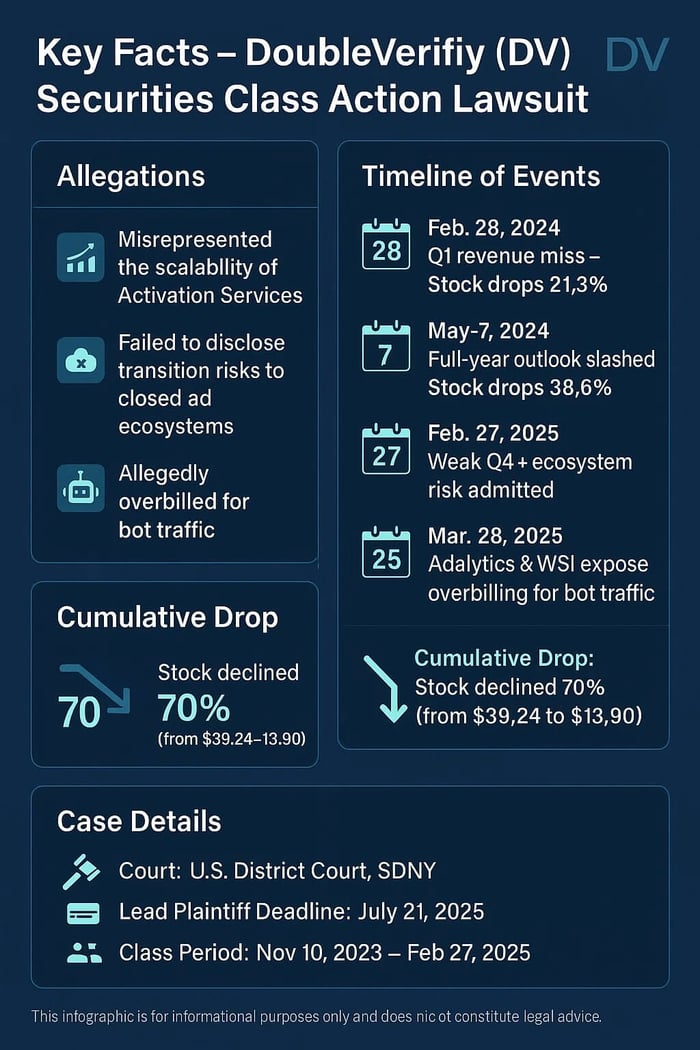
On February 28, 2024, DoubleVerify lowered its Q1 2024 revenue guidance, citing a “slow start by brand advertisers.” The stock fell 21.3%. On May 7, 2024, the company slashed its full-year outlook. That move trigged a further 38.6% drop. Then, on February 27, 2025, DoubleVerify reported lackluster Q4 results and acknowledged that the shift to closed platforms was harming its business. The stock plunged 36% the following day.
Finally, on March 28, 2025, shortseller Adalytics Research released a report alleging DoubleVerify’s fraud detection tools were ineffective and that the company routinely billed clients for bot traffic. The Wall Street Journal published a corroborating article the same day.
Market Reaction
DoubleVerify’s stock declined more than 70% across three major disclosures between February 2024 and February 2025, falling from $39.24 to $13.90 per share.
Next Steps
Submissions for lead plaintiff are due July 21, 2025.
The Court will issue its order for lead plaintiff and counsel in the weeks after submissions are due.
The Court will then consider motion for class certification.
The Court will later consider a Motion to Dismiss.
To learn if you are eligible for recovery under the DoubleVerify securities class action lawsuit, visit the case submission page here.
Disclaimer: This shareholder alert is for informational purposes only and does not constitute legal advice. Consult a qualified attorney for personalized guidance. No specific outcomes are guaranteed.
![Red Cat Holdings, Inc. (RCAT) Securities Class Action Lawsuit Update [June 24, 2025]](https://dropinblog.net/cdn-cgi/image/fit=scale-down,format=auto,width=700/34260815/files/rcat-lawsuit-banner.webp)