
Understanding Insider Trading and Its Implications
Defining Insider Trading: Legal vs. Illegal
As per section 10(b) of the Securities Exchange Act of 1934 and SEC Rule 10b-5, insider trading is the act of buying or selling a company’s securities by individuals who possess material, nonpublic information about that company.
The distinction between legal and illegal insider trading hinges on the use of confidential information and compliance with disclosure regulations (Sections 16(a) and 16(b)).
Legal insider trading occurs when corporate insiders—such as executives, board members, or major shareholders—buy or sell their company’s stock in accordance with federal regulations, including proper disclosure and trading within specified windows.
As per Rule 10(b)-5 of the Securities Exchange Act of 1934, illegal insider trading involves using confidential, material information not available to the public to gain an unfair advantage in the market.
This is a serious offense, subject to civil and criminal penalties, including hefty fines and prison sentences.
The Role of Insiders: Who Qualifies?
The term “insider” is broad. As per Section 16 of the Securities Exchange Act of 1934, statutory insiders include officers, directors, and significant stakeholders.
Still, the definition also extends to anyone who possesses material, nonpublic information due to their relationship with the company or its key stakeholders. ( Section 10(b) of the Securities Exchange Act of 1934, SEC Rule 10b-5, SEC Rule 10b5-1, and SEC Rule 10b5-2)
This can include employees at any level, temporary insiders such as lawyers and accountants, and even individuals who receive confidential information from insiders and are aware (or should be aware) that the information is confidential.
Understanding Material and Nonpublic Information
Material information, as per Rule 10(b)-5 of the Securities Exchange Act of 1934, is any undisclosed detail that could significantly impact an investor’s decision to buy or sell a security, such as upcoming mergers, financial results, regulatory approvals, or management changes.
Material nonpublic information refers to data that has not been disseminated widely and is not available through ordinary research or public sources.
Trading on such information before it becomes public is at the core of illegal insider trading.
The Need for Reporting Insider Trading
1. Why Reporting is Crucial for Market Integrity
Reporting insider trading is crucial for maintaining public trust and ensuring the fair and efficient operation of financial markets.
When insiders exploit their status for personal gain, it undermines confidence in the market’s fairness and can deter investment.
Regulatory oversight, primarily by the Securities and Exchange Commission (SEC), is designed to detect, deter, and penalize insider trading, thereby protecting all market participants.
2. Consequences of Not Reporting Insider Trading
Failure to report insider trading can perpetuate unfair advantages, distort market prices, and erode confidence in the financial system.
It allows those with privileged access to information to profit at the expense of ordinary investors, undermining the integrity of the market and potentially leading to broader financial instability.
Steps to Report Insider Trading Effectively
1. Gathering Evidence and Documentation
Before making a report, it is crucial to collect as much specific, credible, and timely information as possible.
This may include emails, trading records, internal communications, or any documentation that supports the suspicion of insider trading.
The more detailed and organized your evidence, the greater the likelihood that regulators will pursue an investigation.
2. Identifying the Appropriate Regulatory Bodies
The primary agency responsible for investigating and prosecuting insider trading in the United States is the Securities and Exchange Commission ( SEC). In some cases, the Department of Justice (DOJ) may also become involved, particularly in criminal prosecutions. For most whistleblowers, the SEC is the first point of contact.
3. Filing a Report with the SEC: A Step-by-Step Process
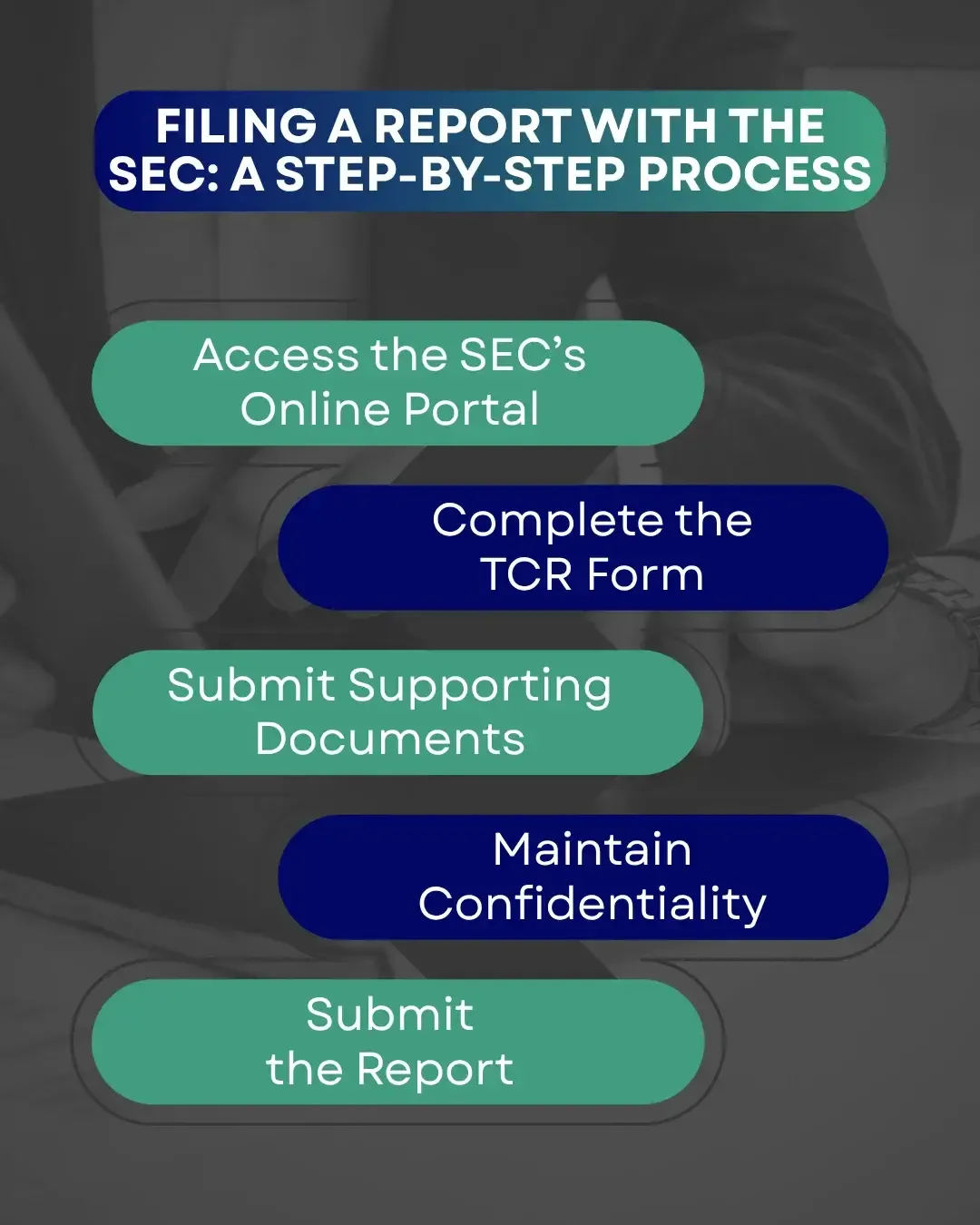
- Access the SEC’s Online Portal: Visit the SEC’s official website to access the Tips, Complaints, and Referrals (TCR) form.
- Complete the TCR Form: Provide detailed information about the suspected violation, including names, dates, companies involved, and a description of the evidence.
- Submit Supporting Documents: Attach any relevant documentation that substantiates your claim.
- Maintain Confidentiality: You may choose to file anonymously, especially if you are represented by an attorney. (Section 21F of the Securities Exchange Act of 1934, SEC Rule 21F-9, and SEC Rule 21F-7)
- Submit the Report: Once the form and evidence are complete, submit the report through the SEC’s online system.
4. Utilizing Whistleblower Programs for Protection and Rewards
Legal Protections for Whistleblowers
The SEC Whistleblower Program, established under the Dodd-Frank Act, offers significant protections for individuals who report insider trading.
Whistleblowers are shielded from retaliation by their employers, and their identities are kept confidential in almost all circumstances.
1. Understanding the SEC Whistleblower Program
The program incentivizes individuals to provide original, high-quality information that leads to successful enforcement actions. Whistleblowers may be eligible for monetary awards ranging from 10% to 30% of the total sanctions collected if the SEC orders monetary penalties exceeding $1 million. As of 2024, nearly $2.2 billion had been awarded to over 440 whistleblowers.
2. Anti-Retaliation Measures for Reporters
Federal law prohibits employers from retaliating against employees who report securities law violations.
This includes termination, demotion, suspension, threats, or harassment.
The SEC takes allegations of retaliation seriously and can take enforcement action against employers who engage in such behavior. ( Sarbanes-Oxley Act)
3. Potential Financial Rewards for Reporting
If your information leads to a successful enforcement action resulting in monetary sanctions exceeding $1 million, you may be eligible for a whistleblower award.
The award amount is determined based on the significance of the information, your level of assistance, and other relevant factors. (Rule 21F-6(c))
High-Profile Insider Trading Cases: Lessons Learned
Examining Noteworthy Cases in Recent History
Several high-profile cases have shaped the landscape of insider trading enforcement.
For example, the conviction of Raj Rajaratnam, founder of the Galleon Group hedge fund, resulted in an 11-year prison sentence and millions in fines after he was found guilty of orchestrating a vast insider trading network.
Another notable case involved Martha Stewart, who was convicted of obstruction of justice and lying to investigators regarding a suspicious stock sale, highlighting the broad reach of insider trading laws and the importance of truthful reporting to authorities.
What We Can Learn from Famous Insider Trading Scandals
These cases underscore the importance of vigilance, transparency, and robust enforcement in maintaining market integrity.
They also demonstrate that insider trading can involve individuals at all levels of an organization and that the consequences for violations are severe and far-reaching.
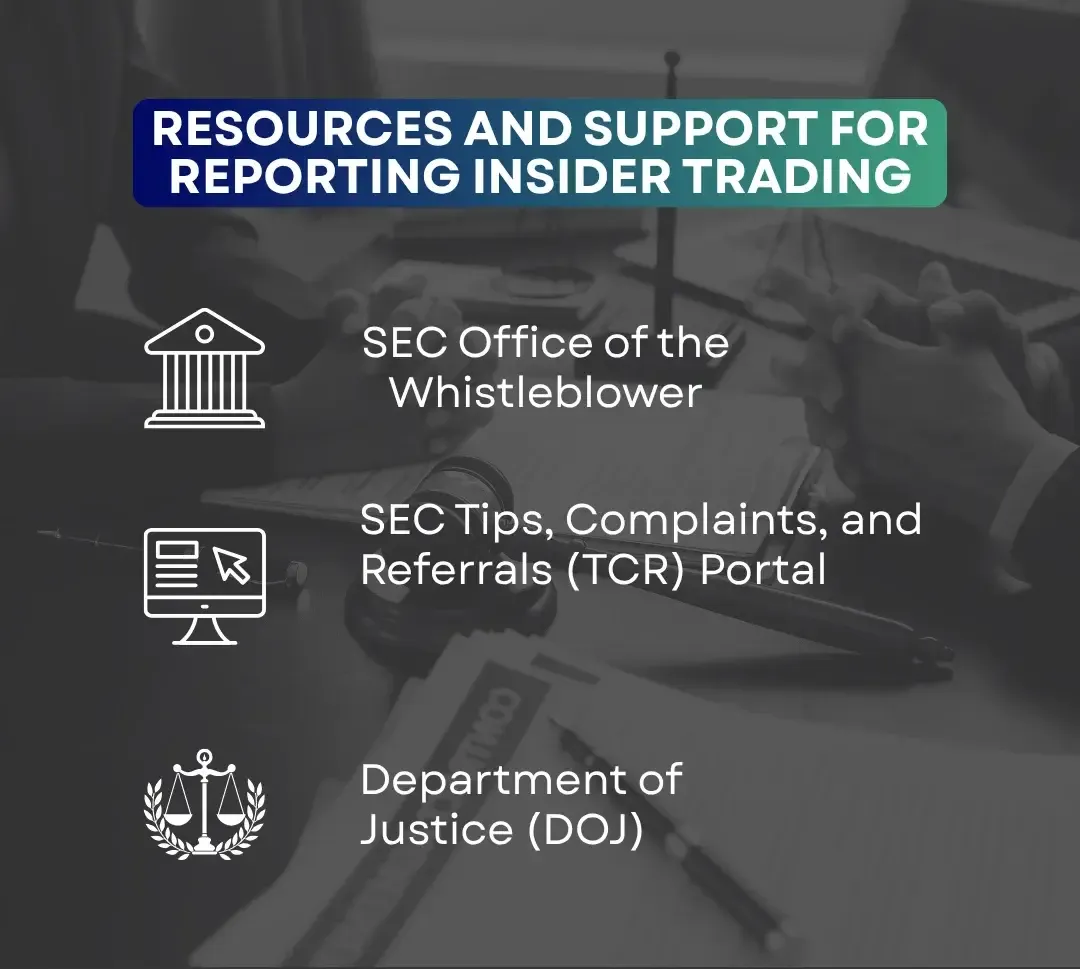
Resources and Support for Reporting Insider Trading
Legal Assistance and Consulting Services
Whistleblowers are strongly encouraged to seek legal counsel before filing a report.
An experienced attorney can help you navigate the process, protect your identity, and maximize your chances of receiving an award. Legal professionals can also assist in gathering evidence and ensuring compliance with all procedural requirements.
At Levi & Korsinsky, LLP, we specialize in legal counsel for investor class action lawsuits, representing shareholders who have suffered financial losses due to securities fraud, corporate misconduct, and deceptive investment practices.
With over 80 collective years of experience, our experienced attorneys are on hand to provide you with the support and legal expertise you need to maximise your recovery.
Government Resources and Contact Information
- SEC Office of the Whistleblower: The SEC provides comprehensive resources, including FAQs, sample complaint letters, and instructions for filing reports and award applications.
- SEC Tips, Complaints, and Referrals (TCR) Portal: The primary online platform for submitting insider trading reports.
- Department of Justice (DOJ): May become involved in criminal cases, particularly when large-scale fraud or organized schemes are suspected.
Navigate to Your Next in the Journey Towards Reporting Insider Trading
Several organizations and networks exist to support whistleblowers, offering guidance, advocacy, and peer support. These networks can provide valuable resources and reassurance throughout the reporting process.
Insider trading undermines the integrity of financial markets and erodes public trust.
By understanding what constitutes insider trading, knowing how to report it, and being aware of the protections and incentives available, you can play a vital role in safeguarding your interests and contributing to fair and transparent markets.
If you suspect insider trading, act decisively—gather evidence, seek legal counsel, and report your concerns to the SEC. Your vigilance not only protects your interests but also helps uphold the integrity of the entire financial system.
Disclaimer: The information provided in this blog is for general informational purposes only and does not constitute legal advice. Readers should not act or refrain from acting on any of the information contained in this blog without consulting a qualified legal professional. Levi & Korsinsky LLP is not responsible for any actions taken or not taken based on the information provided in this blog.