
Caption: Shulman v. Weston and Vogensen
Case No.: 2:23-cv-04121 (JXN)(CF)
Jurisdiction: U.S. District Court, District of New Jersey
Judge: Hon. Julien Xavier Neals
Summary
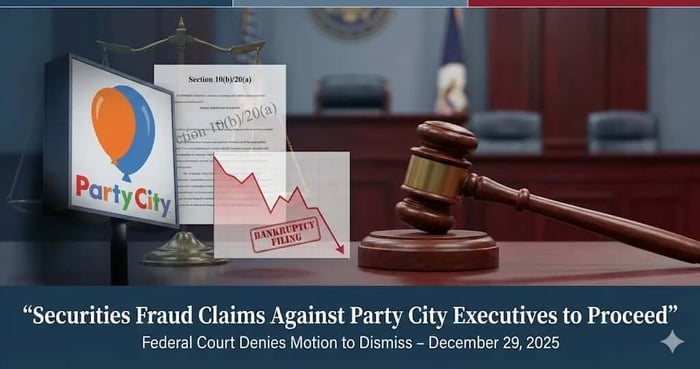
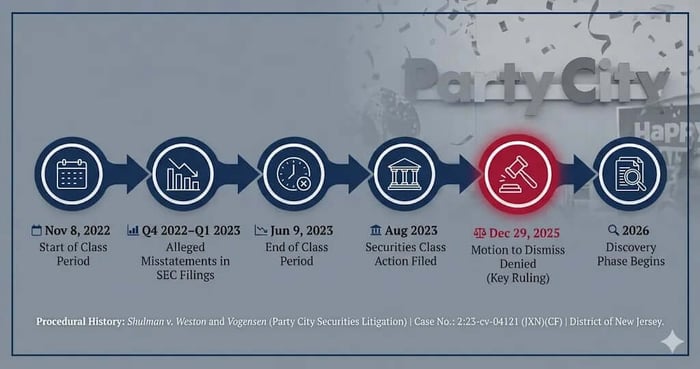
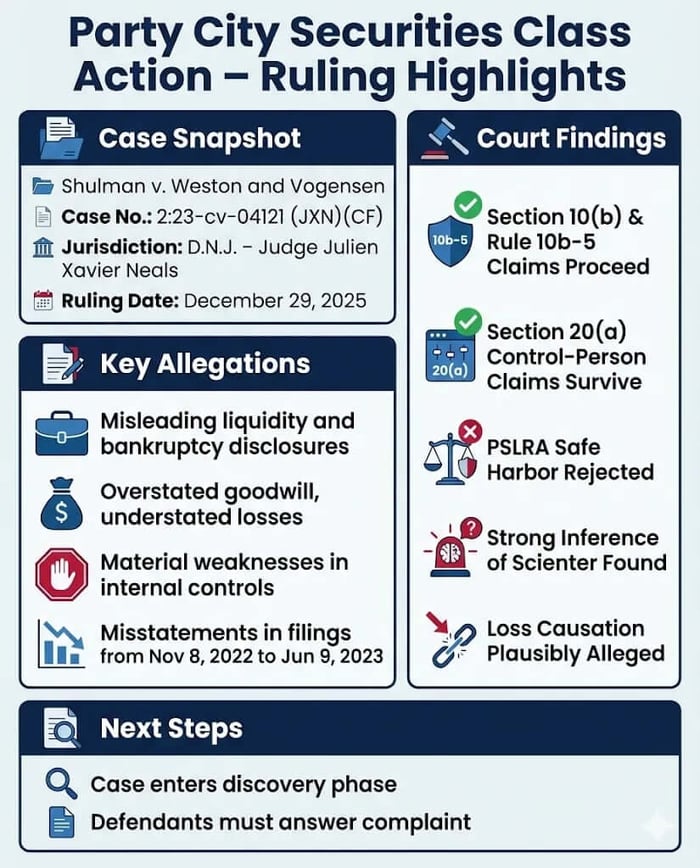
On December 29, 2025, Judge Julien Xavier Neals denied defendants’ motion to dismiss the amended securities class action complaint. The Court allowed Exchange Act claims under Section 10(b) and Rule 10b-5 to proceed against Party City’s former CEO and CFO. Derivative control-person claims under Section 20(a) also survived.
Allegations Against Party City
Plaintiffs alleged that Party City’s former executives misrepresented the company’s liquidity and financial condition in quarterly filings during the class period from November 8, 2022 through June 9, 2023. The complaint alleged omissions concerning substantial doubt about the company’s ability to continue as a going concern, preparation for bankruptcy, overstated goodwill, understated losses, and material weaknesses in internal controls. Plaintiffs said these disclosures painted a misleading picture shortly before Party City filed for bankruptcy.
Defendants’ Motion to Dismiss
The individual defendants moved to dismiss under Rules 9(b) and 12(b)(6) and the PSLRA. They argued the complaint failed to plead actionable misstatements or omissions, scienter, or loss causation. Defendants also contended that the challenged statements were forward-looking, protected by the PSLRA safe harbor, non-actionable opinions, or corporate puffery.
Plaintiffs’ Opposition
Plaintiffs argued that the filings contained misleading statements of present fact about liquidity and borrowing capacity. They contended defendants knew of severe liquidity constraints and bankruptcy preparation at the time of the disclosures. Plaintiffs also asserted that later corrective disclosures and the bankruptcy filing plausibly established loss causation.
Court’s Ruling
The Court denied the motion to dismiss in full. Section 10(b) and Rule 10b-5 claims were allowed to proceed against both defendants. Control-person claims under Section 20(a) also survived based on the adequately pleaded primary violations.
Court’s Rationale
Falsity: The Court held that plaintiffs plausibly alleged materially misleading statements and omissions regarding liquidity, goodwill, internal controls, and going-concern issues. The statements were not immaterial as a matter of law.
PSLRA Safe Harbor / Opinion / Puffery: The Court found the statements were not protected by the PSLRA safe harbor because they conveyed present facts and omitted known adverse conditions. The goodwill disclosures were not shielded as mere opinion, and the alleged statements went beyond non-actionable puffery.
Scienter: The Court found a strong inference of scienter based on allegations that defendants knew of liquidity problems, bankruptcy preparation, auditor disputes, and internal control weaknesses while making contrary public statements. Stock sales and executive certifications further supported the inference.
Loss Causation: The Court held plaintiffs plausibly alleged that corrective disclosures, including bankruptcy-related revelations and restatements, were followed by stock price declines sufficient at the pleading stage.
Section 20(a): Because primary violations were adequately pleaded, and defendants were alleged to have exercised control, the control-person claims survived.
Case Status
The case continues in full. Defendants must answer the complaint, and the matter proceeds into discovery.