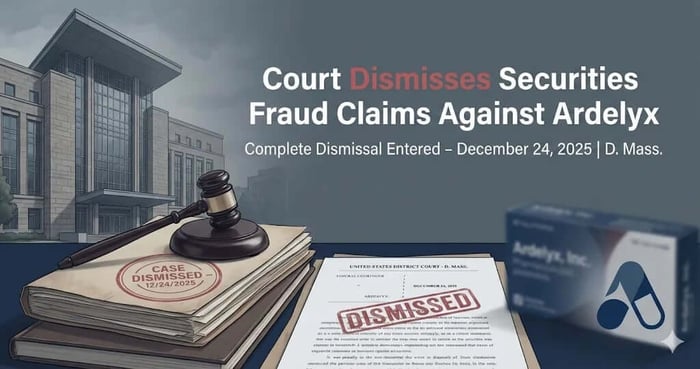

Caption: Yarborough v. Ardelyx, Inc., et al.
Case No.: 1:24-cv-12119-LTS
Jurisdiction: U.S. District Court, District of Massachusetts
Judge: Hon. Leo T. Sorokin
Summary
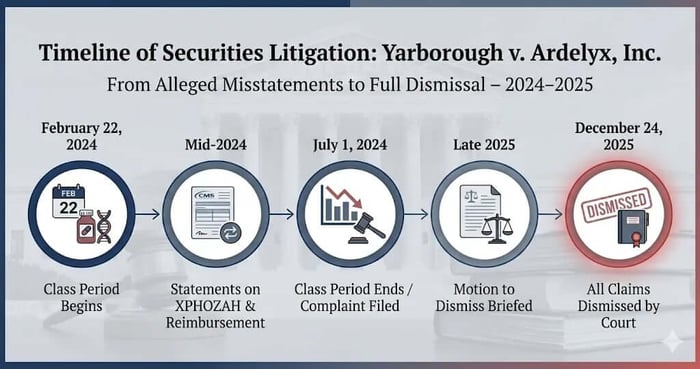
On December 24, 2025, Judge Leo T. Sorokin granted defendants’ motion to dismiss the amended complaint in the securities class action against Ardelyx, Inc. The Court dismissed all claims asserted under the Exchange Act. A separate judgment of dismissal entered the same day, terminating the action.
Allegations Against Ardelyx
Plaintiffs alleged that Ardelyx and certain executives made false or misleading statements during the class period from February 22, 2024, through July 1, 2024. The complaint focused on statements concerning Ardelyx’s intent to apply for transitional Medicare reimbursement for its drug XPHOZAH and alleged that defendants concealed a prior decision not to pursue that pathway. Plaintiffs also asserted insider trading and control-person claims based on executive stock sales.
Defendants’ Motion to Dismiss
Ardelyx and the individual defendants moved to dismiss under Rule 12(b)(6). They argued that plaintiffs failed to plead any materially false or misleading statement, failed to allege scienter, and could not establish loss causation. Defendants also sought dismissal of the insider trading and derivative control-person claims for lack of a viable primary violation.
Plaintiffs’ Opposition
Plaintiffs contended that defendants’ statements implied a present intent to apply for transitional reimbursement that did not exist. They argued that defendants had already concluded the reimbursement pathway was not viable and that later disclosures revealed this truth. Plaintiffs relied on regulatory communications, executive statements, and stock sales to support their theory.
Court’s Ruling
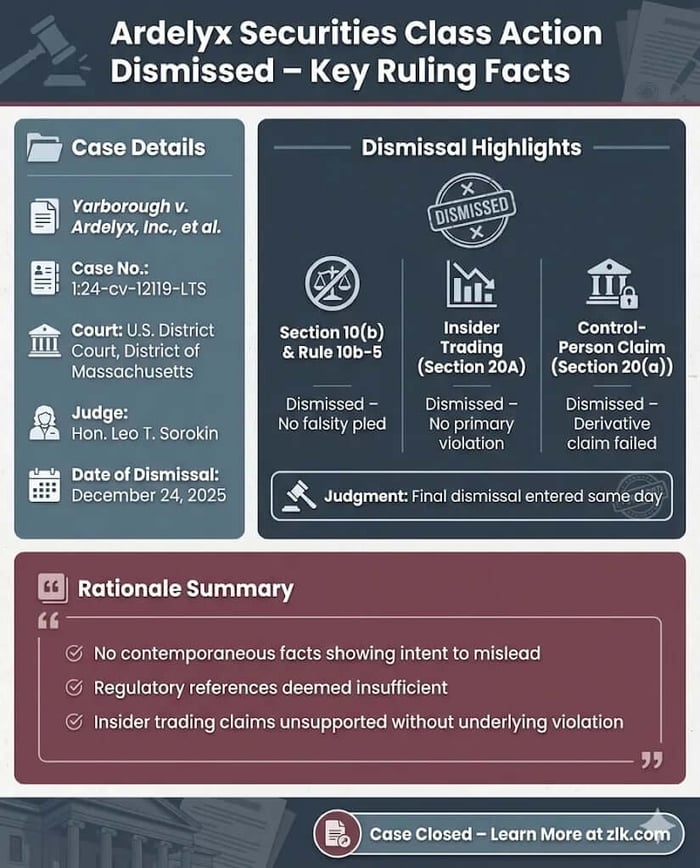
The Court dismissed all Exchange Act claims. It dismissed the Section 10(b) and Rule 10b-5 claims for failure to plead falsity. The Court also dismissed the insider trading claim under Section 20A and the derivative control-person claim under Section 20(a) because plaintiffs failed to allege a predicate securities law violation.
Court’s Rationale
Falsity: The Court held that plaintiffs did not plausibly allege that defendants had decided not to apply for transitional reimbursement, or even harbored serious doubts, at the time of the challenged statements. The Court found plaintiffs’ theory relied on impermissible inferences rather than contemporaneous facts.
Scienter: Because plaintiffs failed to plead a false or misleading statement, the Court did not find a strong inference of scienter.
Insider Trading and Section 20(a): Absent a primary Exchange Act violation, the insider trading and control-person claims could not stand.
Case Status
The action has been dismissed in its entirety, and judgment has entered for defendants.