
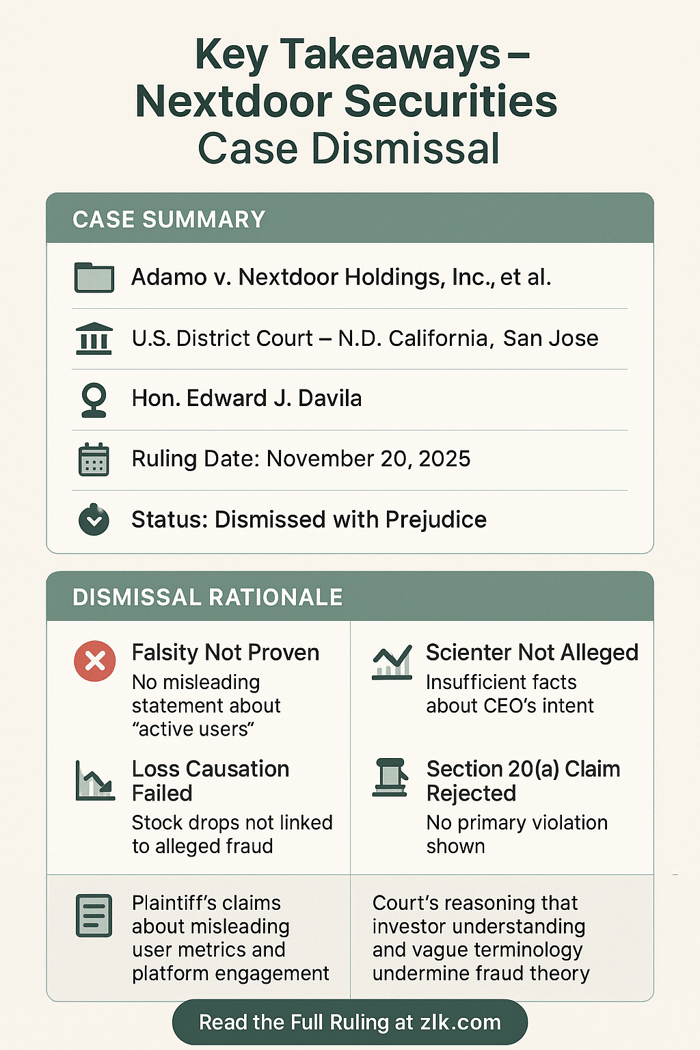
Caption: Adamo v. Nextdoor Holdings, Inc., et al.
Case No.: 5:24-cv-01213-EJD
Jurisdiction: United States District Court, Northern District of California, San Jose Division
Judge: Hon. Edward J. Davila
 Summary
On November 20, 2025, the Court granted the motion by Defendants Nextdoor Holdings, Inc. and CEO Sarah Friar to dismiss the Second Amended Complaint (SAC) in the securities class action. The Court granted the motion to dismiss with prejudice.
Allegations Against Nextdoor Holdings, Inc.
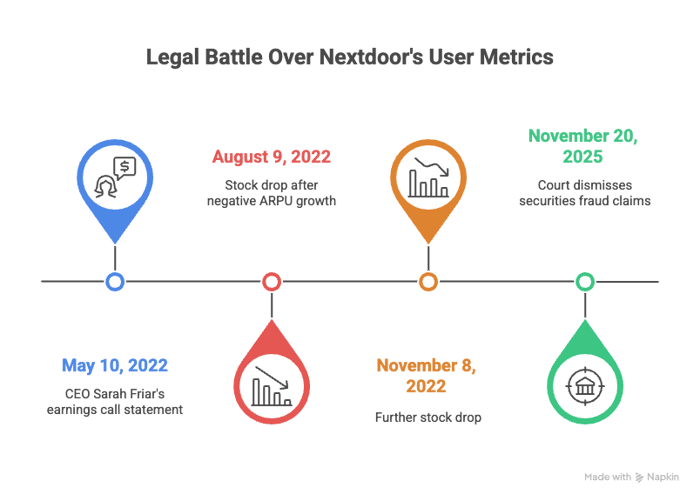
Plaintiff Frankie Adamo brought the securities class action alleging that CEO Sarah Friar made material misrepresentations and omissions about Nextdoor’s projected profitability following its acquisition. The only remaining statement challenged in the SAC was Friar's May 10, 2022, statement on an earnings call concerning the activity of Nextdoor's community. The statement included that in Q1, over 50% of neighbors were weekly active, and over half of weekly active users were active daily, suggesting a high propensity for Nextdoor to become a daily use case. Plaintiff alleged that the statement misled investors about the proportion of "active users" who were on-platform users, arguing the statement implied virtually all were on-platform, when in fact about half of the users simply opened emails ("off-platform" users).
Defendants’ Motion to Dismiss
Defendants Nextdoor Holdings, Inc. and CEO Sarah Friar filed a second motion to dismiss the SAC pursuant to Federal Rule of Procedure 12(b)(6). The Court found that Plaintiff failed to cure the deficiencies identified in the Prior Order regarding a materially false or misleading statement or omission, and also found that Plaintiff failed to allege facts sufficient to show scienter and loss causation.
Plaintiffs’ Opposition
Plaintiff argued that Friar's May 10, 2022, statement created a misleading impression because she implied that virtually all active users were on-platform users in three ways. First, Friar's use of the term "community" implied that "active users" were members who interact on the platform. Second, Friar's reference to an "active valued community" connotes on-platform activity, as Nextdoor's materials used phrases like "involved in the community" and "communicate". Third, Friar's statement that "active users" "make Nextdoor a daily use case" in ordinary parlance means visiting and engaging with the platform daily. Plaintiff argued that three allegations showed Defendants knew that half of the "active users" were off-platform users, including executive reports, employee concerns voiced at meetings, and knowledge being part of the company's "core operations".
Court’s Ruling
The Court granted the Defendants' second motion to dismiss with prejudice. The Court found that Plaintiff failed to cure the deficiencies regarding the first element of a securities fraud claim—a materially false or misleading statement or omission. The Court also found that Plaintiff failed to sufficiently plead facts to show scienter and loss causation. The Section 20(a) control-person claim against Friar necessarily failed because Plaintiff failed to plead a primary violation of the Exchange Act.
Court’s Rationale
Falsity: The Court found the facts in the SAC insufficient to show Friar's statement was false or misleading. The Court held that vaguely describing "active users" as a "community" and using phrases like "communicate" or "daily use case" does not reasonably imply any particular percentage of on-platform versus off-platform users. The Prior Order established that reasonable investors would have known that "active user" includes both on- and off-platform users, and the SAC contained no statements that could reasonably be understood to imply the proportion of on-platform users. Given Plaintiff failed to allege new facts sufficient to cure the deficiencies, the Court found that the pleading could not possibly be cured by the allegation of other facts.
Scienter: The Court found the allegations lacked the necessary particularized facts regarding Friar's state of mind.
- Allegations regarding executive reports were insufficient because Plaintiff did not allege facts to show whether, and when, the reports revealed the alleged 50/50 split in users prior to Friar's statement.
- Employee concerns were tied to the definition of "active users," not the proportion of on-platform users, which is the current theory of the case.
- The "core operations" doctrine was unavailing because the ratio of on-platform versus off-platform users was not alleged to be a fact so significant to Nextdoor's operations that it would be "absurd" to suggest management was unaware of it.
Loss Causation: The Court found Plaintiff's claim that two partial corrective disclosures revealed the truth to be unsupported by the facts.
- Plaintiff alleged that the stock fell after Nextdoor reported negative ARPU (Average Revenue Per User) growth on August 9, 2022 (a 25% drop), and again on November 8, 2022 (an 11% drop), which revealed users were not genuinely engaged.
- The Court held that there were no allegations that anyone attributed Nextdoor's disclosures to issues with its "active users" metrics. The stock drops were not indicated to have been "caused by a revelation of fraudulent activity rather than by changing market conditions, changing investor expectations, or other unrelated facts".
Section 20(a): Plaintiff's Section 20(a) claim against Friar failed because the primary violation of the Exchange Act was not sufficiently pleaded.
Other Issues: The Court granted Defendants' unopposed request for judicial notice of exhibits including SEC filings, investor presentations, and analyst reports.
Case Status
The case has been dismissed with prejudice.