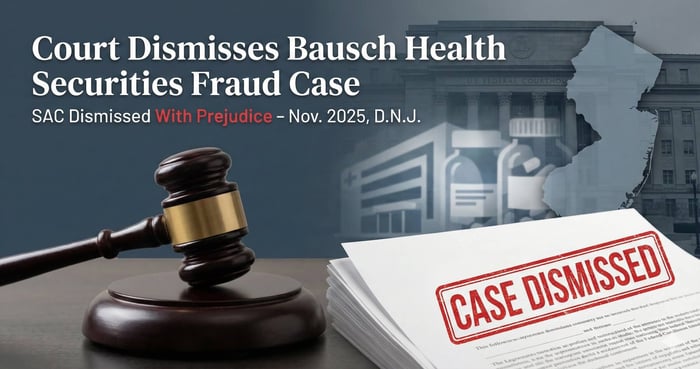
Caption: Anderson v. Bausch Health Companies Inc., et al.
Case No.: 3:23-cv-03996-ZNQ-RLS
Jurisdiction: United States District Court, District of New Jersey
Judge: Hon. Zahid N. Quraishi
Summary
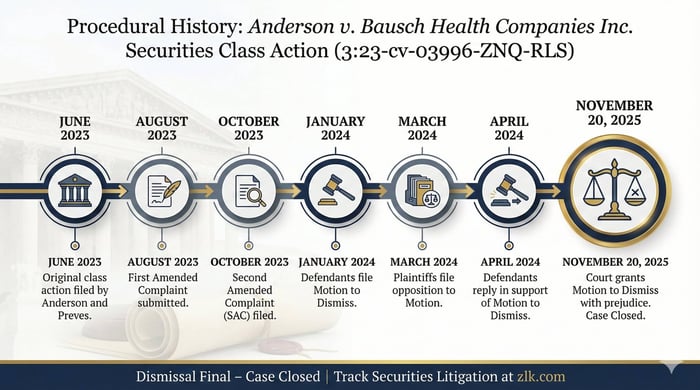
On November 20, 2025, Judge Zahid N. Quraishi granted Defendants’ Motion to Dismiss and also dismissed Plaintiffs’ Second Amended Complaint (“SAC”) with prejudice.
Underlying Lawsuit
The Plaintiffs in this case, R. Cassian Anderson and Donna S. Preves, brought a securities class action lawsuit against Bausch Health Companies Inc., Joseph Papa, and Paul Herendeen, stating that the defendants had violated Sections 10(b) and 20(a) of the Securities Exchange Act of 1934. The SAC challenged three categories of statements that it said were misleading or false statements: (1) representations concerning the Company’s ongoing legacy Valeant litigation, (2) statements regarding a proposed spinoff of Bausch + Lomb (“B+L”), and (3) statements about the Company’s drug, Xifaxan, key to the Company’s bottom line. Plaintiffs stated that these statements materially misrepresented the Company’s potential litigation exposure, the purpose of its planned B+L spinoff, and the strength of Xifaxan’s patent protection.
Defendants’ Motion
Defendants asked the Court dismiss the case under Rule 12(b)(6), arguing that:
None of the statements identified by Plaintiffs were actually false or misleading.
Plaintiffs failed to plead scienter strongly enough.
Plaintiffs did not adequately allege loss causation.
Plaintiffs did not argue conduct that would present a viable “scheme liability” claim under Rule 10b-5(a) and (c).
Plaintiffs did not specify each defendant’s role in making the false and misleading statements.
The Section 20(a) claim failed as well if there was no primary violation under Section 10(b).
Plaintiffs’ Opposition
Plaintiffs argued that the SAC alleged actionable misrepresentations and omissions relating to the Company’s exposure to opt-out litigation, the true purpose of the B+L spinoff, and the credibility of Norwich’s patent challenge to Xifaxan. Plaintiffs also stated that certain of the company’s forward-looking or mixed statements were inactionable only in part and that the alleged conduct supported both misrepresentation and scheme liability claims.
Court’s Ruling
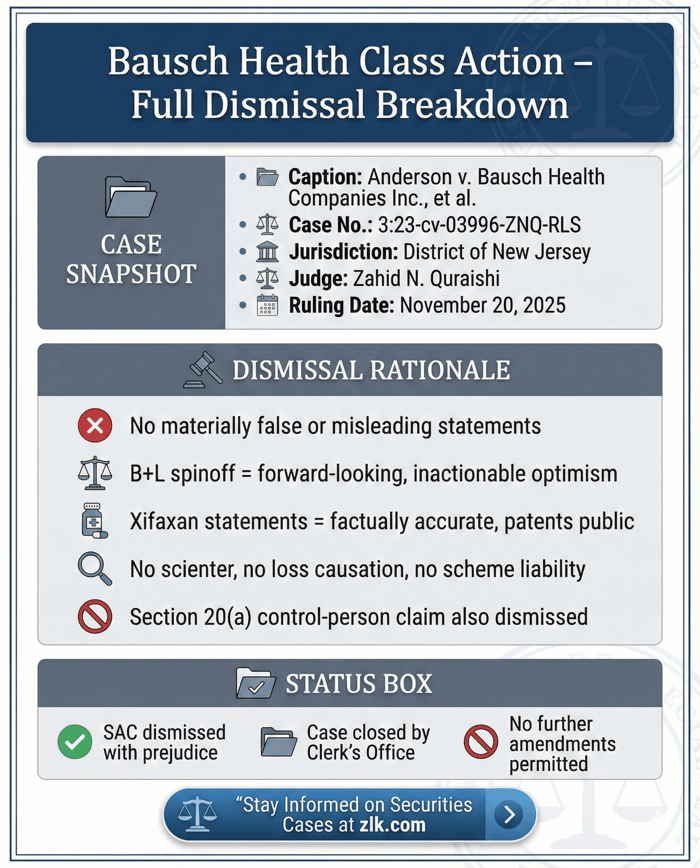
The Court granted Defendants’ Motion to Dismiss in full. All of the Plaintiff’s charges and counts were dismissed, including the claims under Section 10(b) and Rule 10b-5 (Counts I and II) and Section 20(a) (Count III). The Court dismissed the case with prejudice.
Court’s Rationale
Falsity: The Court concluded that none of the alleged statements were materially false or misleading. Statements concerning the Valeant opt-out litigation were held accurate when read in context and adequately disclosed in Company filings. The B+L spinoff press release was found to be a forward-looking statement expressing corporate optimism, not actionable under the PSLRA. Statements concerning Xifaxan’s patents were deemed objectively true and not misleading because the patent challenges were publicly known.
Scienter: Because no materially false statements were found, the Court did not find a sufficient basis for an inference of scienter.
Loss Causation: Given the absence of actionable misrepresentations, the Court held that Plaintiffs failed to plead a causal connection between the alleged statements and stock declines.
Scheme Liability: The Court found that Plaintiffs had failed to allege conduct beyond the alleged misstatements to support a claim under Rules 10b-5(a) and (c). The Court also noted that the alleged fraudulent scheme supporting Plaintiffs’ case—the proposed B+L spinoff—did not even occur.
Section 20(a) Claim: The control person claim under Section 20(a) was dismissed because it was could only stand if the dismissed Section 10(b) claims survived.
Case Status
The Court dismissed the Second Amended Complaint with prejudice and instructed the Clerk’s Office to close the case.