
United States District Court for the District of Arizona
Lew v. ON Semiconductor Corporation, et al., No. 2:24-cv-00594-SMB
Judge Susan M. Brnovich
Order Issued: July 11, 2025
Summary
A federal judge in Arizona has dismissed, without prejudice, a securities fraud class action brought against ON Semiconductor Corporation (Onsemi) and two of its executives. The ruling grants defendants’ motion to dismiss in full but allows plaintiffs thirty days to file an amended complaint.
The decision is rooted in the court’s determination that the plaintiffs failed to adequately allege falsity, scienter, and loss causation under the heightened standards of the Private Securities Litigation Reform Act (PSLRA).
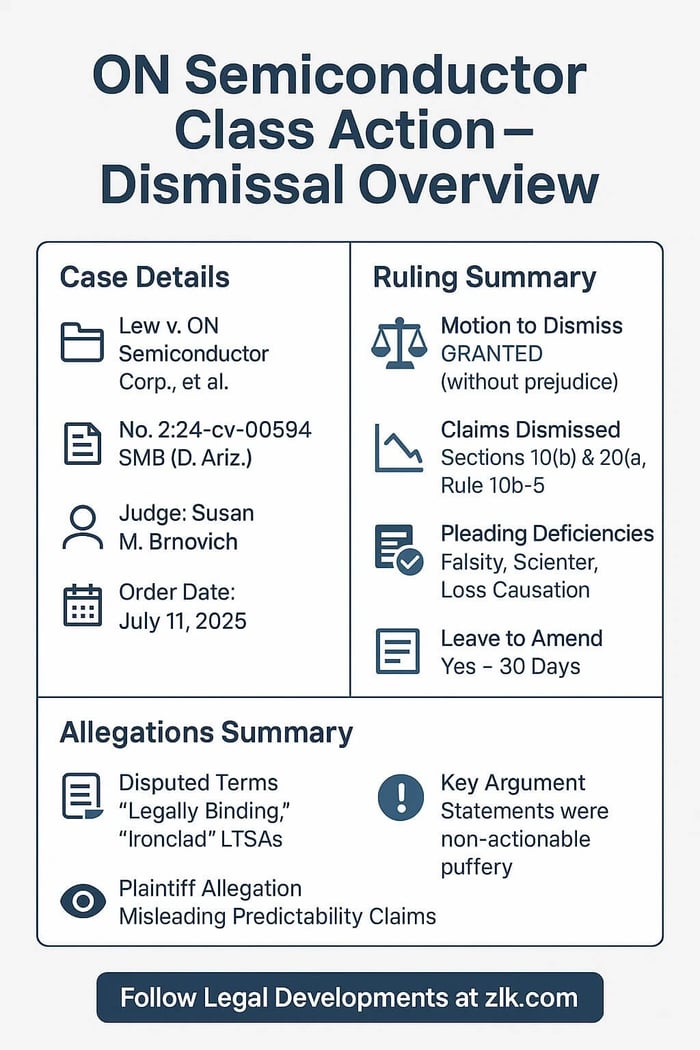
Overview of Securities Fraud Allegations Against ON Semiconductor
Plaintiff Jeffrey S. Lew filed a securities class action under Sections 10(b) and 20(a) of the Securities Exchange Act of 1934 and Rule 10b-5. The complaint targeted Onsemi, CEO Hassane El-Khoury, and CFO Thad Trent. Lew alleged that defendants made materially false and misleading statements about the company’s long-term supply agreements (LTSAs), specifically their enforceability and their role in creating revenue predictability.
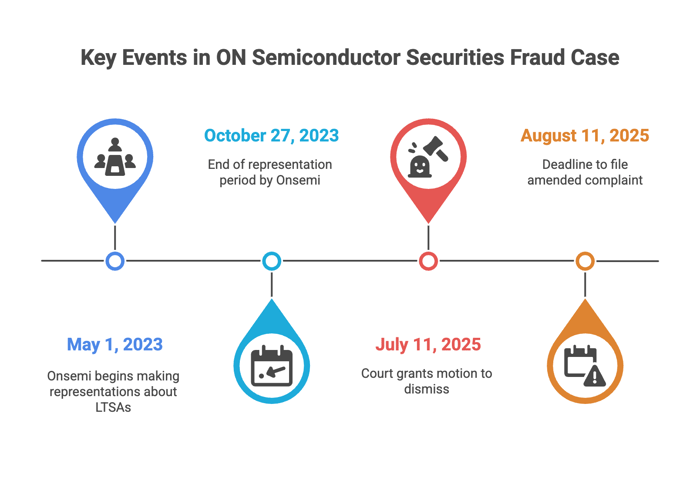
The case centers on Onsemi’s representations between May 1 and October 27, 2023, a period in which the company described its LTSAs as “legally binding” and “ironclad.” Lew claims these statements misled investors about the degree of certainty the agreements offered, resulting in significant losses when the company later revised revenue projections downward.
Arguments in Motion to Dismiss: Falsity, Scienter, and Loss Causation
Defendants moved to dismiss the Second Amended Complaint under Rule 12(b)(6), arguing that the challenged statements were non-actionable puffery, forward-looking statements protected by the PSLRA safe harbor, or general expressions of corporate optimism.
On the issue of falsity, they contended that the alleged misstatements were vague and subjective, rendering them incapable of objective verification. On scienter, defendants maintained that the complaint lacked any particularized facts showing intent to defraud or deliberate recklessness. They also argued the complaint failed to allege loss causation with sufficient clarity.
Plaintiffs’ Opposition to Dismissal
Lew opposed dismissal by arguing that defendants made concrete factual misrepresentations about the LTSAs’ enforceability and failed to disclose their discretionary amendment practices. He alleged that Onsemi allowed customers to cancel or renegotiate orders without offsetting benefits, contradicting public statements about “ironclad” agreements and “win-win” renegotiation structures.
To support scienter, Lew pointed to a confidential witness account regarding a military customer’s unmet LTSA obligations, along with defendants’ roles in executing and promoting the agreements. He also invoked the “core operations” theory to argue that the executives had knowledge of adverse facts related to order misalignment.
Court Ruling and Legal Reasoning
Judge Brnovich granted the motion to dismiss in its entirety, concluding that the complaint failed to meet the heightened pleading standards under the PSLRA and Rule 9(b). The dismissal applies to both the Section 10(b) and derivative Section 20(a) claims.
However, the court granted leave to amend, allowing plaintiffs an opportunity to cure the deficiencies within thirty days.
Analysis of Falsity, Scienter, and Loss Causation
The court found that many of the challenged statements—such as “very, very predictable” or “win-win”—constituted inactionable puffery or opinion statements lacking objective falsifiability. The court held that plaintiffs failed to allege contemporaneous facts showing these statements were false when made.
On scienter, the court found no particularized allegations demonstrating that El-Khoury or Trent knew their statements were false or misleading when made. The confidential witness lacked firsthand knowledge of renegotiations or executive-level discussions.
Although the court did not analyze loss causation in depth, it concluded that plaintiffs’ failure to establish falsity and scienter precluded the claim from advancing.
Dismissal Outcome and Timeline to Amend Complaint
The court dismissed the Second Amended Complaint without prejudice. Plaintiffs have until August 11, 2025, to file a Third Amended Complaint. If no amendment is filed, the case will be dismissed in its entirety.
Judge Brnovich advised plaintiffs to clarify whether their claims rely on misstatements, omissions, or both—and to avoid "puzzle pleading" by clearly connecting factual allegations to the elements of each claim.