
Connecticut Judge Allows Sema4 Fraud Suit to Proceed
Case Name: Helo v. Sema4 Holdings Corp.
Case No.: 3:22-cv-01131
Jurisdiction: United States District Court for the District of Connecticut
Judge Vernon D. Oliver
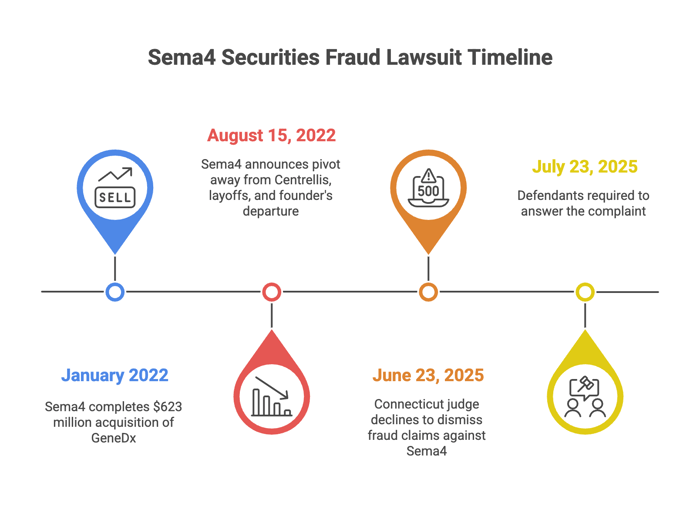
Sema4 Holdings Corp. Securities Fraud Lawsuit Summary
On June 23, 2025, a Connecticut federal judge declined to toss out fraud claims in the Sema4 Holdings lawsuit. The ruling means the case will now move forward against the company and four of its former executives (Eric Schadt, Katherine Stueland, Isaac Ro, and Richard Miao). The judge found the claims about Sema4’s Centrellis platform were specific enough, and the allegations detailed enough, to warrant discovery. Nothing was dismissed. 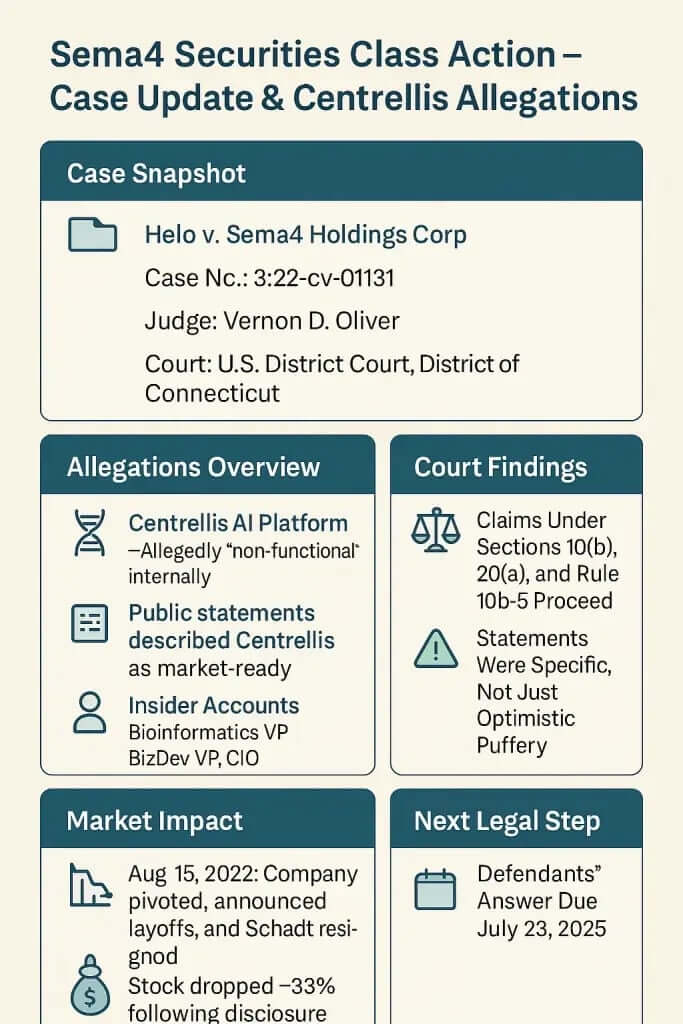
Underlying Lawsuit
The lawsuit was filed in 2022 by Nabil Helo on behalf of investors who bought Sema4 stock between January and August of that year. At the time, Sema4 had just completed a $623 million acquisition of GeneDx. Sem4 was presenting itself as a data-driven health tech company. It was pitching Centrellis as its key product. Centrellis is an AI-drive predictive modeling platform meant to integrate massive genetic and clinical datasets.
But Plaintiff alleges things didn’t line up. Former employees said the platform wasn’t functional . . . or at least, not in the way it was being described. Some said it never really worked. Others pointed to regulatory problems and technical gaps. The lawsuit claims that these internal shortcomings were masked by public statements that made Centrellis sound like a market-ready solution. When the company later shifted direction, announced layoffs, and parted ways with its founder, the stock dropped sharply.
Defendants’ Motion to Dismiss
Sema4 and its executives tried to get the case dismissed, arguing that the statements about Centrellis were vague, forward-looking, or protected under safe harbor rules. They said the complaint didn’t show any intent to mislead, or connect the dots between what was said and how the stock reacted. As for the Section 20(a) claims, defendants argued there wasn’t enough to show control or culpability.
Plaintiff’s Response
The plaintiff pushed back with help from three former insiders: a VP of Bioinformatics, a VP of Business Development, and the company’s former CIO. All three pointed to internal conversations, reports, and weekly meetings where Centrellis’ limitations were discussed. They claimed senior leadership (including Schadt and Stueland) were in the loop and aware of the issues. The lawsuit argues that those same executives continued promoting Centrellis in public, even as the private story unraveled.
Court’s Ruling
Judge Oliver sided with the plaintiff, at least at this stage. He found the complaint included enough detail to plausibly allege securities fraud and control person liability. That means all claims stay in play.
Court’s Rationale
Falsity
The Court found that statements about Centrellis being a leading, real-time intelligence platform could be misleading, especially when internal sources claimed the system either didn’t exist as described or couldn’t function properly. These weren’t generic predictions or optimistic goals. The Court noted that many of the statements used present-tense language and referred to capabilities that appeared to be overstated.
Scienter
The Court pointed to weekly leadership calls, regular access to internal data, and direct involvement in Centrellis-related strategy as factors supporting an inference of scienter. That included allegations that the executives were either aware of the platform’s flaws—or reckless in failing to understand them.
Loss Causation
On August 15, 2022, Sema4 announced it would pivot away from Centrellis-related research and development. The company also revealed it would cut nearly a third of its workforce and that founder Eric Schadt would step down. The stock fell by roughly a third. The Court found it reasonable to infer that this sequence revealed previously concealed risks, making loss causation plausible.
What’s Next
All claims under Sections 10(b), 20(a), and Rule 10b-5 will proceed. No part of the complaint was dismissed. Under the court’s rules, the defendants are required to answer the complaint by July 23, 2025. The case will move ahead in the District of Connecticut before Judge Oliver.