
Expired
Lead Plaintiff Deadline
Mar 24, 2026
Choose your preferred way to stay informed of new case launches and settlement deadlines
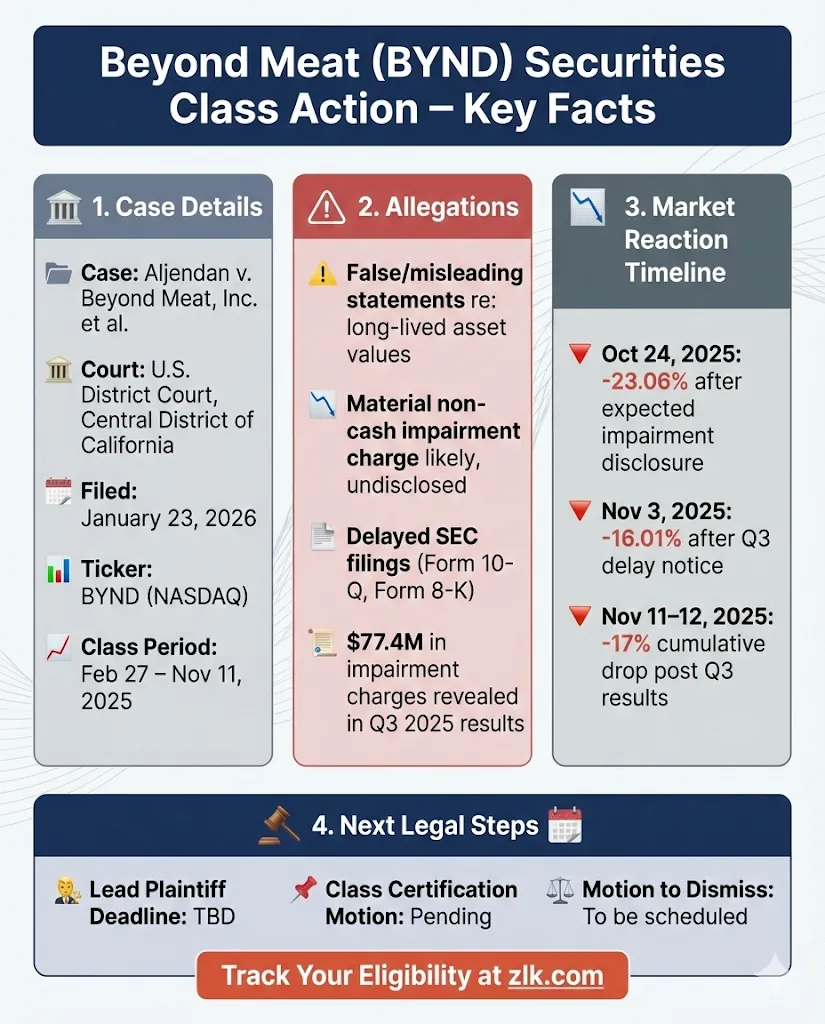
The filed complaint alleges that Beyond Meat, Inc. made materially false and/or misleading statements and/or failed to disclose that: (i) the book value of certain of Beyond Meat’s long-lived assets exceeded their fair value, making it highly likely that the Company would be required to record a material, non-cash impairment charge; (ii) the foregoing was likely to impair Beyond Meat’s ability to timely file its periodic filings with the SEC; and (iii) as a result, defendants’ public statements were materially false and misleading at all relevant times.
In order to be eligible to join the BYND class action lawsuit, you must have incurred a loss on shares of Beyond Meat, Inc. purchased during the class period listed above.
If you suffered a loss in Beyond Meat, Inc. during the relevant time frame or pursuant to the relevant offering(s), you have until March 24, 2026 to request that the Court appoint you as lead plaintiff. Your ability to share in any recovery doesn't require that you serve as a lead plaintiff.
A federal securities class action was filed on January 23, 2026 in the U.S. District Court for the Central District of California against Beyond Meat, Inc. (NASDAQ: BYND), alleging violations of the Securities Exchange Act of 1934, including Sections 10(b) and 20(a) and Rule 10b-5
The case covers investors who acquired Beyond Meat securities on the NASDAQ under ticker BYND between February 27, 2025 and November 11, 2025, both dates inclusive. Investors allege the company misled the market by failing to disclose that certain long-lived assets were carried above their fair value, making a material non-cash impairment highly likely and threatening the company's ability to timely file required reports with the U.S. Securities and Exchange Commission. The truth began to surface when, starting October 24, 2025, Beyond Meat disclosed an expected material impairment for the third quarter, later delaying results and then reporting $77.4 million in non-cash impairment charges with detailed allocations. As disclosures rolled out, the stock moved on multiple days, including declines of 23.06% on October 24 and 16.01% on November 3, reflecting significant stock price declines tied to these disclosures, harming investors.
“Most BYND shareholders never file or join the class action, which means they miss out on potential recovery funds,” said Attorney Joseph Levi.
Case Name: Aljendan v. Beyond Meat, Inc. et al.
Case No.: 2:26-cv-00742
Jurisdiction: U.S. District Court, Central District of California
Filed on: January 23, 2026
Beyond Meat develops, manufactures, markets, and sells plant-based meat products under the "Beyond" brand in the U.S. and internationally, is headquartered in El Segundo, California and is a publicly traded company on the NASDAQ, operating across production, warehousing, and research and development facilities in the plant-based meat industry. As of December 31, 2024, the company reported $308.862 million in consolidated long-lived assets, including property, plant and equipment (PP&E) and operating lease right-of-use assets, as well as prepaid lease costs.
February 27, 2025 - November 11, 2025, inclusive.
All persons and entities other than Defendants that purchased or otherwise acquired Beyond Meat securities traded on the NASDAQ under ticker BYND during the Class Period may be eligible to join the Beyond Meat, Inc. (BYND) class action lawsuit.
According to the complaint, the lawsuit targets Beyond Meat, Inc., its President and Chief Executive Officer Ethan Brown, and its Chief Financial Officer and Treasurer Lubi Kutua, asserting securities fraud claims under the Securities Exchange Act of 1934. Investors allege that throughout the class period the company made materially false and misleading statements about its business, operations, and prospects and its financial statements and disclosures by failing to disclose that certain long-lived assets were carried at inflated amounts, meaning book value exceeded fair value, that a material non-cash impairment was highly likely, and that these conditions risked delaying timely SEC filings of periodic reports.
Around the start of the class period, on February 26, 2025, Brown told investors on the Q4 and FY 2024 earnings call, "I want everybody entirely focused on that goal", referencing the company's emphasis on operational efficiency and EBITDA. As the year progressed, on May 7, 2025, he discussed accounting for the suspension of activities in China, explaining the use of accelerated depreciation through the end of 2026 and noting that each quarter would reflect some impact on long-lived assets.
On August 6, 2025, he announced "significant and immediate actions" aimed at stabilizing the business and achieving EBITDA-positive operations in the second half of 2026 by emphasizing cost reduction and operational efficiency. Meanwhile, investors allege that behind these public statements, Beyond Meat's recoverability testing would show that the carrying amount of certain long-lived assets was not supported by projected cash flows, including property, plant and equipment and operating lease assets, and asset values were overstated.
The complaint asserts this made a material non-cash impairment charge highly likely and jeopardized the company's ability to timely file periodic SEC reports, in violation of Rule 10b-5. As a result, plaintiffs allege the company's public statements were materially false and misleading during the relevant time.
The narrative shifted on October 24, 2025, when Beyond Meat filed a Form 8-K under the federal securities laws disclosing it expected to record a non-cash impairment charge for the three months ended September 27, 2025, related to certain long-lived assets. The company stated that its recoverability test preliminarily indicated the carrying amount of certain long-lived assets was not recoverable and that, although the charge was expected to be material, the amount could not yet be reasonably quantified.
Then, on November 3, 2025, the company issued a press release delaying its Q3 2025 financial results, a filing delay announcement tied to impairment testing, again emphasizing the expected materiality. One week later, on November 10, 2025, Beyond Meat released Q3 2025 results reporting that operating results included $77.4 million in non-cash impairment charges related to certain long-lived assets, with loss from operations of $112.3 million for the quarter.
On November 11, 2025, during a conference call with investors, CFO Lubi Kutua detailed that the $77.4 million impairment was allocated to PP&E, operating lease right-of-use assets, and prepaid lease costs, including manufacturing assets. These disclosures contradicted earlier assurances and omissions by revealing the scope and impact of the impairment and the filing delay tied to completing the review and the company's obligation to make timely SEC filings.
The market moved in step with the revelations, and securities analysts reacted negatively to the impairment disclosures. On October 24, 2025, after the Form 8-K announcing the expected material impairment, Beyond Meat's stock fell $0.655 per share, or 23.06%, to close at $2.185. When the company announced on November 3, 2025 that it would delay reporting Q3 results to finish its impairment review, the stock dropped another $0.265 per share, or 16.01%, to close at $1.39.
On November 11, 2025, following the Q3 results highlighting $77.4 million in non-cash impairment charges, the stock declined $0.12 per share, or 8.96%, to close at $1.22; the next day, November 12, 2025, it fell an additional $0.105 per share, or 8.61%, to close at $1.115, reflecting significant stock price volatility on the NASDAQ.
● The Court will issue its order for lead plaintiff and counsel in the weeks after submissions are due.
● The Court will then consider motion for class certification.
● The Court will later consider a Motion to Dismiss.
Disclaimer: This shareholder alert is for informational purposes only and does not constitute legal advice. Consult a qualified attorney for personalized guidance. No specific outcomes are guaranteed.
TOP