
Expired
Lead Plaintiff Deadline
Apr 14, 2026
Choose your preferred way to stay informed of new case launches and settlement deadlines
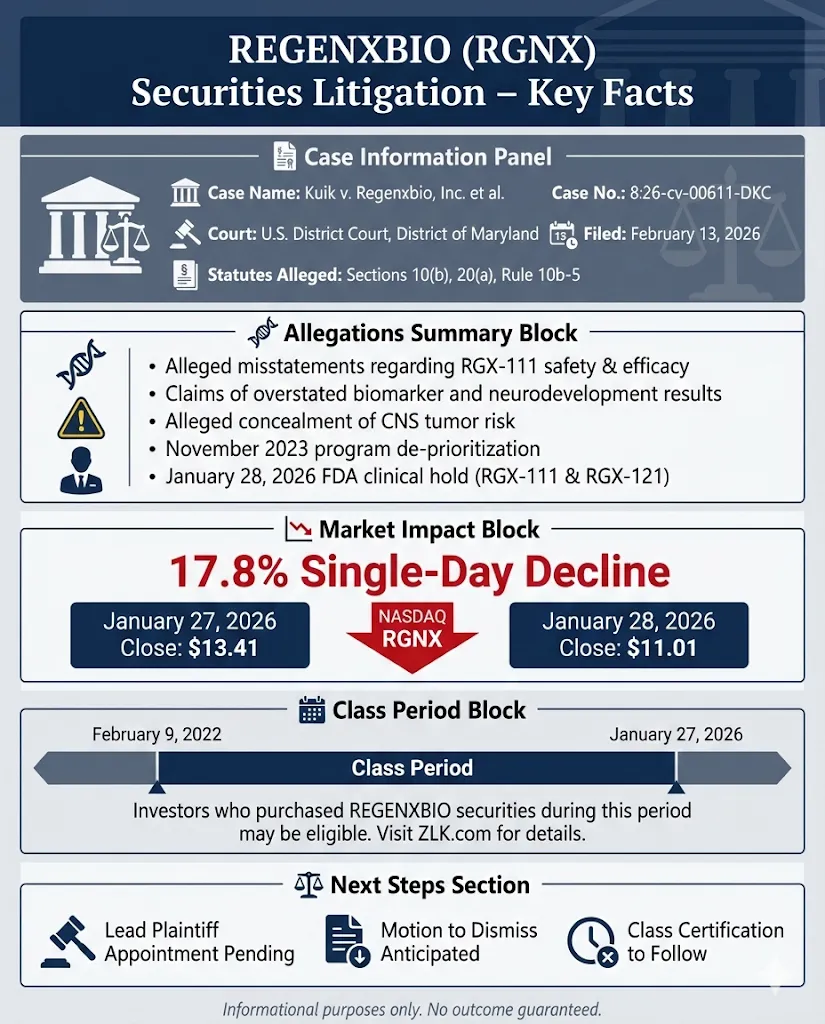
According to the complaint, defendants provided investors with material information concerning REGENXBIO’s plan to develop and commercialize its product candidate RGX-111, a one-time gene therapy for the treatment of severe Mucopolysaccharidosis Type I, also known as Hurler syndrome. Defendants’ statements included, among other things, REGENXBIO’s positive assertions of RGX-111’s future trial success based on continuing positive biomarker and safety data from the ongoing PhaseI/II study. 3. Defendants provided these overwhelmingly positive statements to investors while, at the same time, disseminating false and misleading statements and/or concealing material adverse facts concerning the efficacy and safety of its RGX-111 trial study. On January 28, 2026, REGENXBIO issued a press release announcing that the FDA placed a clinical hold on its investigational gene therapy RGX-111. Defendants announced that an intraventricular CNS tumor was found in a participant treated in its RGX-111 Phase I/II study. Following this news, the price of REGENXBIO’s common stock declined from a closing market price of $13.41 per share on January 27, 2026, REGENXBIO’s stock price fell to $11.01 per share on January 28, 2026, a decline of 17.8% in the span of just a single day.
In order to be eligible to join the RGNX class action lawsuit, you must have incurred a loss on shares of REGENXBIO purchased during the class period listed above.
If you suffered a loss in REGENXBIO during the relevant time frame or pursuant to the relevant offering(s), you have until April 14, 2026 to request that the Court appoint you as lead plaintiff. Your ability to share in any recovery doesn't require that you serve as a lead plaintiff.
A securities fraud class action has been filed against Regenxbio, Inc. (NASDAQ: RGNX), asserting claims under the Securities Exchange Act of 1934, including Sections 10(b) and 20(a) and Rule 10b-5, covering investors who purchased the Company's securities between February 9, 2022 and January 27, 2026, inclusive. According to the complaint, investors allege the Company and senior executives misrepresented the safety and efficacy profile of RGX-111, an AAV gene therapy product candidate for severe MPS I, which received Fast Track designation from the FDA in 2018, by repeatedly highlighting positive biomarker, tolerability, and neurodevelopment results.
Behind those assurances, the complaint alleges serious safety concerns existed, including the potential for a central nervous system neoplasm, and the program was later de-prioritized. The story culminated on January 28, 2026, when REGENXBIO announced the FDA had placed a clinical hold on RGX-111 after a CNS tumor was identified in a trial participant, and the FDA also placed a hold on RGX-121, a related MPS II product candidate due to shared risk. As the truth surfaced, REGENXBIO's stock fell 17.8% in a single day, harming investors who bought at inflated prices.
“Most RGNX shareholders never file or join the class action, which means they miss out on potential recovery funds,” said Attorney Joseph Levi.
Case Name: Kuik v. Regenxbio, Inc. et al.
Case No.: 8:26-cv-00611-DKC
Jurisdiction: U.S. District Court, District of Maryland (Southern Division)
Filed on: February 13, 2026
Regenxbio is a clinical-stage biotechnology company listed on the NASDAQ as RGNX developing gene therapies that deliver functional genes to cells with genetic defects, including rare lysosomal storage disorders such as Mucopolysaccharidosis Type I (MPS I). Its product candidates use the Company's NAV Technology Platform, featuring the NAV AAV9 vector, a proprietary adeno-associated virus (AAV) gene delivery system designed for one-time administration.
February 9, 2022 - January 27, 2026, inclusive (the Class Period).
All investors who purchased or otherwise acquired Regenxbio securities (NASDAQ: RGNX) between February 9, 2022 and January 27, 2026, inclusive, are within the alleged class.
The lawsuit targets REGENXBIO, INC. and three executives: former CEO Kenneth T. Mills, current CEO Curran Simpson, and Executive Vice President and Chief Medical Officer Stephen Pakola, alleging they disseminated false and misleading statements. The complaint alleges they told investors RGX-111 was progressing well, emphasizing safety, biomarker improvements, and neurodevelopmental gains, overstated efficacy based on interim biomarker data, and positioning it as a key program in the Company's pipeline while concealing material safety data.
The narrative begins on February 9, 2022, when Dr. Pakola announced early data from a Phase I/II clinical trial and said "RGX-111 has been well-tolerated with emerging evidence of CNS biomarker activity and improvements in neurodevelopmental function," while planning to enroll more patients.
The message continued on February 24, 2023, as CEO Mills called RGX-111 the Company's second-most advanced neurodegenerative candidate and part of the "5x'25" strategy, touting overwhelmingly positive results, stating the therapy "continues to demonstrate compelling evidence of CNS biomarker activity" and that most trial patients showed "continued skill acquisition across multiple neurodevelopmental assessments."
The optimism persisted into January 14, 2025, when CEO Curran Simpson, announcing a partnership with Nippon Shinyaku, asserted that "RGX-111 has demonstrated very promising results in Phase 1/2 study" for Hurler syndrome. According to the complaint, these upbeat statements concealed material adverse facts about RGX-111's safety, including the potential for a CNS neoplasm, a serious adverse event risk. The pleading further alleges that, despite the public positivity, the Company abruptly decided in November 2023 to de-prioritize RGX-111 and pursue "strategic alternatives" for the program, a corporate strategic pivot.
The picture shifted on November 8, 2023, when management acknowledged a change in course, signaling de-prioritization of the RGX-111 program. Dr. Pakola stated the Company was "no longer moving forward with our RGX-111...rare neurodegenerative programs," and CEO Mills added there would be a "discontinuation of any clinical development work," effectively de-prioritizing the product candidate with only short-term partnering efforts anticipated and no meaningful contribution to operating plans going forward.
Then, on January 28, 2026, REGENXBIO issued a press release announcing the FDA had placed a clinical hold on RGX-111 after a routine MRI revealed an intraventricular CNS tumor in a five-year-old participant in the Phase I/II study who had received intracisternal RGX-111 four years earlier. The Company reported preliminary genetic analysis of the resected tumor detected an AAV vector genome integration event associated with overexpression of a proto-oncogene (PLAG1), an oncogenic safety signal, and noted the investigation into causality was ongoing. The FDA simultaneously placed a clinical hold on RGX-121, an investigational treatment for MPS II due to "the similarities in products, study populations, and shared risk between the clinical studies." These disclosures addressed earlier representations that RGX-111 was well tolerated with no drug-related serious adverse events, contradicting prior safety and tolerability claims.
Investors reacted immediately to the January 28, 2026 disclosure. REGENXBIO's stock on NASDAQ: RGNX fell $2.40, or 17.8%, from a prior close of $13.41 on January 27, 2026 to close at $11.01 on January 28, 2026, reflecting a significant stock price decline.
The Court will issue its order for lead plaintiff and counsel in the weeks after submissions are due.
The Court will then consider motion for class certification.
The Court will later consider a Motion to Dismiss.
Disclaimer: This shareholder alert is for informational purposes only and does not constitute legal advice. Consult a qualified attorney for personalized guidance. No specific outcomes are guaranteed.
TOP