
Expired
Lead Plaintiff Deadline
Mar 9, 2026
Choose your preferred way to stay informed of new case launches and settlement deadlines
According to the complaint, defendants provided overwhelmingly positive statements to investors while, at the same time, disseminating materially false and misleading statements and/or concealing material adverse facts concerning the true state of Varonis’ ability to convert its existing customer base; notably, that it was not truly equipped to convince existing users of the benefits of converting to the SaaS offering or otherwise maintain those customers on its platform, resulting in significantly reduced ARR growth potential in the near-term. On October 28, 2025, Varonis announced its financial results for the third quarter of fiscal 2025, disclosing a significant miss to ARR and reducing its projections for the full fiscal year 2025, despite previously uplifting guidance for the previous two consecutive quarters. The Company attributed its results and lowered guidance on weaker than expected renewals and conversions in their federal and non-federal on-premises subscription business. Varonis further resultantly announced the end of life of the self-hosted solution and a 5% headcount reduction. Following this news, Varonis’ common stock declined dramatically. From a closing market price of $63.00 per share on October 28, 2025, Varonis’ stock price fell to $32.34 per share on October 29, 2025, a decline of about 48.67% in the span of just a single day.
In order to be eligible to join the VRNS class action lawsuit, you must have incurred a loss on shares of Varonis purchased during the class period listed above.
If you suffered a loss in Varonis during the relevant time frame or pursuant to the relevant offering(s), you have until March 9, 2026 to request that the Court appoint you as lead plaintiff. Your ability to share in any recovery doesn't require that you serve as a lead plaintiff.
A federal securities fraud class action has been filed against Varonis Systems, Inc. (NASDAQ: VRNS) for investors who acquired common stock, including NASDAQ: VRNS purchasers between February 4, 2025 and October 28, 2025, under the Securities Exchange Act of 1934. Investors allege the company and its senior executives misrepresented Varonis' ability to convert existing customers in its on-premises subscription business to its SaaS offering while maintaining aggressive 2025 annual recurring revenue (ARR) targets, a key revenue metric in subscription-based businesses. The complaint asserts that, despite repeated confidence and rising outlook on revenue guidance, the company concealed material adverse facts and material misrepresentations about renewal and conversion trends. On October 28, 2025, Varonis disclosed a significant ARR miss and cut full-year projections, citing weaker-than-expected renewals and conversions in both federal and non-federal on-prem subscriptions, including weakness in the federal vertical. The next day, the stock fell 48.67%, from $63.00 to $32.34 per share, a dramatic single-day stock price decline for VRNS securities.
Case Name: Molchanov v. Varonis Systems, Inc. et al.
Case No.: 1:26-cv-00117
Jurisdiction: U.S. District Court, Southern District of New York
Filed on: January 7, 2026
Varonis is a global security company that provides software products and services in the cybersecurity software and data security software markets to discover and classify critical data, remediate exposures, and detect advanced threats using AI-powered technologies on a subscription-based business model, offering both on-premises and SaaS solutions via cloud and on-premises deployment models. As of the third quarter of 2025, Varonis reported approximately $718.6 million in ARR (annual recurring revenue), with SaaS representing 76% of total ARR, reflecting the company's SaaS conversion strategy.
February 4, 2025 - October 28, 2025, inclusive.
All investors who purchased or otherwise acquired Varonis' common stock or other VRNS securities during the Class Period, are included in this securities class action.
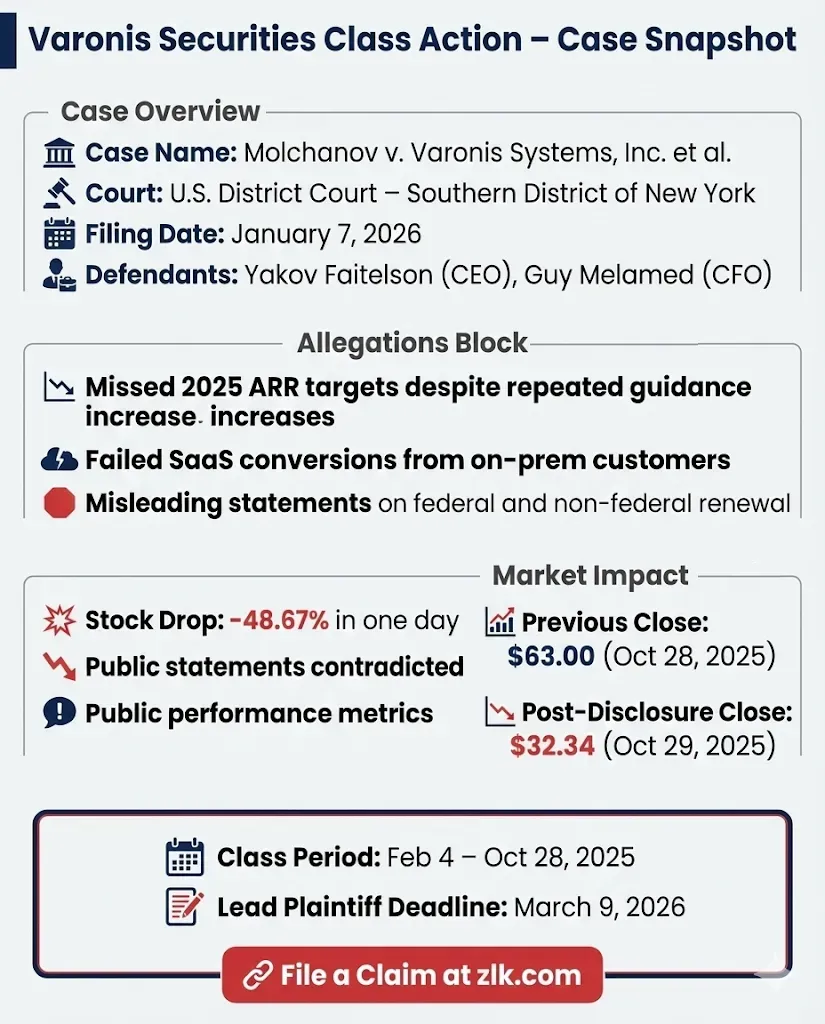
The lawsuit targets Varonis Systems, Inc., its Co-Founder/Chairman/CEO/President Yakov Faitelson, and its CFO/COO Guy Melamed, alleging violations of the Securities Exchange Act of 1934. According to the complaint, defendants told investors that Varonis could convert existing on-prem customers in the on-premises subscription business- within the federal vertical and non-federal customer base-to SaaS while meeting ambitious 2025 ARR goals and revenue guidance.
The story begins on February 4, 2025, when Faitelson told investors the company was "well on our way to becoming a SaaS company" and highlighted the benefits expected once the transition was complete during an earnings call, emphasizing its software-as-a-service model. That same day, Melamed said conversions of self-hosted customers were "very strong" because customers saw the value of SaaS and MDDR, and he projected full-year 2025 ARR to $737-$745 million, or 15%-16% growth, presenting this as reliable guidance to the market.
Momentum continued on May 6, 2025. Faitelson said the company converted existing customers "more effectively" in the first quarter due to lessons learned and added investments in the sales team, while Melamed raised full-year ARR guidance to $742-$750 million, or 16%-17% growth, signaling sustained ARR growth.
On July 29, 2025, Faitelson announced FedRAMP Authorization, enabling the company to offer its entire SaaS platform to the federal sector as part of its federal vertical strategy, and described demand as positively inflecting and materially contributing. Melamed again lifted guidance to $748-$754 million, representing 17% growth. Meanwhile, the complaint alleges these upbeat statements concealed material adverse facts about lower-than-expected quarterly conversions and weaker renewals necessary for ARR growth regarding the true state of Varonis' ability to convert its existing customer base and sustain renewals. Investors allege defendants disseminated materially false and misleading statements that created a false impression of reliable revenue projections and artificially inflated the stock price during the class period while confidence in conversion capabilities and ARR targets was overstated.
The picture changed on October 28, 2025, when Varonis reported third-quarter fiscal 2025 results in its earnings announcement, disclosed a significant miss to ARR versus prior projections, and reduced full-year guidance for revenue and ARR. Management admitted that, "In the final weeks of the quarter, we experienced weaker-than-expected renewals in our federal business (the federal vertical) in our non-federal on-prem subscription business, which resulted in Q3 coming below our expectations."
This corrective disclosure contradicted months of confident commentary and consecutive guidance increases that emphasized effective conversions and strengthening demand and attributed the shortfall to renewals and conversions. According to the complaint, the sudden disclosure revealed that conversion capabilities and renewal rates were significantly weaker than previously represented, undermining the portrayed growth trajectory.
Investors reacted immediately to the corrective disclosure. From a closing price of $63.00 per share on October 28, 2025, Varonis' stock fell to $32.34 per share on October 29, 2025-down $30.66, or 48.67%, reflecting a severe single-day stock price decline in VRNS. The sharp decline followed the company's disclosure of the ARR miss and reduced full-year outlook tied to weaker-than-expected renewals and conversions, consistent with market efficiency where price adjusts to new information.
● The Court will issue its order for lead plaintiff and counsel in the weeks after submissions are due.
● The Court will then consider motion for class certification.
● The Court will later consider a Motion to Dismiss.
Disclaimer: This shareholder alert is for informational purposes only and does not constitute legal advice. Consult a qualified attorney for personalized guidance. No specific outcomes are guaranteed.
TOP