Graphic Packaging Holding Company Class Action Lawsuit – GPK
|
Graphic Packaging Class Action Summary |
|
|
Company |
Graphic Packaging Holding Company (NYSE: GPK) |
|
Lead Plaintiff Deadline |
July 6, 2026 |
|
Class Period |
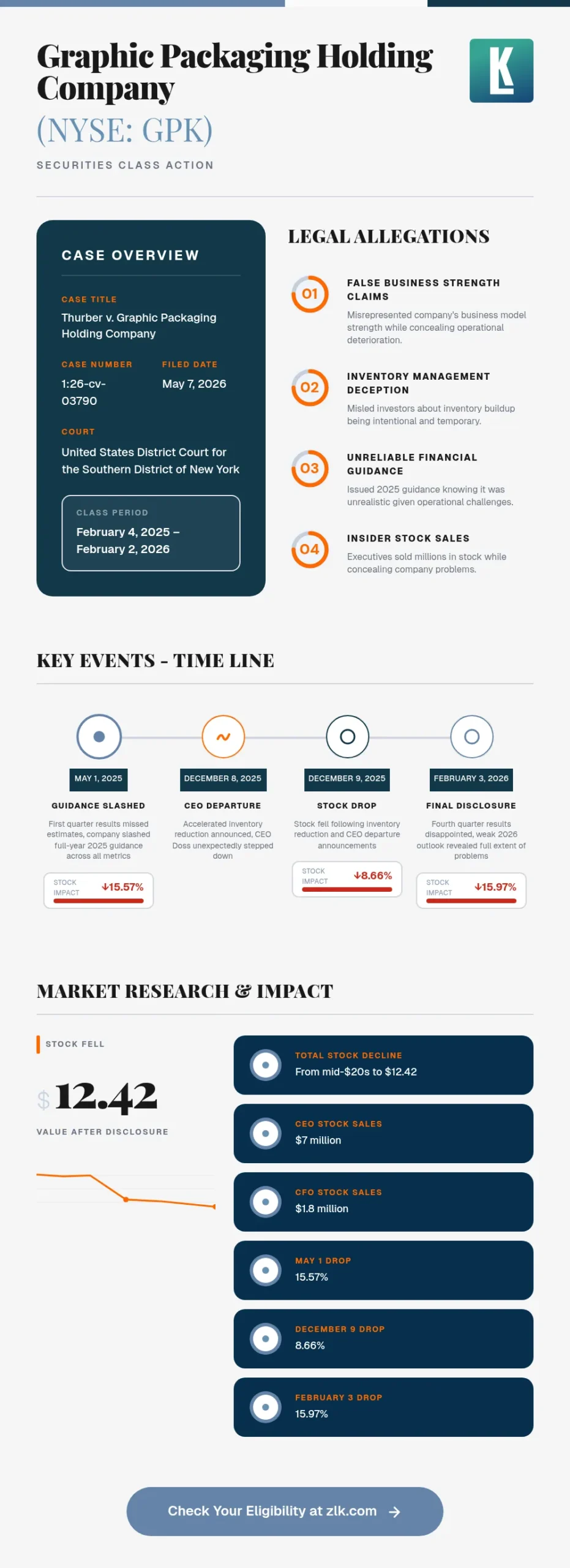
February 4, 2025 – February 2, 2026 |
|
Stock Drop |
May 1, 2025 – GPK fell $3.94 (15.57%) to $21.37; December 9, 2025 – GPK fell $1.35 (8.66%) to $14.23; February 3, 2026 – GPK fell $2.36 (15.97%) to $12.42 |
|
Lawsuit Type |
Securities Class Action |
Introduction
A securities class action lawsuit has been filed against Graphic Packaging Holding Company (NYSE: GPK), its former President and CEO Michael P. Doss, and its former Executive Vice President and CFO Stephen R. Scherger by plaintiff Michael Thurber, represented by Pomerantz LLP. The lawsuit covers a class period from February 4, 2025 through February 2, 2026, during which the complaint alleges defendants made materially false and misleading statements regarding the strength and sustainability of Graphic Packaging's business model, its ability to manage inventory effectively, and the reliability of its full-year 2025 financial guidance. According to the complaint, the truth emerged through a series of corrective disclosures beginning in May 2025, when the company slashed its financial outlook, followed by further guidance cuts in December 2025 and disappointing fourth quarter results in February 2026. Investors suffered significant losses as GPK's stock price declined sharply after each disclosure, falling from the mid-$20s to $12.42 per share over the course of the class period.
Company Profile
Graphic Packaging Holding Company, together with its subsidiaries, designs, produces, and sells consumer packaging products. Its customers include businesses in the food, foodservice, beverage, household, and other consumer product industries across the Americas, Europe, and the Asia Pacific region, with products sold through sales offices and broker arrangements with third parties.
Class Period
February 4, 2025 – February 2, 2026
Investors who purchased or acquired Graphic Packaging Holding Company (GPK) securities during the Class Period may be entitled to seek recovery under the federal securities laws.
Allegations
The complaint alleges that throughout the class period, defendants repeatedly touted the purported strength and stability of Graphic Packaging's business model and its ability to deliver on cost reduction, inventory management, free cash flow, and profitability targets — even as the company was experiencing significant inventory management problems, reduced demand and volumes, and rising costs that undermined those representations. In February 2025, defendant Doss characterized the company's results as "consistent," "profitable," and "strong and steady," and issued full-year 2025 guidance projecting net sales of $8.7 billion to $8.9 billion, adjusted EBITDA of $1.68 billion to $1.78 billion, and adjusted EPS of $2.53 to $2.78. The complaint alleges these projections were unreliable and unrealistic given the operational challenges defendants knew the company faced.
When analysts specifically questioned whether Graphic Packaging's elevated inventory levels were a concern, defendant Doss represented that the buildup was intentional — necessary to protect customers during the startup of a new paperboard mill in Waco, Texas — and assured investors that the excess inventory would "wash through pretty quickly." According to the complaint, these assurances were materially misleading because the company was already grappling with inventory management issues far more severe than defendants acknowledged. Defendant Scherger similarly emphasized "strong and steady margins" and characterized the business model as resilient even at the bottom of the guidance range.
After the first corrective disclosure in May 2025 forced a dramatic downward revision of the company's outlook, the complaint alleges defendants continued to mislead investors by downplaying the severity of the problems. Defendant Doss characterized volume declines as "small" and assured the market that challenges were "not long-term in nature." Over the following months, defendants repeatedly stressed their ability to actively manage inventory and match supply to demand. Defendant Scherger stated the company was "aggressively matching supply and demand" and touted having removed "over 50,000 tons of inventory" in the first half. The complaint alleges these statements concealed the true scope of the company's deteriorating operations and the unreliability of its revised financial guidance, which would be cut again twice before the class period ended.
The complaint further alleges that the Individual Defendants had both the motive and opportunity to commit fraud. During the class period, defendant Doss sold nearly 1.6 million shares of Graphic Packaging common stock, enriching himself by over $7 million, while defendant Scherger sold 65,529 shares, enriching himself by nearly $1.8 million. As the company's most senior executives who personally signed Sarbanes-Oxley certifications attesting to the accuracy of Graphic Packaging's financial filings, the Individual Defendants had direct access to internal information about the company's inventory levels, demand trends, and cost pressures, and the complaint alleges they knew or recklessly disregarded that their public statements were materially false and misleading.
The Truth Emerges
The truth began to surface on May 1, 2025, when Graphic Packaging reported first quarter 2025 results that fell well short of market expectations. The company reported non-GAAP EPS of $0.51, missing consensus estimates by $0.07, and revenue of $2.12 billion, a 6.2% year-over-year decline that also missed estimates by $10 million. More significantly, Graphic Packaging slashed its full-year 2025 guidance across every major metric: net sales were revised down to $8.2 billion to $8.5 billion from $8.7 billion to $8.9 billion, adjusted EBITDA was cut to $1.4 billion to $1.6 billion from $1.68 billion to $1.78 billion, and adjusted EPS was reduced to $1.75 to $2.25 from $2.53 to $2.78. The company attributed the revisions to an expected 2% volume decline, $80 million of input cost inflation, and "higher macroeconomic and consumer spending uncertainty" — the very headwinds the complaint alleges defendants had previously downplayed.
The truth continued to emerge on December 8, 2025, when Graphic Packaging disclosed that it was accelerating inventory reduction plans originally scheduled for 2026 into the fourth quarter, with production curtailments expected to cost an additional $15 million on top of $15 million in curtailments already announced. The company again cut its full-year 2025 guidance, reducing expected adjusted EBITDA to $1.38 billion to $1.43 billion and adjusted EPS to $1.75 to $1.95. In a separate press release issued the same day, Graphic Packaging announced that defendant Doss had "mutually agreed" with the board of directors to step down as President, CEO, and director, effective December 31, 2025 — a departure multiple analysts characterized as "unexpected."
The final corrective disclosure came on February 3, 2026, when Graphic Packaging reported fourth quarter non-GAAP EPS of $0.29, missing consensus estimates by $0.06, and revealed that fourth quarter adjusted EBITDA had declined 19% year-over-year due to lower volumes, increased costs, and inventory reduction decisions. The company projected a meaningful decline in 2026 adjusted EBITDA as well, citing a $130 million negative impact from inventory reduction actions, an approximately $100 million incentive compensation accrual, and weather-related production impacts. New CEO Robbert Rietbroek announced a "comprehensive review" of Graphic Packaging's organization structure, operations, and footprint — a statement the complaint alleges confirmed the weakness and unsustainability of the business model defendants had spent the class period championing.
Market Reaction
The market reacted sharply to each corrective disclosure. On May 1, 2025, GPK fell $3.94 per share, or 15.57%, to close at $21.37 — the largest single-day decline since October 2018, according to Bloomberg. Trading volume surged to 8.39 million shares, more than three times the average daily volume of 2.73 million, and the stock touched a new 52-week low of $21.16 during intraday trading.
On December 9, 2025, following the accelerated inventory reduction announcement and the unexpected CEO departure, GPK fell $1.35, or 8.66%, to close at $14.23. Bloomberg reported that the stock opened down more than 8% with trading volume at more than seventeen times the 20-day average for that time of day.
The most severe reaction came on February 3, 2026, when GPK fell $2.36, or 15.97%, to close at $12.42 following the disappointing fourth quarter results and weak 2026 outlook. Analyst reactions were uniformly negative: Jefferies described the results as "disappointing," stating the company "will likely be in the penalty box for some time." Raymond James wrote that the quarterly result was "completely overshadowed by a disappointing 2026 guide." RBC Capital Markets noted the 2026 guidance was "Significantly Below-Street" expectations, and Wells Fargo cited "repeated EBITDA guidance cuts and mounting competitive pressure" in downgrading the stock.
Next Steps
● Lead Plaintiff Deadline: July 6, 2026
● The Court will issue its order for lead plaintiff and counsel in the weeks after submissions are due.
● The Court will then consider motion for class certification.
● The Court will later consider a motion to dismiss.
Disclaimer: This shareholder alert is for informational purposes only and does not constitute legal advice. Consult a qualified attorney for personalized guidance. No specific outcomes are guaranteed.
Check Eligibility
✓ No cost or obligation
✓ See if you qualify