Lucid Group, Inc. Class Action Lawsuit - LCID
Company: Lucid Group, Inc.
Ticker: (NASDAQ) LCID
8
Days Left
Lead Plaintiff Deadline: July 28, 2026
See If You Qualify For Monetary Reward
Join the Lucid Group, Inc. Class Action Lawsuit
Please Upload related files below
Add Transactions
Fill in below.
Certification of Plaintiff Pursuant to Federal Securities Laws
Upload Your Stock Tickers
Tell us the stocks you own using SnapTrade, and we will keep you informed about class action litigation related to your stocks. We monitor critical case developments that may affect the price of your shares and your possible monetary recovery. SnapTrade only shares the tickers you own and your transaction history, not your account numbers. Using SnapTrade and participating in our monitoring service is free and does not create any attorney-client relationship or obligation on your part.
Don’t miss out on possible monetary recovery - link your brokerage account with SnapTrade.
Class Period
Begins
25
Feb 2026
Ends
13
Apr 2026
February 25, 2026 - April 13, 2026
Allegations
Eligibility
In order to be eligible to join the LCID class action lawsuit, you must have incurred a loss on shares of Lucid Group, Inc. purchased during the class period listed above.
Lead Plaintiff Deadline
If you suffered a loss in Lucid Group, Inc. during the relevant time frame, you have until July 28, 2026 to request that the Court appoint you as lead plaintiff. Your ability to share in any recovery doesn't require that you serve as a lead plaintiff.
Lucid Group, Inc.Class Action Lawsuit Details
|
LCID Class Action Summary |
|
|
Company |
Lucid Group, Inc. (NASDAQ: LCID) |
|
Lead Plaintiff Deadline |
July 28, 2026 |
|
Class Period |
February 25, 2026 – April 13, 2026 |
|
Stock Drop |
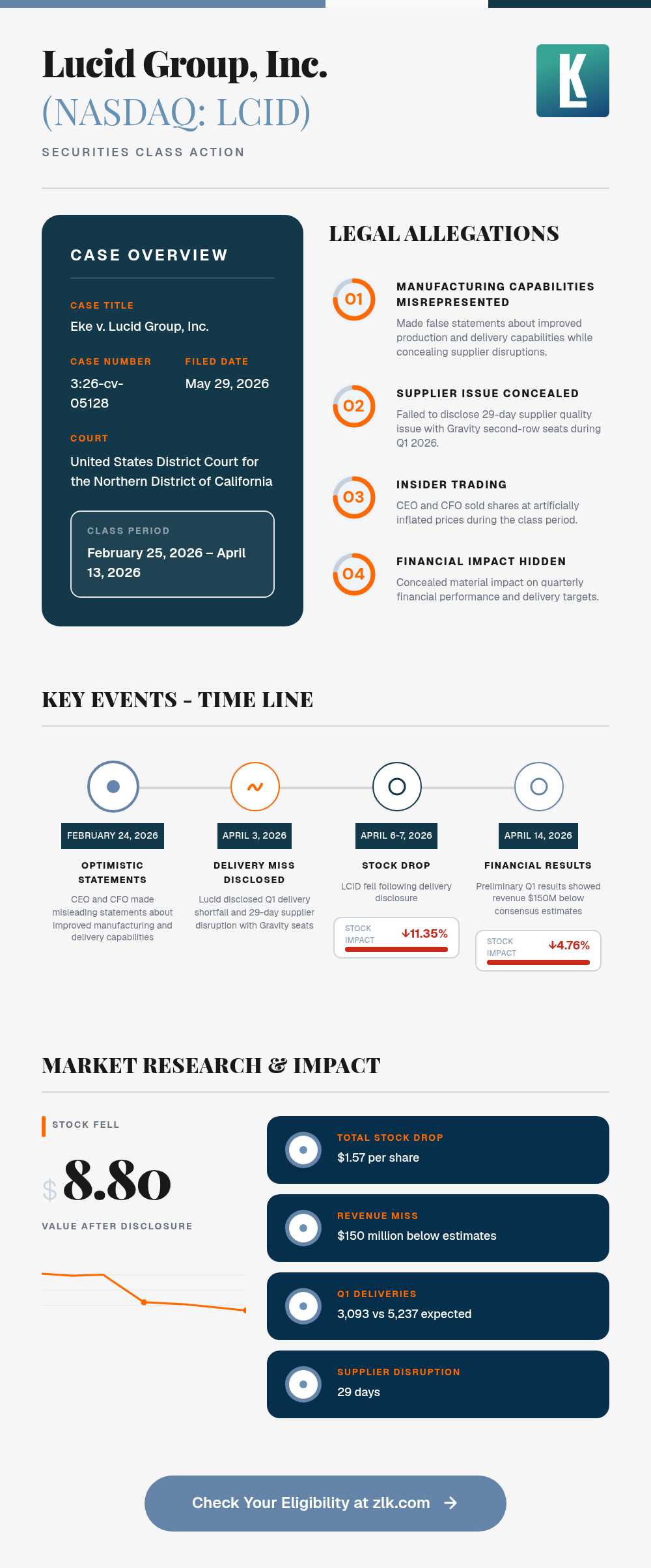
April 6–7, 2026 – LCID fell $1.13 (11.35%) to $8.83; April 14, 2026 – LCID fell $0.44 (4.76%) to $8.80 |
|
Lawsuit Type |
Securities Class Action |
Introduction
A securities class action lawsuit has been filed against Lucid Group, Inc. (NASDAQ: LCID), its Interim CEO Marc Winterhoff, and its CFO Taoufiq Boussaid on behalf of investors who purchased or acquired Lucid securities between February 25, 2026 and April 13, 2026. The complaint, filed in the United States District Court for the Northern District of California, alleges that defendants made materially false and misleading statements about the Company's manufacturing and delivery capabilities, failing to disclose that a supplier quality issue had significantly disrupted deliveries of the Lucid Gravity SUV for 29 days during the first quarter of 2026. When the truth emerged through a series of disclosures beginning on April 3, 2026, Lucid's stock price declined sharply, falling $1.13 per share, or 11.35%, over two trading sessions and dropping an additional $0.44 per share, or 4.76%, following the release of preliminary financial results that revealed revenue roughly $150 million below consensus estimates. The lawsuit seeks to recover damages for investors under Sections 10(b) and 20(a) of the Securities Exchange Act of 1934.
Company Profile
Lucid Group, Inc. is a technology company that designs, develops, manufactures, and sells electric vehicles, EV powertrains, and battery systems. The Company's core product lineup includes the Lucid Air sedan and the Lucid Gravity SUV, and its Class A common stock trades on the NASDAQ under the ticker symbol LCID.
Class Period
February 25, 2026 – April 13, 2026
Investors who purchased or acquired Lucid Group, Inc. (LCID) securities during the Class Period may be entitled to seek recovery under the federal securities laws.
Allegations
The complaint alleges that, beginning in late February 2026, defendants made a series of materially false and misleading statements touting purported enhancements to Lucid's manufacturing and delivery capabilities and overall operations. On February 24, 2026, during post-market hours, Lucid issued a press release reporting its Q4 and FY 2025 financial results, in which Defendant Winterhoff stated that "2025 was all about execution and strategy adjustment to set Lucid up for long-term success," claiming the Company had "nearly doubled production, gained market share, reduced unit costs, and strengthened" its financial position. Defendant Boussaid similarly described Q4 as "a clear step-change in production and unit economics" and characterized the Company's progress as "structural, creating a more repeatable and stable operating cadence heading into 2026."
During a conference call with investors and analysts the same day, defendants elaborated on these themes with highly specific claims. Defendant Winterhoff stated that Lucid had "improved throughput, reduced rework, built repeatable processes" and "overcame quality problems that hindered our Gravity ramp in the beginning," while touting an eighth consecutive quarter of record deliveries. Defendant Boussaid reinforced these claims, asserting that the Company had exited Q4 "with an underlying run rate that supports up to 7,500 vehicles per quarter" and emphasizing that this was "not the result of temporary measures" but rather "a more repeatable operating cadence heading into 2026." Lucid's 2025 annual report on Form 10-K, also filed on February 24, 2026, included representations about the Company's "strong relationships with suppliers and partners" and a "comprehensive qualification process" for its supply network, and was accompanied by Sarbanes-Oxley certifications signed by both Individual Defendants. On March 12, 2026, Lucid issued yet another press release touting the Company's 2026 business prospects, with Defendant Winterhoff claiming Lucid had "already proven its capabilities" and Defendant Boussaid asserting that the Company's "technology leadership is now fully aligned with a business model designed for scale."
According to the complaint, these statements were materially false and misleading because defendants failed to disclose that a supplier quality issue with the second-row seats of the Lucid Gravity had significantly disrupted deliveries for 29 days during Q1 2026, with the impact concentrated in February 2026, the very month in which defendants began making these optimistic representations. The complaint alleges that, as Lucid's Interim CEO and CFO, the Individual Defendants were undoubtedly focused on the production and delivery of the Lucid Gravity, one of the Company's core products, and were presumably aware of the supplier disruption at the time they disseminated these statements. The complaint further alleges that both Individual Defendants sold tens of thousands of shares of Lucid common stock during the Class Period at artificially inflated prices, with Defendant Winterhoff selling 42,925 shares for approximately $440,839 and Defendant Boussaid selling 20,051 shares for approximately $205,924.
The Truth Emerges
The truth began to emerge on April 3, 2026, when Lucid issued a press release announcing its Q1 2026 production and delivery totals. The Company revealed that it had produced 5,500 vehicles during the quarter but delivered only 3,093, significantly below analyst expectations of 5,967 vehicles produced and 5,237 delivered. The press release disclosed for the first time that "deliveries of the Lucid Gravity were disrupted for 29 days due to a supplier quality issue with the second-row seats," acknowledging that "the company's ability to meet customer demand was impacted." A Reuters article published the same day provided additional detail, reporting that the disruption involved "a temporary sales halt and recall tied to an unauthorized supplier change" and, critically, quoting Defendant Winterhoff as acknowledging that deliveries were "particularly hit in February," when Lucid paused to reverse the unauthorized change and inspect vehicles already produced. Reuters also reported that Lucid had recalled 4,476 Gravity SUVs built between December 2024 and February 2026 over seatbelt anchor welds that did not meet safety standards.
The disclosures continued on April 14, 2026, when Lucid filed a Form 8-K with the SEC reporting preliminary Q1 2026 financial results that provided further detail on the alleged financial impact.. Revenue came in at $280 million to $284 million, roughly $150 million below the consensus estimate of $433.8 million, while losses from operations ranged from $985 million to $1.005 billion. The same day, Lucid announced plans for a $1.05 billion capital raise, including a $300 million public stock offering. According to the complaint, these disclosures allegedly revealed a gap between defendants’ optimistic statements and Lucid’s Q1 supplier disruptions, recall-related issues, and revenue shortfall.
Market Reaction
Following the April 3, 2026 disclosure of Lucid's Q1 2026 delivery shortfall and the supplier disruption, Lucid's stock price fell $1.13 per share, or 11.35%, over the next two trading sessions, closing at $8.83 per share on April 7, 2026. On April 6, 2026, 24/7 Wall St. published an article entitled "Lucid Faces Biggest Disaster Ever," describing the Company's Q1 delivery total as "remarkably small" and stating that Lucid "cannot sell fewer than 4,000 vehicles and even pretend this is sustainable."
The decline deepened on April 14, 2026, when Lucid disclosed preliminary Q1 2026 financial results showing revenue far below consensus estimates and announced a $1.05 billion capital raise. LCID fell an additional $0.44 per share, or 4.76%, to close at $8.80 per share on April 14, 2026. Across these two sets of disclosures, Lucid's stock price fell $1.13 per share following the April 3 delivery report and an additional $0.44 per share following the April 14 preliminary financial results. TD Cowen subsequently slashed its price target on Lucid to $10.00 from $19.00, citing the "tougher start to the year" and noting that near-term focus would center on execution risk.
Next Steps
● Lead Plaintiff Deadline: July 28, 2026
● After the lead plaintiff deadline, the Court will consider any lead plaintiff motions.
● Defendants may file a motion to dismiss.
● If the case proceeds, the Court may later consider class certification.
Disclaimer: This shareholder alert is for informational purposes only and does not constitute legal advice. Consult a qualified attorney for personalized guidance. No specific outcomes are guaranteed.